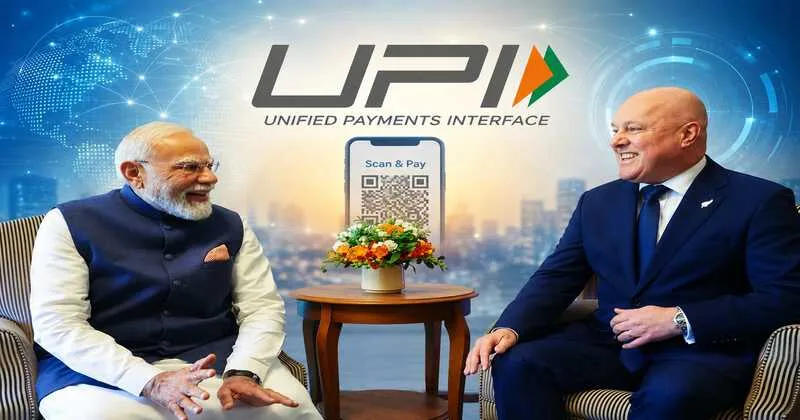
Prime Minister Narendra Modi announced that India and New Zealand will work towards integrating India’s Unified Payments Interface (UPI) with New Zealand’s fast-payment system, marking another significant step in the global expansion of India’s digital public infrastructure.
The announcement came during Modi’s historic two-day state visit to New Zealand on July 10 and 11, the first by an Indian Prime Minister in four decades, as the two countries elevated their relationship to a Strategic Partnership.
Addressing a gala lunch hosted by New Zealand Prime Minister Christopher Luxon in Auckland, Modi said the newly established Strategic Partnership would be translated into practical cooperation across multiple sectors, including financial technology, agriculture, education, healthcare, defence and maritime security.
“To make our Strategic Partnership meaningful, we are transforming the strengths of both countries into practical cooperation. In the area of fintech, we are going ahead in connecting India’s UPI and New Zealand’s payment system”, the Prime Minister said.
The proposed integration is expected to strengthen digital payment connectivity between the two countries while further extending the international reach of India’s home-grown payment platform. The move reflects New Delhi’s broader strategy of promoting Digital Public Infrastructure (DPI) and India Stack as global public digital goods.
Expanding India’s digital public infrastructure
The proposed UPI linkage with New Zealand adds another milestone to India’s expanding digital diplomacy. The Government of India has already signed Memorandums of Understanding (MoUs) and cooperation agreements with 23 countries for sharing or adopting components of India Stack and Digital Public Infrastructure. These agreements focus on collaboration in digital identity, digital payments, secure data exchange and digital service delivery.
UPI itself is already operational in more than eight countries, including the United Arab Emirates, Singapore, Bhutan, Nepal, Sri Lanka, France, Mauritius and Qatar. Its international expansion has helped facilitate cross-border digital payments, improve remittance efficiency and strengthen financial inclusion while enhancing India’s standing as a global fintech leader.
List of outcomes (18 in total) : PM @narendramodi’s Official Visit to New Zealand ⬇️
🇮🇳 🇳🇿 pic.twitter.com/LerTxuDUb2
— Randhir Jaiswal (@MEAIndia) July 11, 2026
The proposed partnership with New Zealand underscores India’s efforts to position UPI as an internationally interoperable payment platform capable of supporting seamless digital transactions beyond its borders.
Besides fintech, Modi said India and New Zealand had developed a strong framework for cooperation in agriculture, dairy and food processing, which would benefit farmers and livestock owners in both countries. He also announced that both governments had agreed to expand cooperation in traditional medicine as part of broader healthcare collaboration.
Strategic partnership beyond fintech
The digital payments initiative forms part of a wider roadmap unveiled during Modi’s visit. Both countries agreed to deepen defence and security cooperation, reflecting what the Prime Minister described as growing strategic trust between the two democracies.
According to Modi, India and New Zealand have also agreed on a framework for maritime cooperation in the Indo-Pacific, including logistics support and hydrography, highlighting the increasing strategic dimension of bilateral relations.
Education emerged as another important pillar of cooperation. Modi invited leading New Zealand educational institutions to expand their presence in India under recently liberalised policy frameworks, aiming to strengthen academic exchanges and institutional collaboration.
The visit also builds upon the Free Trade Agreement signed earlier this year. Modi said the agreement would provide a strong foundation for doubling bilateral trade, supported by New Zealand’s commitment to invest US$20 billion in India, creating new opportunities for businesses from both countries.
Economic data also reflects growing commercial engagement. According to Rubix Data Sciences, merchandise trade between India and New Zealand recorded a compound annual growth rate of 8 per cent between FY22 and FY26, reaching US$1.155 billion.
Against this backdrop, the proposed UPI integration represents more than a fintech collaboration. It signals India’s continuing effort to embed its digital payment architecture within international financial ecosystems while complementing broader cooperation in trade, investment, education, agriculture and strategic affairs under the newly elevated India-New Zealand Strategic Partnership.