Every year, financial transactions worth nearly Rs 2 lakh crore move through India’s Self-Help Group network. Savings collected in the village, loans advanced to members, and repayments recorded rupee by rupee. For decades, this vast economy lived in handwritten registers maintained by the diligence of a bookkeeper and the trust of a village. Today, it flows through a digital platform whose ambition is to improve the economy and the digitisation of the village. LokOS, where Lok means people and OS means operating system, is the People’s Operating System. Built under the Deendayal Antyodaya Yojana–National Rural Livelihoods Mission (DAY-NRLM), this poverty alleviation programme promoting self-employment and sustainable livelihoods for poor rural households, LokOS delivers end-to-end digitisation of the largest women’s collective movement anywhere in the world. The village bahi-khata has become a real-time national dashboard. What Aadhaar did for individual identity, LokOS is now doing for community institutions, giving them a verifiable, trackable and bankable digital existence. This is how a poverty alleviation mission quietly built one of the largest financial governance systems in the world and then, in June, taught it to power entrepreneurship.
What LokOS Actually Does
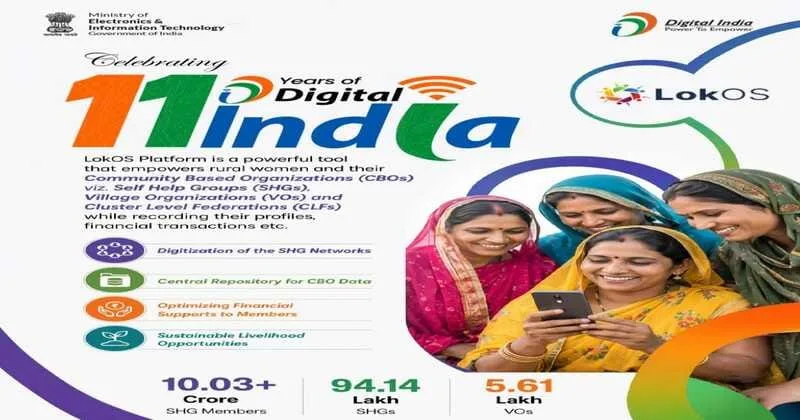
LokOS is a web and mobile platform that digitises every layer of the SHG ecosystem. It records member profiles, savings, lending, repayments, livelihood data and convergence with other government schemes. Each Community-Based Organisation (CBO) and its members receive Aadhaar-linked and bank-linked digital identities. Role-based administration enables user management, approvals, monitoring and reporting from the village to the national level, while real-time analytics deliver dashboards and one-click reports for data-driven decision-making.
The architecture is deliberately two-tiered. The web application serves administrators, e-bookkeepers and transaction approvers, who create and approve Self-Help Groups, Village Organisations (VOs), Cluster Level Federations (CLFs) and their members. The mobile application travels to the field, enabling community cadres to record CBO activities where they actually happen. The outcome is a sharp reduction in manual record-keeping, real-time transaction tracking and a degree of transparency, accountability and operational efficiency that the old paper trail could never offer. For the woman at the centre of it, the change is tangible. Her passbook entry, her loan approval, and her repayment history now exist in a system her federation can see, and her bank can trust.
Building a digitally empowered rural India.
Under the leadership of PM Shri @narendramodi ji, LokOS is strengthening Self-Help Groups with a unified digital platform, improving governance, enhancing transparency, and expanding livelihood opportunities across the country.… pic.twitter.com/Ejyx8zz9Cc
— BJP MINORITY MORCHA (@BJPMinMorcha) July 9, 2026
The Footprint of LokOS
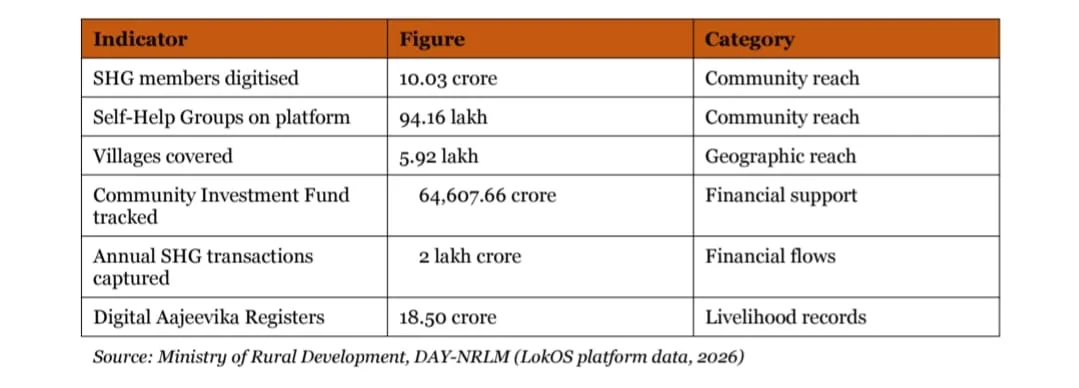
The numbers describe something closer to a parallel administrative map of India than a software rollout. LokOS today covers 34 States and Union Territories, 762 districts, 7,241 blocks, 2.57 lakh Gram Panchayats and 5.92 lakh villages. Within this canvas, it has digitally integrated 94.16 lakh Self-Help Groups, 5.62 lakh Village Organisations and 34,314 Cluster Level Federations, together representing 10.03 crore SHG members. Put plainly, roughly one in every seven Indians is now connected to this digital architecture through an SHG member in the household.
The platform monitors Rs 9,718.41 crore under the Revolving Fund, Rs 64,607.66 crore under the Community Investment Fund and Rs 38.34 crore under the Community Enterprise Fund.
SHE-LEAPS
On 29 June 2026, at the Rashtriya Gramin Vikas Sammelan held at the NASC Complex in Pusa, New Delhi, the government built the newest floor on this digital foundation. SHE-LEAPS, the Self-Help Entrepreneur–Livelihoods and Enterprise Application for Prosperity and Sustainability, was collectively launched by Union Minister of Rural Development Shivraj Singh Chouhan alongside Ministers of State Dr Chandrasekhar Pemmasani and Kamlesh Paswan.
Developed by the Digital India Corporation and implemented under the LokOS platform, SHE-LEAPS is a unified digital ecosystem for enterprise creation, performance tracking and business management for SHG women. It will support the Rural Livelihoods Missions of all 34 States and UTs in capturing real-time operational and enterprise data of rural women engaged in both farm and non-farm livelihoods. The significance lies in the shift it represents. LokOS digitised records. SHE-LEAPS digitises journeys. Where the parent platform tells the government what an SHG owns and owes, the new application tracks the complete arc of a woman’s enterprise, from profile creation to performance monitoring, integrating rural producers into formal value chains and enabling evidence-based course correction in place of periodic manual reporting.
The stated objectives read like a charter for rural capitalism with a woman’s face empowering SHG entrepreneurs nationwide, creating and strengthening women-led enterprises, deepening the financial inclusion of SHG households and enabling data-driven rural entrepreneurship. Because SHE-LEAPS sits on LokOS rather than beside it, the two platforms share one data backbone, avoiding the duplication that has dogged earlier SHG-related digital initiatives and giving policymakers, for the first time, a single continuous picture of a rural woman’s economic life from her first savings entry to her enterprise.
The Lakhpati Didi Engine
Behind the announcements stands machinery of remarkable scale. LokOS supports the Lakhpati Didi initiative, which recognises SHG women earning a sustainable annual household income of Rs 1 lakh or more, through a network of 6,611 Master Trainers, 4.09 lakh Community Resource Persons and 3.87 crore Potential Lakhpati Didis. The platform maintains 18.50 crore Digital Aajeevika Registers, the granular livelihood records on which planning and monitoring rest.
The policy escalation this year tells its own story. The original target of three crore Lakhpati Didis was achieved ahead of its March 2027 deadline, prompting the Prime Minister in February 2026 to approve doubling the goal to six crore women by March 2029. At the June Sammelan, the ministry backed the ambition with money, announcing a bank-linkage roadmap worth Rs 10 lakh crore over the next five years for women-led community enterprises. A dedicated Lakhpati Didi Dashboard was launched at the same event, giving the mission a real-time public scoreboard. Chouhan has since directed officials to work on a war footing, noting that reaching six crore Lakhpati Didis will require linking at least ten crore women to the ministry’s financial inclusion initiatives. Stronger bank linkages, credit access, insurance coverage and financial literacy are what will convert group membership into genuine economic self-reliance.
The Larger Canvas: Viksit Gram, Viksit Bharat
The two-day Sammelan, themed Gramodaya Se Rashtrodaya, brought Rural Development Ministers of 29 states and UTs onto one platform for the first time and set the stage for the nationwide rollout of the VB-G RAM G scheme from 1 July 2026, replacing MGNREGS with an interim approval of Rs 95,682 crore and SHE-LEAPS. Ministe urged states to deploy artificial intelligence for monitoring and transparency in rural schemes and framed the moment in the language of cooperative federalism, declaring that “this is the time for partnership, not politics.” Digital public infrastructure for villages, the message is no longer an add-on to rural policy. It is the operating principle. The same conference reviewed the flagship troika of Pradhan Mantri Awas Yojana-Gramin, Pradhan Mantri Gram Sadak Yojana and the Deendayal Upadhyaya Grameen Kaushalya Yojana, with the minister directing states to release funds on time, fill vacant posts, provide land to eligible landless beneficiaries and prepare water-conservation and employment contingencies against the possibility of below-normal rainfall. Every review conversation circled back to the same instrument: data, captured in real time, visible from Krishi Bhawan to the Gram Panchayat.
Antyodaya in the Age of the App
The scheme carries the name of Pandit Deendayal Upadhyaya, whose philosophy of Antyodaya demanded that the state measure itself by the rise of the last person. Six decades later, that dream has become literal. The last woman in the last village now has a digital identity, a tracked enterprise, bank linkage and a register that cannot be misplaced or manipulated. Transparency at the scale of Rs 2 lakh crore is itself a form of empowerment, for a ledger visible to the nation can no longer be hidden from the woman whose savings it records. From LokOS to SHE-LEAPS, India is not merely digitising its villages. It is handing ten crore women the receipts of their own rise.