At a time when cooking gas prices are steadily rising in many countries and a geopolitical crisis in West Asia has shaken the global energy market, India continues to provide the world’s cheapest cooking gas to its citizens. From neighboring countries like Pakistan, Nepal, Bangladesh and Sri Lanka to developed economies like the US, Canada and Australia, the price of domestic gas is significantly higher everywhere than in India. Despite this, opposition parties, including the Congress, continue to attack the central government over gas prices. This raises the question; does this criticism present the full picture, or is it merely part of political discourse?
The data reveals the full picture
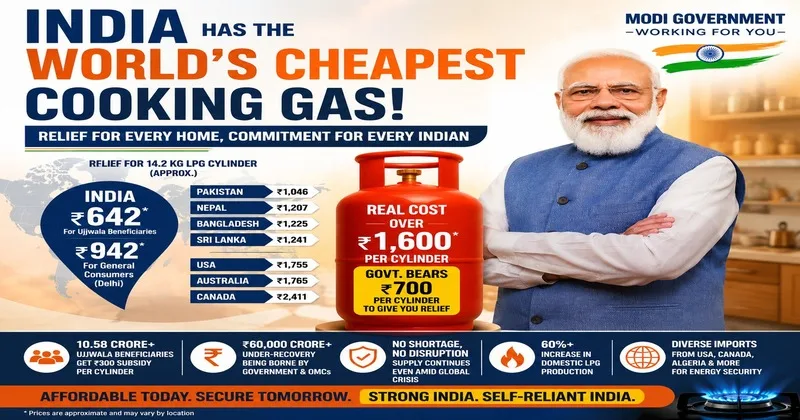
According to government figures, beneficiaries of the Pradhan Mantri Ujjwala Yojana can effectively access a 14.2 kg domestic LPG cylinder for Rs 642, whereas a general consumer in Delhi pays Rs 942.
A comparison with international prices shows that a cylinder of the same capacity costs approximately Rs 1,046 in Pakistan, Rs 1,207 in Nepal, Rs 1,225 in Bangladesh and Rs 1,241 in Sri Lanka. The situation is even more expensive in developed nations; prices have reached around Rs 1,755 in the US, Rs 1,765 in Australia and Rs 2,411 in Canada. This comparison demonstrates that Indian consumers are paying a significantly lower price compared to the global market.
Every time there is a small revision in LPG prices, the Opposition cries foul. What they conveniently ignore is that Indian households continue to get cooking gas at among the lowest prices in the world.
Today, a PM Ujjwala Yojana beneficiary pays an effective ₹642 for a 14.2… pic.twitter.com/e7zIwfoiR2
— Amit Malviya (@amitmalviya) June 7, 2026
Opposition allegations vs. reality
The Congress and other opposition parties have consistently alleged that the government has burdened the common public with inflation. LPG cylinder prices have also been a key political issue for the opposition. However, available data indicates that the price at which consumers purchase gas is far lower than its actual cost. As of June 2026, the supply cost of a 14.2 kg domestic LPG cylinder has exceeded Rs 1,600. Despite this, ordinary consumers are charged only Rs 942, while Ujjwala beneficiaries effectively pay Rs 642 per cylinder. This means the government and public sector oil marketing companies are shouldering an additional burden of approximately Rs 700 on every cylinder.
Amit Malviya Hits Back at the Opposition
Amid the ongoing political debate over LPG prices, Amit Malviya, in-charge of the BJP’s National Information and Technology Department, has responded to opposition allegations with data. In a detailed post shared on the social media platform X, he compared LPG prices in India with those in various other countries. He noted that while the opposition creates an uproar whenever there is a marginal price hike, they fail to mention that India still has the cheapest cooking gas in the world.
According to Malviya, beneficiaries of the Pradhan Mantri Ujjwala Yojana effectively receive a cylinder for Rs 642, whereas the actual international cost exceeds Rs 1,600. Ordinary consumers also pay about Rs 700 less than the actual cost. He further stated that although India imports a significant portion of its requirements, the government has not passed the entire burden of global price hikes onto consumers. He noted that the ‘under-recovery’ on domestic LPG has reached approximately Rs 60,000 crore, a large share of which is being borne by the government and oil marketing companies.
Hormuz Crisis and Rising Global Prices
It is worth noting that India imports approximately 60 percent of its total LPG requirements. Prices are linked to the Saudi Contract Price (Saudi CP) set by Saudi Aramco. A sharp surge in international LPG prices was recorded following tensions in West Asia and disruptions in the Strait of Hormuz in February 2026.
The blended LPG benchmark rose from approximately $542 per tonne in February to around $790 per tonne by June, an increase of nearly 46 percent. Had this entire cost been passed directly to consumers, the price of domestic gas cylinders would have been significantly higher. However, the government provided relief to consumers by bearing a significant portion of this price hike itself.
Ujjwala Yojana: A Safety Net for Poor Families
The Pradhan Mantri Ujjwala Yojana has emerged as a robust means of ensuring energy security for crores of poor families across the country. Currently, more than 10.58 crore beneficiaries are receiving direct assistance of Rs 300 per cylinder. This subsidy, applicable to the first four refills, provides an annual benefit of up to Rs 1,200 per family. Consequently, the effective cost of a cylinder for Ujjwala beneficiaries is reduced to Rs 642. Amidst the global energy crisis, this relief holds special significance for families belonging to poor and low-income groups.
Government Bears a Burden of Thousands of Crores
LPG price protection extends beyond mere subsidies. The gap between international costs and controlled retail prices has been steadily widening. In the 2024-25 fiscal year, the total under-recovery on domestic LPG stood at Rs 41,338 crore, rising to approximately Rs 60,000 crore by the end of the following fiscal year. To address this situation, the Central Government has approved a compensation of Rs 30,000 crore for oil marketing companies.
This demonstrates that the government and public sector companies are absorbing a significant portion of the global price surge, thereby providing relief to consumers.
Supply Remained Uninterrupted Despite the Crisis
Approximately one-fifth of the world’s oil and energy supplies pass through the Strait of Hormuz. While many nations faced supply-related challenges during the crisis, India successfully maintained its energy supply chain. Domestic LPG production was increased by over 60 percent. Simultaneously, imports were secured from alternative sources such as the US, Canada and Algeria. Consequently, the country faced no shortage of any petroleum product and the gas distribution system remained seamless.
Politics vs. Facts
In a democracy, it is the opposition’s duty to question the government, but debates must be grounded in facts. When India provides cooking gas at some of the lowest prices globally, when the government shoulders a massive financial burden per cylinder and when supplies remain uninterrupted despite international crises, focusing solely on the limited aspect of price increases fails to present the full picture. Available data indicates that, despite global circumstances, Indian consumers continue to benefit from the most affordable cooking gas in the world.