

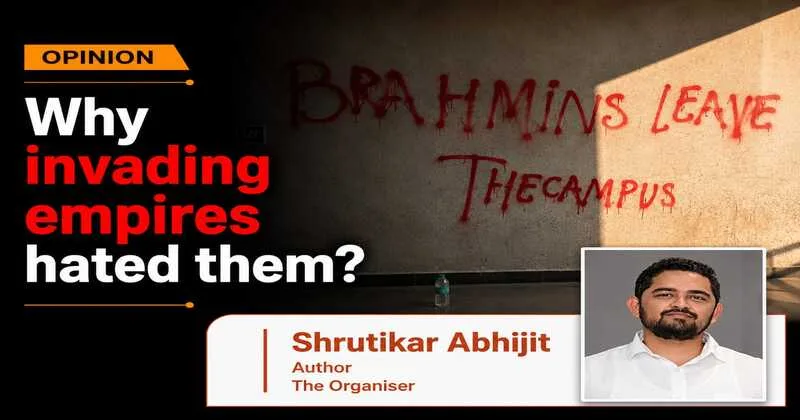
Here is a strange thing about history. When a powerful empire invades a land, especially a civilisational Nation, apart from the enemy army, the invaders had also made it their mission to annihilate the keepers of the civilisational soul. History stands witness, be it the Roman Empire’s endeavour to eradicate the Druids or the Brahmins of India, when it came to subjugating a civilisational land, the keepers of its memory were a bigger threat than its army or its kings. For history has preserved in its immortal womb hundreds of such instances when, be it the warring Celtic tribes or the sparring Hindu kings, only this class had the authority to overcome their petty differences and unite them against a common enemy.
The priests, scholars and judges, the people who carry a civilisation’s memory, wielded authority to settle its disputes and to remind it of its shared civilisational ethos, establishing a bridge to overcome differences. Therefore, both the Celtic land and India stood testimony to a common mooring based on which invading forces anchored their philosophy to completely subjugate a civilisation, i.e., “break the army; you only win a battle, but when you destroy those who preserve the civilisational teachings, you break the spirit of the entire Nation”. Two civilisational communities, at opposite ends of the ancient world, show this pattern with startling clarity.
In the ancient Gallic lands of Europe, they were the Druids of the Celtic tribes, while in India, they were the Brahmins. Their stories, told side by side, reveal something every empire seems to learn sooner or later, and never quite admits. Different people, but a similar fate. At first, the resemblance is uncanny, as if it is more than a coincidence. Myles Dillon, Celts and Aryans: Survivals of Indo-European Speech and Society, is a highly influential academic monograph written by the prominent Irish linguist and Indologist Myles Dillon. Published posthumously in 1975 by the Indian Institute of Advanced Study (IIAS) in Simla, India, it was stated that the Druids and the Brahmins had many similarities.
Both sat at the very top of society, above even the warrior, nobles or Kings. Both spent up to 20 years memorising their sacred knowledge by heart, and refused to write it down, in case of the later, it was subsequently written down. Both were exempt from taxes and did not perform mandatory military service. Both were the judges, teachers and timekeepers of their Civilisation. And, remarkably, both taught that the soul does not die but is reborn in a new body, the idea Indians know as rebirth, which the Roman writer Caesar and the Greek historian Diodorus both noted among the Druids, too.
The ancients themselves saw the link. Around 200 CE, the scholar Clement of Alexandria listed the great thinkers of the world and, in almost the same breath, named “the Druids among the Gauls” and “the Brahmins” of India. To the educated ancient mind, these were two versions of the same thing: the keepers of a nation’s deepest wisdom and the men who could stop intra-tribal wars.
Why did this matter so much? Because the power of these men did not come from the king, but was almost divine, as if the gods above bestowed this influence on them. Diodorus left an unforgettable picture of the Druids. Imagine two Celtic armies facing each other, swords drawn, spears raised, seconds from slaughter.
Then a Druid walks calmly into the gap between them and the fighting stops.
“Even among the most savage barbarians”, Diodorus wrote, “anger yields to wisdom”.
A man with no weapon walks between two armies, and the killing stops. That was the power no other authority could match. The geographer Strabo confirmed it: the Druids were trusted to judge disputes, and “in former times they even arbitrated cases of war.” Caesar added that once a year, Druids from every tribe in Gaul gathered at one sacred spot to settle quarrels for the entire people. They were the glue holding rival tribes together, an eerie similarity between the types of Kumbh prevalent in India.
The Brahmins held the same kind of standing, and we know it from outsiders who had no reason to flatter them. Megasthenes, a Greek ambassador to the Indian court around 300 BCE, ranked the Brahmins by similar characteristics: first in honour, fewest in number, and said the king consulted them every new year. A thousand years later, the Chinese Buddhist monk Xuanzang travelled across India and, though he followed a different faith, still recorded the Brahmins as the first and most learned of the social orders. A Greek and a Chinese pilgrim, a millennium apart, described the very same thing.
Now, let’s delve into the darker half of the story. After numerous Gallic wars against the Celts, Rome understood exactly how dangerous the Druids were, not for their rituals, but for their power to unite the tribes against the empire. Modern scholars agree. In a 2023 study in The Classical Quarterly, historian Tyler Creer argues that Caesar deliberately played down the Druids in his writings because they were “a potent source of anti-Roman sentiment”.
So, Rome moved against them, step by step. The Roman writer Suetonius records that the Druid religion was first banned for Roman citizens under Emperor Augustus, then “thoroughly abolished” under Emperor Claudius. The final blow came in 60–61 CE, on the island of Mona, today’s Anglesey, off the coast of Wales, the Druids’ last stronghold.
The historian Tacitus described the Roman legions landing on the Island of Mona in chilling detail: “On the shore stood the defenders, with black-robed women waving torches, like Furies, and a ring of Druids raising their hands to the sky, hurling curses. For a moment, the Roman soldiers froze in fear”. Then they charged, cut the defenders down, and did the thing that mattered most: they burned the sacred groves where the Druids taught.
The school and library of their world, and then the whole civilisation collapsed. And the Druids? They were finished. Because they had never written anything down, when the men were killed, and the groves burned, everything they knew, their law, history, astronomy, philosophy simply vanished. Within two generations, the Druids had disappeared from history entirely. This is the single biggest difference between their fate and that of the Brahmins, and it explains everything that follows.
India and its thousand-year ordeal. The Brahmins faced the same threat, but not in one blow. They faced wave after wave, across a thousand years. It began in 712 CE, when the young Arab general Muhammad bin Qasim conquered Sind. The kingdom he toppled, that of Raja Dahir, was itself ruled by a Brahmin dynasty, a fact confirmed by early Arab histories and by the modern scholar André Wink. The main account of the conquest, the Chach Nama, brutally describes sieges, killings, enslavement and temple plunder.
From the 11th century, the raids grew fiercer, and the great temple universities, the homes of Brahmin learning, became targets. Mahmud of Ghazni’s sack of the Somnath temple in 1026 became the most infamous. Around 1193, the forces of Bakhtiyar Khilji destroyed the ancient university of Nalanda along with many monks and priests.
“The greater number of the inhabitants of that place were Brahmans, and the whole of those Brahmans had their heads shaven; and they were all slain. There were a great number of books there; and, when all these books came under the observation of the Musalmáns, they summoned a number of Hindús that they might give them information respecting the import of those books; but the whole of the Hindús had been killed. On becoming acquainted [with the contents of those books], it was found that the whole of that fortress and city was a college, and in the Hindúí tongue, they call a college Bihár”.
Minhāj-i-Sirāj Jūzjānī. Ṭabaqāt-i-Nāṣirī: A General History of the Muhammadan Dynasties of Asia. Translated by H. G. Raverty, vol. 1, Asiatic Society of Bengal, 1881, pp. 551–52.
Why were these centres singled out? Historians offer two answers, and a fair article presents both. André Wink argues that religious hostility to idol-worship drove invaders to strike the great holy sites. Richard Eaton, in a much-cited 2000 study, argues that temples stood for a defeated king’s authority, so smashing them was a way to crush his legitimacy. Either way, the result was the same: the institutions that housed civilisational learning were marked for destruction.
Kerala tells a similar story from an earlier century. The Namboodiri Brahmins of Malabar were among India’s most learned priestly communities, keepers of an unbroken Vedic and Sanskrit tradition with their own colleges along the south-western coast. That world was shattered during the Islamic invasions under Hyder Ali and Tipu Sultan (c. 1766–1792). William Logan, whose official Malabar Manual (1887) remains the standard record of the region, catalogued the temples destroyed and the forced conversions inflicted on Malabar’s Hindus. A contemporary British enquiry estimated that some 30,000 Brahmins fled to Travancore, abandoning their lands. As the anthropologist Joan Mencher observed, the Namboodiris never fully recovered their old position. Once again the pattern held: to break a people, an invader went first for the class that carried its learning.
(Logan, William. Malabar Manual. Vol. 1, Government Press, Madras, 1887)
The Mughal centuries are not a simple tale of slaughter but under Aurangzeb, the mood turned harsh. The court chronicle Maasir-i-Alamgiri records the destruction of temples and centres of learning, and the return of the jizya tax on non-Muslims. The most famous episode is that of the Kashmiri Pandits: pressed to convert, they turned to the Sikh Guru Tegh Bahadur, who went to Delhi and was martyred in 1675 for defending them. From Qasim to Aurangzeb, the history of the Islamic regime is filled with gory tales of persecution
The subsequent subjugators, the British Raj, did something cleverer than burning groves. They achieved the same end with knowledge and without spilling too much blood. It started with Sir William Jones, who in 1784 founded the Asiatic Society and discovered that Sanskrit, Greek and Latin shared a common root. Jones admired Sanskrit and learned it from Brahmin scholars. But, as historian Bernard Cohn showed, the British translated and codified various tenets of Hindu philosophy, then came the sharp edge: Thomas Macaulay’s famous 1835 note on education.
Admitting he knew no Sanskrit, Macaulay still declared that “a single shelf of a good European library was worth the whole native literature of India.” He wanted to stop traditional learning, naming his target plainly “Benares is the great seat of Brahminical learning.” His goal was to create a new class of Indians “English in taste, in opinions, in morals, and in intellect.” No massacre needed, just make the old learning worthless. Colonial rule also reshaped caste itself, as historian Nicholas Dirks argued. British census-takers and officials hardened caste into a rigid system and fixed the Brahmin at the top of the official picture, handing later politics a ready-made villain.
The pressure did not end with the empires. In post-colonial India, the old idea of the Brahmin as villain hardened into politics and in two regions it turned into the uprooting of whole communities. In Tamil Nadu, the Dravidian movement built its rise on opposition to Brahmin dominance; its leaders cast Brahmins not merely as oppressors but, as scholars note, as “Aryan” outsiders no different from the British. The sociologist André Béteille documented how this injected a lasting caste idiom into southern politics, and the anthropologists C. J. Fuller and Haripriya Narasimhan have charted the result: a steady exodus of Tamil Brahmins out of the state’s villages and professions into the cities and abroad, a community that once flourished, reduced to a small and politically invisible minority.
Far graver was the fate of the Kashmiri Pandits, the almost entirely Brahmin Hindu community of the Kashmir Valley. In early 1990, as a violent Islamic separatist insurgency took hold, the Pandits were targeted, threatened, raped and killed; political scientist Alexander Evans and others record that of a population of around 120,000–140,000, some 90,000 to 100,000 fled within months, never to return in any number. Pandit organisations call it genocide; most scholars describe it as forced displacement or ethnic cleansing. Either way, a community that had kept Kashmir’s civilisational spirit alive for centuries was emptied from its homeland in a single winter.
What every power, Roman, Arab, Turk, Mughal, British and modern left has confronted is the same thing, a community influence and acceptance by the Nation Society came not from money, office or weapons, but from being the keeper of a civilisation’s memory. That kind of authority cannot simply be ordered about. And so, age after age, multitudes of forces, foreign either in ideology, like the left or foreign empires, have tried to break it, use it, or vilify it.
The real lesson? Put the two stories together and the pattern is clear. The Druid stilled a battle with raised hands, and so could the Brahmins of that era. Rome answered the Druids with fire, wiping them out completely. India’s conquerors came for the Brahmins again and again, yet because their learning was written as well as remembered, and spread across a subcontinent and protected by Dharmic kings from the likes of the Maharana’s, the Maratha’s, the Sikhs and to the Ahom’s, the Brahmins survived where the Druids vanished
The invaders’ empires or ideologies, for the matter, like communists, fear what they cannot grant and cannot easily take away. A throne can be toppled, a treasury seized, a government overthrown, but a group of people who remember and hold on to the civilisational collective are a people truly the resistance to their intentions. The fury with which empire after empire came for these quiet, unarmed, keepers of memory is, in the end, the surest proof of how much they were really worth.