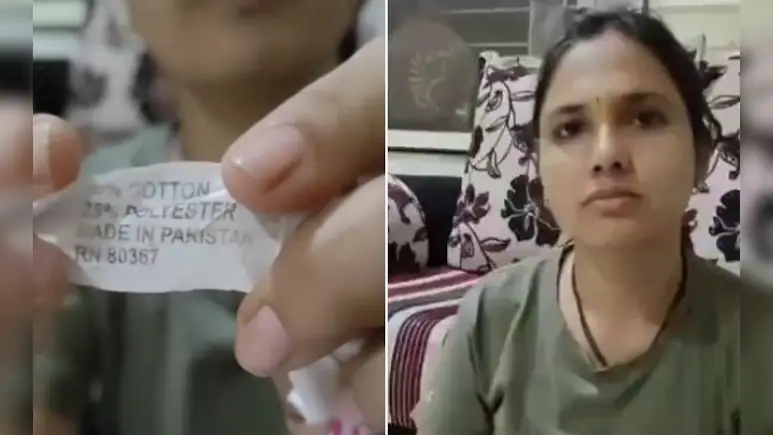
A seemingly routine purchase at a religious fair in Maharashtra’s Pune district has turned into the subject of an official investigation after a woman claimed she discovered a “Made in Pakistan” label on a bedsheet she had purchased during a temple fair.
The incident was reported from Chinchwad in Pimpri-Chinchwad, where devotees had gathered in large numbers for the Sankashti Chaturthi celebrations near the revered Morya Gosavi Temple complex.
According to the woman, the bedsheet appeared ordinary at the time of purchase and there was no indication that it had been manufactured outside India. However, after washing the bedsheet at home, she allegedly noticed a stitched label carrying the words “Made in Pakistan”.
Surprised by the discovery, she recorded a video and shared it on social media, questioning how a product allegedly manufactured in Pakistan had reached a local market and was being sold at a religious gathering in Maharashtra.
Social Media Post Draws Attention
The woman’s video quickly gained traction online, with users raising concerns about the product’s origin and demanding an investigation into how such items were being sold through local vendors.
As the video spread across social media platforms, it eventually caught the attention of local authorities, prompting a formal inquiry into the matter.
The issue generated considerable discussion online, with many users seeking clarity on whether the product had entered India through legal commercial channels, secondary markets, or unauthorised supply networks.
A Hindu woman bought a bedsheet at a religious fair in Pune, Maharashtra.
It had “Made in Pakistan” tag inside. She exposed how Pakistani goods are being sold openly at Hindu events to insult sentiments.@DGPMaharashtra pic.twitter.com/Zhr31Dpkho
— Angry Saffron (@AngrySaffron) June 6, 2026
Following the circulation of the video, the Pimpri-Chinchwad Police initiated an investigation and constituted a special team to examine the circumstances surrounding the sale of the bedsheet.
Officials are currently attempting to identify the vendor who sold the item, determine the source from which it was procured, and establish the chain of distribution through which it reached the religious fair.
Police have also reportedly written to the Pimpri-Chinchwad Municipal Corporation seeking cooperation and appropriate action should any regulatory violations be discovered during the course of the inquiry.
Authorities are expected to examine purchase records, supplier details and other documentation connected to the stall where the bedsheet was sold.
Police Focus on Product Origin and Distribution Network
Investigators are now working to determine whether the bedsheet was an isolated case or part of a larger supply chain involving similar products.
The inquiry is expected to focus on several key questions: where the bedsheet originated, who imported or supplied it, how it reached the local vendor, and whether comparable products are being sold elsewhere in Maharashtra.
Officials are also examining whether the product was sold with its original label concealed or whether the tag became visible only after the item was washed, as claimed by the purchaser.
At present, authorities have not announced any conclusions regarding the source of the bedsheet, and the investigation remains ongoing.
Incident Comes Amid Recent Action in Maharashtra
The Pune case has emerged shortly after a separate incident in Maharashtra’s Sambhajinagar district, where three individuals were reportedly arrested for allegedly selling cosmetic products carrying “Made in Pakistan” labels.
That case had also triggered scrutiny of product supply chains and raised questions about the movement of foreign-labelled goods in local markets.
The latest incident in Pune is likely to intensify attention on retail distribution networks, particularly in high-footfall public events and religious fairs where temporary vendors operate during festivals and gatherings.
For now, police officials have indicated that any further legal or administrative action will depend on the findings of the ongoing investigation.
As authorities trace the product’s journey from manufacturer to marketplace, the incident has once again highlighted the importance of supply-chain verification and regulatory oversight in local retail markets.
Whether the bedsheet turns out to be an isolated case or part of a broader distribution network remains a question investigators are now seeking to answer.