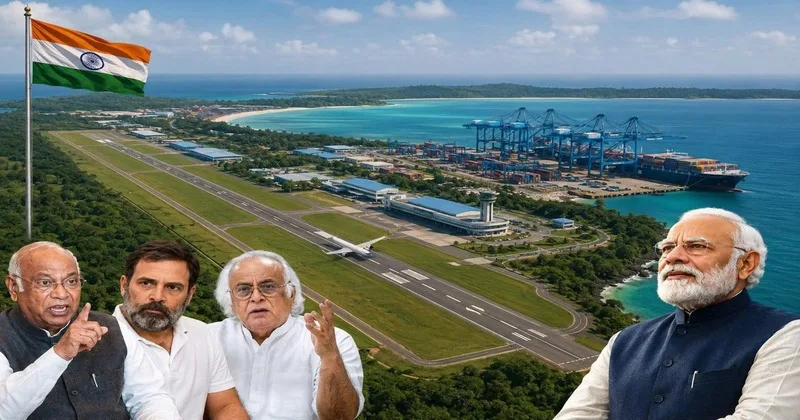
India is currently traversing a phase where economic strength, maritime security and energy self-reliance have become the cornerstones of future global competition. In this context, the Great Nicobar project has emerged as a vital component of India’s national interest. Despite this, the Congress leadership continues to oppose the project, sparking a fresh debate between development and politics. With an estimated cost of around ₹90,000 crore, the Great Nicobar project proposes the construction of an international container transshipment terminal, a greenfield international airport, a modern township and energy infrastructure; its most significant attribute, however, is its geopolitical importance.
Critics of this plan should also bear in mind that Great Nicobar Island is situated in close proximity to the Strait of Malacca, a vital artery for a significant portion of global trade. Currently, India relies on Singapore, Colombo and other foreign ports for the majority of its container transshipment needs. This project offers an opportunity to break free from this dependency and strengthen India’s strategic position in the Indian Ocean region.
Congress’s Opposition and Emerging Questions
Rahul Gandhi, Mallikarjun Kharge and Jairam Ramesh have consistently alleged that the project will harm the environment and is designed to benefit specific large corporate interests. Rahul Gandhi has attempted to frame this as a battle of “Green vs. Greed.” However, amidst these allegations, a question arises: if the project’s sole objective were private gain, why would it incorporate such broad dimensions as national security, maritime trade, port development, air connectivity and energy infrastructure?
While criticism is indeed an integral part of democracy, does it imply that criticism need not be grounded in facts, that one can simply say anything based on imagination or whims, or merely to level accusations against the ruling dispensation? Just level an allegation, and let the other party spend their time offering clarifications! Is it right to level such allegations based merely on political perceptions?
Environmental Concerns: A Demand for Solutions or Total Opposition?
The Congress argues that the project will impact a vast forest area and harm biodiversity. This is certainly a valid concern; a rigorous assessment of environmental impacts is essential for any development project. However, the Congress seems to be overlooking, or perhaps deliberately ignoring, the fact that this project has undergone a comprehensive Environmental Impact Assessment (EIA) process. Studies have been conducted by various expert institutions, and approval has been granted subject to numerous environmental conditions.
The government maintains that land usage will be limited, compensatory afforestation will be undertaken and sensitive areas will be preserved. The Congress itself has previously held power at the Centre and worked on numerous projects; applying today’s arguments, one could just as easily claim that the Congress should not have pursued the very initiatives it once deemed essential for India’s development. Therefore, the real debate should focus on ensuring strict compliance with these conditions, rather than halting the project altogether.
Tribal Rights: Genuine Concern or Political Tool?
A key argument raised by the Congress party concerns the rights of the Shompen and Nicobari tribes. While safeguarding the culture, traditions and lifestyles of tribal communities is undoubtedly a national obligation, official documents indicate no proposal for the large-scale displacement of any tribal community. Provisions for monitoring mechanisms, tribal welfare measures and protected areas have also been put in place. Any existing shortcomings need to be addressed; however, portraying the entire project as being against tribal interests could undermine the seriousness of the actual issues.
Discovery of Natural Gas Boosts Project Significance
The Congress party should recognize that the recent discovery of vast natural gas reserves in the Andaman and Nicobar region has further enhanced the area’s importance. Union Petroleum Minister Hardeep Singh Puri has shared information confirming that Oil India Limited has detected a significant presence of natural gas in the Sri Vijay Puram-3 area of the Andaman offshore basin.
This discovery marks a major achievement in India’s journey toward energy self-reliance. Previous findings had already confirmed the existence of gas reserves in this region. Consequently, the entire Andaman basin could emerge as a hub for India’s future energy revolution. These new discoveries ensure that the Great Nicobar project is not limited merely to a port and an airport but also emerges as a potential energy hub, establishing a strong link between national security, economic development and energy strategy.
The Modi Government’s Maritime and Energy Vision
Over the past decade, Prime Minister Narendra Modi’s government has placed special emphasis on transforming India into a maritime power. Initiatives such as the ‘SAGAR’ policy, the Indo-Pacific strategy and the recently launched ‘Samudra Manthan Mission’ are all part of this comprehensive vision. India is taking these steps at a time when China is steadily expanding its presence in the Indian Ocean region and neighboring countries are developing their maritime infrastructure. In such a climate, remaining passive could prove strategically detrimental for India. The Great Nicobar project has the potential to empower India in the realms of maritime trade, defense preparedness and energy security.
The Role of the Opposition: Reform or Obstruction?
In a democracy, the opposition’s responsibility is not merely to dissent but also to offer better alternatives and constructive suggestions. While questioning environmental clearances, transparency and the interests of local communities is essential, it is natural for the public to wonder whether the objective is reform or obstruction when almost every major national project becomes a subject of opposition. Indeed, the Congress party ought to clarify through which alternative model India would expand its maritime, commercial and energy capabilities if projects like Great Nicobar are opposed.
The Need to Prioritize National Interest Over Politics
Therefore, to all those opposing this scheme, including the Congress, it must be said that while questioning the “Great Nicobar project” is a democratic right, maintaining a balanced perspective on issues concerning national interest is equally vital. Advancing on the path of development while ensuring the protection of the environment, biodiversity and tribal rights may well be the best course of action.
Recent discoveries of natural gas clearly indicate that the Andaman and Nicobar Islands could become more than just an archipelago; they could emerge as the future hub of India’s strategic, economic and energy prowess. In this context, political parties must rise above the confines of opposition and support to prioritize the national interest. Ultimately, this debate is not about the government or the opposition, but about India’s future, a future in which we must all unite to strengthen our nation in every respect and across every sector.