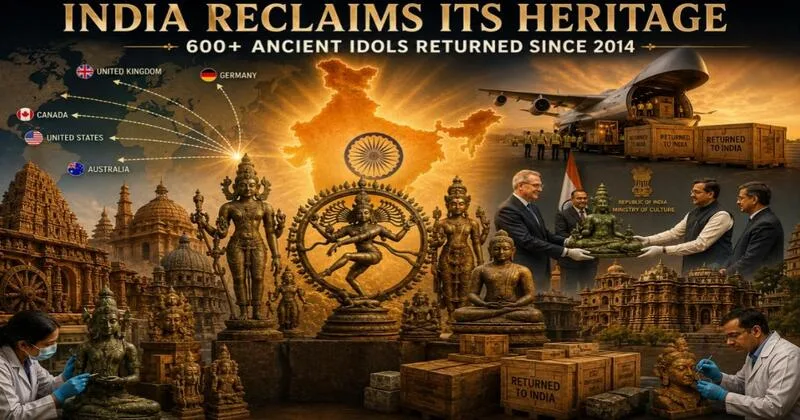
India has brought back more than 600 ancient murtis and sacred artefacts that were once smuggled out of the country and scattered across foreign museums, private collections and auction houses. The reclamation driven by the central government under Prime Minister Narendra Modi ranks among the most ambitious heritage-recovery campaigns any nation has mounted in modern times.
The latest milestone came from the Netherlands. Speaking to reporters on Sunday after listening to the 134th episode of the radio programme Mann Ki Baat, Union Minister of State for Information and Broadcasting L. Murugan announced that a rare Chola-era copper plate inscription, the seppu pattayam, had been repatriated from Dutch custody and would soon be sent back to its original home in Tamil Nadu. “During his recent five-nation tour, Prime Minister Narendra Modi brought back a Chola-era copper plate inscription from the Netherlands. Steps are being taken to return the historic copper plates to their rightful place in Tamil Nadu at the earliest,” Murugan said. He thanked the Prime Minister on behalf of the people of Tamil Nadu and noted that the Centre had already retrieved more than 600 antiquities.
Decade of Homecomings: India Major Repatriations Since 2014
India’s heritage recovery drive opened with a cherishing moment in July 2014, when Australia returned the Sripuranthan Nataraja, a priceless Chola-era bronze stolen from a Tamil Nadu temple, a return that signalled the start of an aggressive diplomatic campaign.
The United States quickly became the biggest contributor. In November 2014, it handed over 61 Indian antiquities, followed by 19 more in September 2015. Then in November 2016, the US returned 111 antiquities, among the largest such returns at the time.
A symbolic recovery came in 2019, when a 16th-century Nataraja statue stolen in 1982 from Tirunelveli district was traced to the Art Gallery of South Australia and brought home on 13 September 2019. In 2021, the 18th-century idol of Maa Annapurna, smuggled out in 1913, was installed in Varanasi after 108 years.
The single richest moment arrived during Modi’s US visits. In September 2021, 157 artefacts were returned, including a 12th-century bronze Nataraja and a 10th-century sandstone Revanta panel. March 2022 saw three more idols come back: a goat-headed Yogini from London, a Buddha from Italy and a Hanuman from Australia.
The campaign high point came in September 2024, when the US returned 297 antiquities spanning 2000 BCE to 1900 CE, including a sandstone Apsara, a bronze Jain Tirthankara and bronze figures of Ganesha and Vishnu.
In May 2026, the 11th-century Chola copper plates returned from the Netherlands after three centuries, and the Smithsonian agreed to return a 9th-century Shiva Nataraja bronze and two other sculptures.
From 13 in six decades to 600-plus in a decade
The scale of the turnaround is what gives the campaign its weight. For most of independent Indian history, the recovery of looted antiquities barely registered as a policy priority. Government figures place the number of artefacts officially returned between 1955 and 2014 at just thirteen. Since 2014, that number has multiplied many times over.
By the government’s own accounting, more than 640 stolen antiquities and sacred artefacts have been brought back to the country since 2014. Union Culture Minister Gajendra Singh Shekhawat told the Rajya Sabha in March 2025 that 642 antiquities had been repatriated, a sharp leap from the thirteen recovered in the previous six decades. Murugan, in his Sunday remark, noted that more than 200 culturally significant idols and artefacts have been returned to India from foreign countries in recent years.
The United States has been by far the largest contributor. Of the antiquities recovered since 2014, roughly 90 per cent, some 578 pieces, have come from the US alone. Other returns have flowed in from across the world: 16 artefacts from the United Kingdom and 40 from Australia, among others. Singapore returned sculptures and manuscripts in 2017, while Scotland handed over seven colonial-era objects in 2022.
The diplomacy behind the homecoming
This diplomacy has been woven into the fabric of India’s foreign engagements, often timed to coincide with PM Narendra Modi’s overseas visits. During his 2021 US trip, 157 antiquities were handed over, including a twelfth-century bronze Nataraja statue. A few days after his 2023 US visit, another 105 were returned.
The single largest tranche came in September 2024. On the sidelines of a meeting between PM Narendra Modi and then-US President Joe Biden in Wilmington, Delaware, the United States returned 297 antiquities that had been stolen and smuggled out of India. These objects span an astonishing arc of time, almost 4,000 years from 2000 BCE to 1900 CE, with origins across different parts of India, the majority being terracotta artefacts from Eastern India alongside others in stone, metal, wood and ivory.
In July 2024, India and the US signed their first-ever Cultural Property Agreement to prevent and curb the illicit trafficking of antiquities from India to the US. Negotiations are reportedly continuing with the UK, Australia, Singapore and the Netherlands for further returns.
Why it matters
The significance of this campaign runs deeper than the count of objects. When the US handed over artefacts in 2024, PM Narendra Modi remarked that these objects were not only part of India’s historical material culture but formed the inner core of its civilisation and consciousness. Each idol smuggled out of a village temple represented not just a stolen object but a severed thread in a living tradition of worship and memory.
Many of these artefacts were lifted directly from active temples, leaving sanctuaries with empty plinths and communities without the deities their ancestors had venerated for centuries. Bringing them home is therefore an act of cultural healing as much as legal recovery.
The government’s stated intention is not to lock these treasures away but to return them to their places of origin, as is planned for the Chola plates heading back to Tamil Nadu and to display others publicly. The Archaeological Survey of India has set up a dedicated gallery for repatriated antiquities at Purana Qila in Delhi, where reclaimed treasures are shown to the public and shared with institutions for research.
The recovery of the seppu pattayam sits within a larger story of national self-confidence. In reclaiming these scattered fragments of its past, India is, in a sense, reassembling the story of who it has always been.