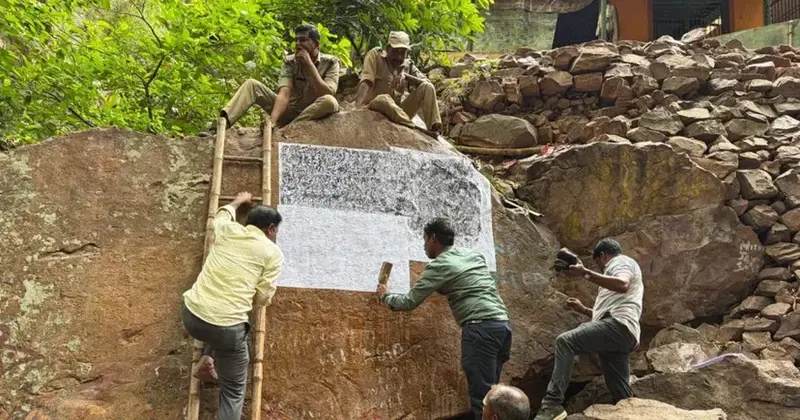
Tirupati: Recent archaeological discoveries in the forested regions of Tirupati district have unveiled two significant inscriptions dating back to the Vijayanagara Empire, offering valuable insights into the political, religious, and socio-economic landscape of South India during the 16th century. The inscriptions, discovered during a survey conducted by experts, have been identified as belonging to the reign of Emperor Sadasiva Deva Raya, one of the rulers of the later Vijayanagara period.
Two Vijayanagara-era inscriptions discovered in forests in Tirupati district.
The inscriptions, discovered during a recent survey, have been confirmed by experts to belong to 16th century.
According to the inscriptions, during the reign of Emperor Sadasiva Deva Raya, land… pic.twitter.com/0QCcOSGqkP
— News Arena India (@NewsArenaIndia) June 24, 2026
The findings are of immense historical importance as they provide rare documentary evidence about temple administration, land grants, governance structures, and the relationship between the state and religious institutions during the height of the Vijayanagara Empire.
Discovery in the Forests of Tirupati
The inscriptions were found in the forest areas of Tirupati district during a recent exploration and documentation exercise undertaken by heritage researchers and epigraphists. Preliminary studies and expert analysis confirmed that the inscriptions date to the 16th century, a period when the Vijayanagara Empire was one of the most powerful kingdoms in South India. Despite centuries of exposure to natural elements, the inscriptions have remained sufficiently preserved, allowing scholars to decipher their contents and reconstruct important aspects of regional history.
The inscriptions refer to the reign of Emperor Sadasiva Deva Raya, who ruled the Vijayanagara Empire during the mid-16th century. Although much of the administrative authority during his reign was exercised by powerful regents and military commanders, the empire continued to maintain extensive systems of governance and patronage.
The newly discovered records indicate that land grants were issued during his reign for the maintenance of religious activities at the Parashurameswara Mandir located in Gudimallam village of Yerpedu mandal. Such grants formed an important component of Vijayanagara state policy, helping sustain Mandirs that served not only as religious centres but also as hubs of economic and social activity.
Land Grants for Mandir Rituals
According to the inscriptions, specific parcels of land were donated to support the daily rituals, offerings, and maintenance of the Parashurameswara Mandir. These grants ensured a steady source of income through agricultural production, allowing Mandir authorities to conduct regular worship and religious ceremonies without interruption.
Mandir endowments were a common feature of medieval South Indian administration. Kings, local chieftains, merchants, and wealthy patrons often donated land, livestock, and other resources to religious institutions. In return, temples played a vital role in preserving cultural traditions, supporting local economies, and fostering social cohesion. The inscriptions provide direct evidence of this system in operation and demonstrate how state-sponsored patronage contributed to the functioning of important sacred centres.
Historical Significance of the Parashurameswara Mandir
The Parashurameswara Mandir at Gudimallam is itself a site of exceptional archaeological importance. The Mandir is renowned for housing one of the oldest known Shiva lingas in India, making it a significant destination for historians, archaeologists, and devotees alike. The newly discovered inscriptions add another layer to the temple’s long and rich history. They help establish the continued patronage and importance of the shrine during the Vijayanagara period, centuries after its original foundation. Such records also enable scholars to trace the evolution of temple management practices and understand how ancient sacred sites remained integrated into successive political and administrative systems.
Insights into Vijayanagara Governance
Beyond their religious significance, the inscriptions offer valuable information about governance under the Vijayanagara Empire. Land grants required careful documentation, surveying, and administrative oversight. The inscriptions reveal the existence of organised bureaucratic mechanisms that recorded donations, protected endowed lands, and ensured compliance with royal orders.
These records illustrate how imperial authority extended into local communities through networks of officials, village institutions, and Mandir administrations. They also highlight the role of temples as intermediaries between rulers and subjects.
Historians often rely on inscriptions as primary sources because they provide firsthand evidence of governmental decisions, legal arrangements, taxation systems, and local administration. The Tirupati inscriptions therefore, contribute significantly to our understanding of how the Vijayanagara state functioned at the regional level.
The discovery underscores the importance of continued archaeological surveys and heritage conservation efforts in Andhra Pradesh and across India. Many historical records remain hidden in remote forests, neglected temples, and rural landscapes, waiting to be documented and studied.
Each inscription serves as a tangible link to the past, helping historians reconstruct events, institutions, and traditions that shaped the subcontinent’s civilizational heritage. The newly discovered Vijayanagara inscriptions from Tirupati are a reminder that India’s historical landscape continues to yield valuable discoveries capable of enriching our understanding of the past.
The discovery of two 16th-century Vijayanagara inscriptions in the forests of Tirupati district is a significant contribution to South Indian history. By recording land grants made during the reign of Emperor Sadasiva Deva Raya for the Parashurameswara Mandir at Gudimallam, the inscriptions illuminate the intricate relationship between religion, governance, and society under the Vijayanagara Empire.