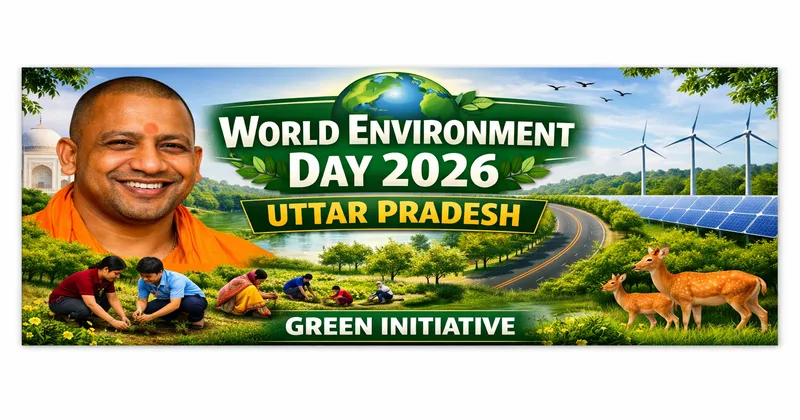
As the world observes World Environment Day 2026 amid growing concerns over climate change and environmental issues, Uttar Pradesh is emerging as a strong example of how development and environmental protection can progress together. The occasion coincides with the birthday of UP Chief Minister Yogi Adityanath, whose government has made environmental protection and afforestation a major component of the state’s development agenda.
Over the last nine years, Uttar Pradesh has undertaken some of the world’s largest plantation drives, expanded green cover, promoted ecological awareness, and integrated sustainability into infrastructure development. From planting trees along expressways to carrying out large plantation drives on riverbanks, Uttar Pradesh is working to promote development while also protecting the environment. Let us look closely to understand.
A Green Revolution Rooted in Public Participation
One of the most visible achievements of the Yogi Adityanath government has been the transformation of plantation drives into a mass public movement. What were once routine government programmes have evolved into statewide campaigns involving schools, colleges, self-help groups, government departments, gram panchayats, religious organizations, and ordinary citizens.
This year, Uttar Pradesh has once again launched a major tree plantation drive under the “Ek Ped Maa Ke Naam” campaign proposed by Prime Minister Narendra Modi. The initiative encourages people to plant a tree in their mother’s name, linking environmental protection with family values. The state has set a target of planting over 35 crore saplings during this plantation season, making it one of the biggest tree-planting campaigns in the world. The campaign covers every district of the state, with plantations being carried out along roads, expressways, canals, riverbanks, schools, colleges, government offices, parks, and community lands.
Since 2017, Uttar Pradesh has repeatedly broken its own plantation records. The state has planted hundreds of crores of saplings through annual drives that have attracted national and international attention. These campaigns have involved millions of citizens and thousands of institutions, helping create a culture of environmental responsibility across urban and rural areas alike.
Uttar Pradesh’s environmental journey extends beyond the number of saplings planted. The government has increasingly focused on improving survival rates and ensuring long-term maintenance of plantations. Technology such as geo-tagging, digital verification, and regular monitoring is being used to track planted saplings and support their growth into mature trees.
UP has also developed urban forests, biodiversity parks, medicinal forests, and thematic plantations to conserve native species and strengthen ecological awareness. These initiatives have helped convert plantation drives from one-day events into long-term environmental programmes. As a result, Uttar Pradesh has emerged as one of the leading states in India’s afforestation efforts. Large-scale plantation campaigns, combined with improved monitoring and community participation, have contributed to expanding green cover and strengthening environmental sustainability across the state.
Greening Infrastructure: Development and Environment Together
A defining feature of Uttar Pradesh’s environmental strategy has been the integration of greenery with major infrastructure projects. The state has witnessed unprecedented infrastructure development under Chief Minister Yogi Adityanath through projects such as the Purvanchal Expressway, Bundelkhand Expressway, Gorakhpur Link Expressway, and the under-construction Ganga Expressway.
Alongside these projects, large-scale plantation drives have been undertaken to create greener infrastructure corridors. Under initiatives such as Mission Chhaya, shade-giving trees are being planted along roads and highways to improve air quality, reduce heat stress, and enhance environmental sustainability.
The government has also prioritised the conservation of rivers, wetlands, and natural ecosystems. Large-scale tree plantation drives have been carried out along the banks of the Ganga, Yamuna, Gomti, Sarayu, Rapti, and other rivers. Wetland conservation and ecological restoration projects have also gained momentum in recent years.
Uttar Pradesh’s environmental vision goes beyond plantation drives. The state is also focusing on creating green jobs and encouraging environmentally responsible businesses. Various programmes are training young people in areas such as waste management, renewable energy, environmental conservation, and sustainable technologies.
Climate Action Through Community Participation
Climate change is no longer a distant concern. Rising temperatures, irregular rainfall, heatwaves, and environmental degradation are already affecting communities around the world. In this context, plantation drives have become an important tool for climate action. Trees absorb carbon dioxide, improve air quality, reduce temperatures, conserve soil, and support biodiversity. Large-scale afforestation therefore plays a crucial role in helping India meet its climate commitments while improving local environmental conditions.
Students, farmers, women’s groups, social organisations, religious institutions, and local communities have all become active participants in Uttar Pradesh’s environmental initiatives. This collective approach has helped transform environmental conservation from a government programme into a shared public responsibility.
On a day that celebrates both World Environment Day and the birthday of UP Chief Minister Yogi Adityanath, the message from Uttar Pradesh is clear: development and environmental protection are not competing goals. When pursued together, they can lay the foundation for a stronger, greener, and more sustainable future.