Azerbaijan, a Muslim-majority country with nearly 97 percent of its population adhering to Islam, is home to a predominantly Shia Muslim population alongside a significant Sunni minority.
In recent years, the country has emerged as a vocal supporter of Pakistan and Turkey on issues involving India. During and after Operation Sindoor, Azerbaijan publicly backed Pakistan.
However, the country’s involvement has now moved beyond diplomatic statements. Azerbaijani territory is increasingly being used as a platform for organised anti-India activities.
According to information released by Disinfo Lab, anti-India campaigns are being actively promoted under the leadership of the Baku Initiative Group (BIG), an organisation backed by the Azerbaijani state.
Originally created to advance anti-France narratives, BIG has now shifted significant attention towards nurturing and amplifying Khalistani activities.
As a result, Azerbaijan is emerging as a new hub for Khalistani activism alongside traditional centres such as Canada, the United Kingdom and the United States.
The organisation has been linked to anti-India seminars, conferences, events commemorating Khalistani terrorists, the hosting of separatist leaders, and the promotion of narratives aligned with Pakistan’s strategic interests.
The most recent seminar organised in Baku serves as another example of this expanding campaign.
Baku becomes a platform for Khalistani activities
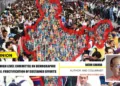
A seminar titled “June 1984, Amritsar Events: India’s Transnational Repression Against Ethnic Minorities in the Context of Genocide” was recently organised in Azerbaijan’s capital, Baku, with the participation of Pakistani and Khalistani-linked groups associated with the Sikh Federation International (SFI).
The venue itself is significant. In January 2026, the same location hosted an event commemorating Khalistani separatist Hardeep Singh Nijjar, who was shot dead by unidentified assailants in Canada in 2023.
Reports published by the Azerbaijan State News Agency indicate that the latest seminar was also held at this venue.
Among the prominent participants was Moninder Singh, a leading figure associated with the Sikh Federation of Canada (SFC). Indian investigative agencies have identified Moninder Singh as a close associate of the late Nijjar.
Other attendees included Prabjot Singh, legal adviser to the Sikh Federation International (SFI), and Dabinderjit Singh Sidhu. Sidhu serves as Senior Adviser to Sikh Federation United Kingdom (SF-UK) and was previously associated with the International Sikh Youth Federation (ISYF), an organisation designated as a terrorist organisation by the Government of India.
Azerbaijan Emerging As New Hub For Khalistani Networks?
Indian Intelligence Raises AlarmAzerbaijan is reportedly emerging as a new focal point for Khalistani-linked networks, with Indian intelligence sources warning of increased anti-India activities from the region.… pic.twitter.com/bmFYF1wPPM
— Augadh (@AugadhBhudeva) June 4, 2026
The growing prominence of Azerbaijan in Khalistani activities comes at a time when Canada’s role as a major hub for Sikh separatist activism is undergoing changes.
Under former Prime Minister Justin Trudeau, Khalistani networks enjoyed considerable political space. However, the government of Prime Minister Mark Carney has adopted a different approach and has simultaneously moved towards improving political and trade relations with India.
Union Minister Piyush Goyal’s visit to Canada in May marked the beginning of another phase in bilateral engagement. Throughout the years, India consistently raised concerns about Sikh separatist activities operating from Canadian soil during diplomatic discussions.
The killing of Nijjar further exposed a transnational network operating across several Western countries. At the same time, India has adopted a more assertive stance in discussions with countries including the United States and the United Kingdom regarding extremist activities directed against India.
As India’s economic, political and military influence continues to grow, countries that previously ignored New Delhi’s concerns find it increasingly difficult to do so.
Consequently, the political support that Khalistani networks once enjoyed has weakened. A notable example was the arrest of Sikhs for Justice operative Inderjeet Singh Gosal by Canadian police in September 2025 on firearms-related charges.
While Khalistani networks continue to operate, their influence in some traditional Western centres has faced setbacks. Against this backdrop, Azerbaijan appears to be emerging as an alternative platform for these activities.
The geopolitical logic behind Azerbaijan’s shift
The growing prominence of Azerbaijan in Khalistani activities comes at a time when Canada’s role as a major hub for Sikh separatist activism is undergoing changes.
Under former Prime Minister Justin Trudeau, Khalistani networks enjoyed considerable political space. However, the government of Prime Minister Mark Carney has adopted a different approach and has simultaneously moved towards improving political and trade relations with India.
Union Minister Piyush Goyal’s visit to Canada in May marked the beginning of another phase in bilateral engagement. Throughout the years, India consistently raised concerns about Sikh separatist activities operating from Canadian soil during diplomatic discussions.
The killing of Nijjar further exposed a transnational network operating across several Western countries. At the same time, India has adopted a more assertive stance in discussions with countries including the United States and the United Kingdom regarding extremist activities directed against India.
One striking aspect of Azerbaijan’s growing involvement is the almost complete absence of a sizeable Sikh diaspora within the country.
The rationale behind organising international conferences focused on Sikh issues in a country with virtually no Sikh community therefore raises important questions.
The broader explanation lies in the strategic alignment between Pakistan, Azerbaijan and Turkey. Azerbaijan’s principal geopolitical rival is neighbouring Armenia, regarded as the world’s first Christian nation.
Tensions between the two countries revolve largely around Nagorno-Karabakh, a region historically inhabited by ethnic Armenians.
Pakistan, Turkey and Azerbaijan probably did not enjoy watching this parade today. 🇮🇳🇦🇲
Armenia just rolled out Indian Akash systems, Pinaka rocket launchers and ATAGS artillery guns right in the middle of Yerevan for the whole world to see.
And that is a very deliberate… pic.twitter.com/E6SEtVHn5Q
— Military Observer (@TheMilObserverr) May 28, 2026
Between 2020 and 2023, military operations conducted by the Azerbaijani-Turkish alliance resulted in the displacement of large numbers of ethnic Armenians from the region, while many others were killed.
Reports from the conflict period documented the involvement of more than 2,000 Syrian Islamist fighters deployed in support of Azerbaijani operations.
Pakistan has increasingly become a partner in this strategic alignment. Both Pakistan and Azerbaijan maintain close military ties with Turkey and have procured Turkish-made drones and weapon systems.
As this trilateral partnership deepened, Armenia simultaneously strengthened its relationship with India. The expanding India-Armenia defence partnership has become a significant concern for Azerbaijan.
India has now surpassed France to become Armenia’s leading arms supplier. Defence agreements signed since 2020 are estimated at approximately US$7–8 billion.
Among the major systems acquired by Armenia are India’s Akash surface-to-air missile systems, the Pinaka multi-barrel rocket launcher system, the Advanced Towed Artillery Gun System (ATAGS), and Sukhoi fighter aircraft.
Discussions are also underway regarding the possible acquisition of the BrahMos supersonic cruise missile system.
Baku Initiative Group: From anti-France campaigns to anti-India narratives
The Baku Initiative Group (BIG) was formally established on July 6, 2023. It did not emerge as an independent civil society organisation but was created with state backing.
The intellectual and organisational foundation for BIG lies in the AIR Center, an institution established by a presidential decree issued by Azerbaijani President Ilham Aliyev on February 6, 2019.
The centre’s primary objective was to promote narratives opposing France, largely in response to growing military cooperation between France and Armenia.
BIG is headed by Abbas Abbasov, a former member of SOFAZ, Azerbaijan’s State Oil Fund. Since its creation, the organisation has actively promoted narratives aligned with Azerbaijan’s foreign policy objectives.
During 2023 and 2024, BIG organised conferences and events in regions such as Africa, New Caledonia, Corsica and French Polynesia under anti-colonial themes. These initiatives largely targeted French interests.
French investigative agencies reached a significant conclusion in December 2024, stating that BIG had functioned as an organisation used to advance Azerbaijani foreign-policy narratives between July 2023 and October 2024.
Baku Initiative Group’s Sudden Support for Moninder Singh Bual is Manufactured
The Baku Initiative Group’s sudden interest in Sikh issues, especially its support for Moninder Singh Bual and other Khalistani activists, does not seem natural or genuine.
In January, the… https://t.co/BlspqL6MmD pic.twitter.com/cV4008KRrv
— Allen Hampton (@Hamp_Allen) March 1, 2026
In essence, the organisation’s primary purpose has been to target countries viewed as adversaries of Azerbaijan. India has increasingly become one of those targets.
In March 2026, BIG and Sikh Federation International jointly published a book titled “Beyond Borders: India’s Transnational Repression Against the Sikh Diaspora.”
The publication portrayed Khalistani figures in a sympathetic light and called for a United Nations investigation into India.
The partnership between BIG and SFI illustrates the depth of cooperation between Azerbaijani narrative institutions and Khalistani organisations.
As India’s economic, political and military influence continues to grow, countries that previously ignored New Delhi’s concerns find it increasingly difficult to do so.
Consequently, the political support that Khalistani networks once enjoyed has weakened. A notable example was the arrest of Sikhs for Justice operative Inderjeet Singh Gosal by Canadian police in September 2025 on firearms-related charges.
While Khalistani networks continue to operate, their influence in some traditional Western centres has faced setbacks. Against this backdrop, Azerbaijan appears to be emerging as an alternative platform for these activities.
The SFI connection and the legacy of ISYF
Sikh Federation International traces its origins to Sikh Federation United Kingdom (SFUK), which was established in 2003 as the successor organisation to the International Sikh Youth Federation (ISYF). The ISYF has been banned in India, Canada, Japan and the United States.
In 2018, India formally requested the United Kingdom to take action against SFUK. The request was raised during the visit of Minister of State for Home Affairs Kiren Rijiju to London.
However, no action was taken, allowing networks associated with the earlier ISYF structure to continue operating under a different organisational identity.
The relationship between BIG and SFI has extended beyond conferences and public events. In March 2026, BIG and SFI collaborated on a report prepared with the involvement of SFI legal adviser Prabjot Singh.
Deputy Prime Minister / Foreign Minister Senator Muhammad Ishaq Dar @MIshaqDar50, while in London, spoke with Foreign Minister of Azerbaijan Jeyhun Bayramov @Bayramov_Jeyhun.
The two leaders discussed bilateral cooperation, regional & international developments, including the… pic.twitter.com/sRCryZMSqg
— Ministry of Foreign Affairs – Pakistan (@ForeignOfficePk) February 21, 2026
The document described Khalistani separatist Hardeep Singh Nijjar as an “activist,” included references to India’s intelligence leadership, and called for sanctions against Indian officials.
The report also argued that India’s Interpol Red Notices against Khalistani operatives should be treated as a form of persecution and demanded international scrutiny of India’s actions.
These initiatives reflect a sustained effort to internationalise Khalistani narratives through institutions operating outside traditional Western centres.
Pakistan-Azerbaijan cooperation and the expanding anti-India axis
Following India’s Operation Sindoor targeting terrorist infrastructure in Pakistan, Azerbaijan issued official statements supporting Pakistan’s position.
In September 2025, Azerbaijani President Ilham Aliyev publicly endorsed Pakistan’s claim of having prevailed against India during discussions surrounding the Shanghai Cooperation Organisation summit in Tianjin, China, attended by Prime Minister Narendra Modi.
This alignment extended beyond official rhetoric. Pakistani think tanks and Azerbaijani narrative institutions intensified cooperation through a series of coordinated engagements.
One of the most active organisations has been the Islamabad-based Muslim Institute, which, in partnership with the Azerbaijani Embassy, organised multiple high-level events, including roundtable discussions on “Pakistan-Azerbaijan Brotherhood” and programmes focusing on issues such as Black January and Karabakh.
Similarly, the Institute of Strategic Studies Islamabad (ISSI) has regularly hosted discussions promoting Azerbaijan-Pakistan cooperation.
#PHOTOS
On May 17, President of Azerbaijan Ilham Aliyev received Punjab Chief Minister Maryam Nawaz Sharif in Baku, where the sides praised the growing strategic partnership between Azerbaijan and Pakistan and discussed expanding cooperation in trade, regional ties, and public… pic.twitter.com/1BGuPspX1Y— Aamaj News English (@aamajnews_EN) May 17, 2026
Through these initiatives, Pakistan has actively supported Azerbaijani narratives regarding Armenia, while both sides have simultaneously worked to strengthen the Turkey-Azerbaijan-Pakistan trilateral axis.
Within this framework of reciprocal support, Azerbaijani institutions have increasingly provided space for anti-India and Khalistani activities.
Pakistan’s political engagement with Azerbaijan has also expanded significantly. Punjab Chief Minister Maryam Nawaz Sharif recently visited Baku to participate in the World Urban Forum.
During the visit, she held discussions with Azerbaijan’s Finance Minister, and both sides established a Joint Working Group on Trade and Investment.
The Azerbaijani Foreign Minister has also held meetings with Pakistan’s Deputy Prime Minister Ishaq Dar to deepen bilateral cooperation.
In January 2026, Pakistan’s Punjab Minority Affairs Minister Ramesh Singh Arora attended a BIG conference in Baku and participated in an event observing silence for Hardeep Singh Nijjar. During the gathering, Arora called for a United Nations investigation into the 1984 anti-Sikh riots.
The diplomatic relationship between Pakistan and Azerbaijan extends to multilateral forums as well. Pakistan consistently supports Azerbaijan against Armenia within the Organisation of Islamic Cooperation (OIC).
In return, Azerbaijan has repeatedly supported Pakistan’s positions against India, including after Operation Sindoor.Azerbaijan is also a member of the OIC Contact Group on Jammu and Kashmir, alongside Turkey, Saudi Arabia and Niger.
Furthermore, Pakistan and Azerbaijan frequently coordinate positions at the United Nations General Assembly and have jointly endorsed statements critical of India.
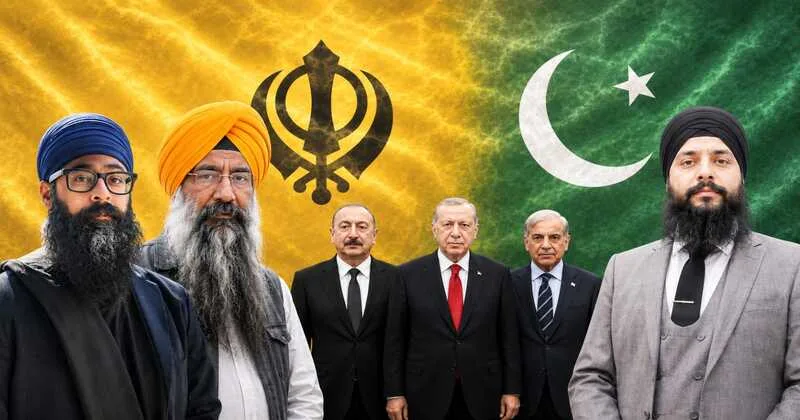
Taken together, these developments reveal an expanding Pakistan-Azerbaijan-Turkey alignment that increasingly intersects with Khalistani networks.
What began as a campaign directed against France through institutions such as the Baku Initiative Group has now broadened into a wider effort targeting India through conferences, publications, lobbying initiatives and narrative-building exercises.
The same infrastructure that was previously employed against French interests is now being deployed against India, reflecting the growing convergence of geopolitical, strategic and ideological interests among these actors.