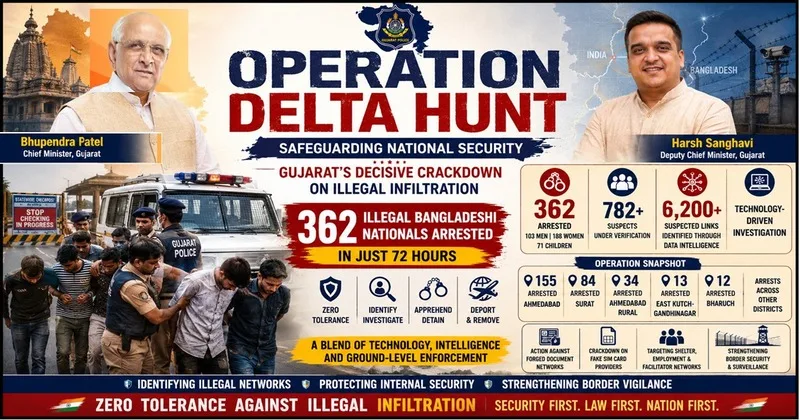
AHMEDABAD: The Gujarat State Police has executed one of its largest-ever operations against illegal infiltration and the networks associated with it. Under a special drive codenamed ‘Operation Delta Hunt,’ 362 illegal Bangladeshi nationals were arrested in just 72 hours. This group includes 103 men, 188 women and 71 children.
Additionally, more than 782 suspicious individuals have been identified and are currently being interrogated. The police assert that this operation is not limited merely to those residing illegally; rather, it also targets the entire networks responsible for providing them with identity cards, SIM cards, employment, and shelter.
An Issue of National Security
Terming this action a matter of national security, the Gujarat government has clarified that it has adopted a ‘zero-tolerance’ policy against foreign nationals residing illegally within the state. According to Deputy Chief Minister Harsh Sanghavi, no element that poses a threat to the state’s borders or internal security will be spared. He stated, “Illegal infiltrators are being identified and brought within the ambit of the law; furthermore, the process for their deportation has been initiated in accordance with established regulations.”
Strategy Devised in 72 Hours; Blockades Implemented First
Deputy Chief Minister Harsh Sanghavi explained, “Before launching the operation, extensive blockades were established across the state at bus stands, railway stations, major highways and border routes. The objective was to ensure that no suspicious individual could flee the state upon receiving word of the impending raids.”
The effectiveness of this police strategy was clearly evident. During the operation, 18 suspicious individuals attempting to flee were apprehended directly at these blockade points. According to officials, had the area not been cordoned off in advance, many of these suspects could have escaped.
Ahmedabad Emerges as the Primary Hub
According to data released by the police, the highest number,155- of illegal Bangladeshi nationals were apprehended in the city of Ahmedabad. Additionally, 84 individuals have been detained from Surat city, 34 from the Ahmedabad rural area, 13 from the East Kutch-Gandhinagar region and 12 from Bharuch. Arrests have also been made in other districts.
The Gujarat Police and investigative agencies believe that cities with significant industrial and commercial activity offer a higher likelihood of employment for illegal migrants. For this very reason, illegal infiltrators have long gravitated toward cities like Ahmedabad and Surat, where they attempt to blend into the crowds and remain undetected.
A Blend of Technology and Human Intelligence
The most distinctive feature of this operation is reported to be its technology-driven approach. According to Gujarat’s Director General of Police (DGP), Dr. K.L.N. Rao, the operation was not based solely on traditional policing methods; rather, it involved the extensive utilization of cyber analysis and data intelligence.
He explained that telecom data was analyzed based on technical inputs received from the ‘Cyber Center of Excellence’ combined with local intelligence. Investigative agencies compiled a database of Indian mobile numbers that were in regular contact with Bangladeshi numbers. Based on this analysis, a list of over 6,200 suspected individuals was generated, following which on-the-ground verification and enforcement actions were initiated.
Network of Forged Documents Also Under Scrutiny
During the course of the investigation, several startling facts have come to light. According to the police, some of the arrested individuals have admitted to having entered India from various parts of West Bengal anywhere between two to four years ago, or even earlier. Preliminary investigations indicate that, with the assistance of local intermediaries, documents from West Bengal were first procured; subsequently, these documents were used as a basis to obtain Aadhaar cards and other identity proofs.
Following these revelations, the focus of the investigative agencies is no longer limited solely to the illegal migrants themselves but has now expanded to include the agents and networks involved in facilitating the creation of forged documents, providing SIM cards, and aiding in the concealment of identities. The police have stated that strict legal action will be taken against such individuals as well. Questions Raised Over Border Security
Facts that emerged during the operation have once again brought the issues of border security and illegal infiltration to the center of public discourse. Deputy Chief Minister Harsh Sanghavi stated that security arrangements along the India-Bangladesh border are being continuously strengthened. He expressed optimism that the expansion of border fencing and surveillance mechanisms would lead to a reduction in incidents of illegal entry in the future.
The Campaign Will Continue
The Gujarat government has made it clear that ‘Operation Delta Hunt’ is not a one-off exercise. The campaign will continue across all districts and regions of the state. The police are actively engaged in identifying suspicious individuals, scrutinizing documents, and searching for other members of the network.
The state government has hailed the large-scale action, executed within a single night and over the span of just a few days, as a ‘historic success’ for the Gujarat Police. As the investigation progresses in the coming days, it will become evident just how extensive this network involving illegal infiltration, forged documents, and local accomplices truly is. For the time being, ‘Operation Delta Hunt’ has certainly sent a clear message: a large-scale campaign has been launched in Gujarat against foreign nationals residing illegally in the state and the networks facilitating them.