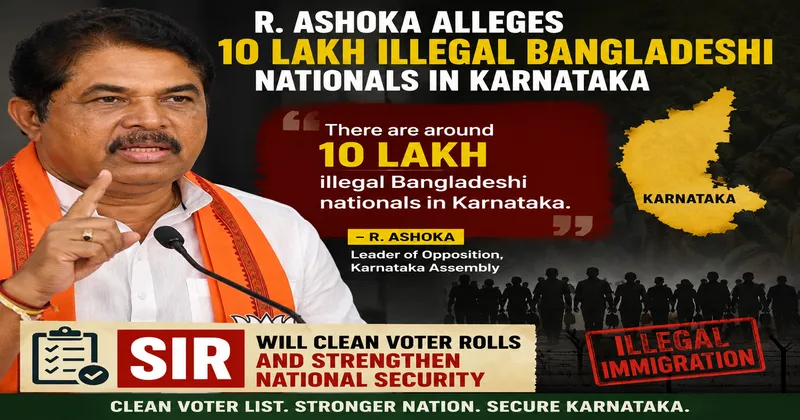
Bengaluru: Leader of Opposition in the Karnataka Legislative Assembly R Ashoka on May 16 made serious allegations claiming that around 10 lakh illegal Bangladeshi nationals are residing in Karnataka and asserted that the Special Intensive Revision (SIR) of electoral rolls is a crucial step to identify fake voters, remove illegal entries and strengthen national security.
Speaking to reporters in Bengaluru, Ashoka strongly defended the Special Intensive Revision (SIR) exercise, which is scheduled to begin in Karnataka from June 20 and will cover more than 5.55 crore voters across the state. He said the initiative is aimed at cleaning up electoral rolls by removing duplicate entries, deceased voters, and ineligible names that have been misused over time.
He said the exercise is not merely an administrative reform but a necessary measure to protect the integrity of democracy. According to him, a clean voter list is essential for ensuring free and fair elections and preventing misuse of the electoral system.
However, the Opposition leader made sharp political and security-related allegations, claiming that illegal immigration from Bangladesh has become a serious issue in Karnataka. “There are around 10 lakh illegal Bangladeshi nationals in Karnataka,” he alleged, adding that the issue cannot be ignored any longer.
He further said that if anyone disputes his claim, he is ready to personally identify and show locations in Bengaluru where such individuals are allegedly residing. He argued that the presence of undocumented migrants is not limited to the capital city but extends to other parts of the state as well.
Ashoka claimed that illegal Bangladeshi nationals are working in large numbers in coffee plantation belts of Chikkamagaluru and Kodagu districts, where they are reportedly employed at low wages in informal labour sectors. He also alleged that several such individuals are residing in temporary tent settlements in parts of Mahadevapura constituency in Bengaluru.
Expanding his remarks, Ashoka stated that India as a whole is dealing with a large-scale illegal immigration issue. He alleged that over 2 crore Bangladeshi nationals are staying illegally in the country, with higher concentrations in West Bengal, Assam, and Bihar, apart from Karnataka.
Citing recent enforcement actions, he said Bengaluru Police have identified around 250 illegal Bangladeshi nationals and handed them over to security agencies for deportation procedures. He claimed that these individuals were transported to the border by flight at a cost of nearly Rs 65 lakh, and added that the action was carried out recently as part of enforcement measures.
Responding to statements made by Congress leaders, including Minister Zameer Ahmed Khan, who denied the presence of illegal Bangladeshi nationals in the state, Ashoka said the government is “denying ground realities for political reasons.” He insisted that the situation on the ground is different from official claims.
He also warned that illegal immigration could pose potential risks to internal security and law and order, including the possibility of involvement in criminal or anti-national activities. According to him, the SIR process would help identify such vulnerabilities and prevent misuse of identity documents and voter registration systems.
At the same time, Ashoka clarified that the SIR exercise is not directed against any religion, caste or community. He said all eligible Indian citizens, irrespective of background, will continue to retain their voting rights without any discrimination.
He added that if any errors occur during the voter list revision process, there is a proper legal mechanism for appeals and corrections, ensuring transparency and fairness in implementation.
Emphasising the need for political cooperation, Ashoka said booth-level agents from all major parties, including Congress, BJP and JD(S), will participate in the process to ensure accountability at every stage.
He concluded that the SIR initiative is essential for removing fake, duplicate and deceased entries from electoral rolls, and said it will ultimately strengthen democratic institutions and safeguard national security by ensuring only legitimate citizens are included in the voter list.