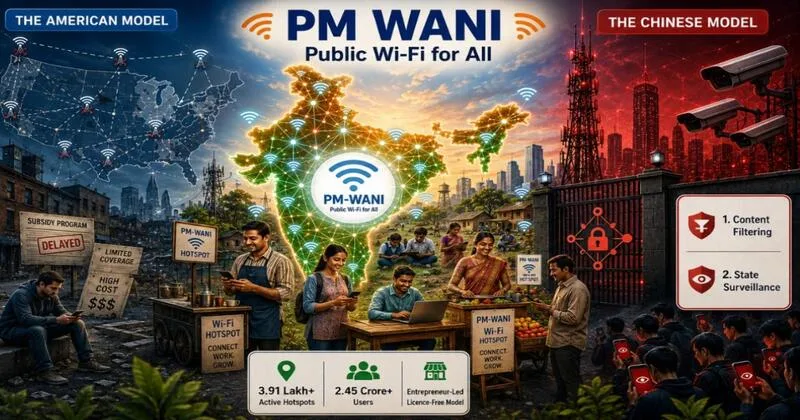
Department of Telecommunications issued a fresh circular on 22 May 2026 to streamline India’s public Wi-Fi network. The Prime Minister Wi-Fi Access Network Interface (PM-WANI) has grown to 3,91,599 active hotspots as of 26 November 2025, with nearly 2.45 crore users having consumed roughly 58.64 petabytes of data since launch, according to figures the government placed before the Rajya Sabha. More striking than the numbers is the design philosophy behind them. PM-WANI lets any tea-stall owner, grocer or small entrepreneur become an internet provider without a licence, a fee or a registration process. A decentralised, interoperable public-infrastructure approach that stands apart from both the United States subsidy-heavy market model and China’s tightly state-controlled identity-gated system.
This is the framing that matters for anyone assessing India’s digital governance. The story of PM-WANI is the story of a distinctly Indian template for delivering a public good, the same template that produced UPI and Aadhaar, where the state lays down a thin, open protocol layer and then steps back to let millions of private actors build on top of it.
The architecture of openness
PM-WANI was approved by the Union Cabinet on 9 December 2020. Its structure rests on four interlocking roles. The Public Data Office (PDO) is the local entity, often a shop, kiosk or small business that physically operates the Wi-Fi access point and delivers broadband to users. The Public Data Office Aggregator (PDOA) handles authorisation, accounting and the aggregation of multiple PDOs. App Providers build the applications through which users discover and connect to nearby compliant hotspots. And a Central Registry, maintained by the Centre for Development of Telematics (C-DoT), an autonomous telecom R&D body under the DoT, established in 1984, keeps records of all participants.
When the scheme was announced, the then Union Minister Ravi Shankar Prasad made clear that PDOs would not need a licence, would not have to pay any entry fee, and would not have to undergo a registration process, while aggregators would be registered within a week of applying. In an era when telecom has long been synonymous with heavy licensing and capital barriers, allowing a kirana store to resell unused bandwidth was a structural departure. A household or business with a spare broadband connection can now register as a hotspot and earn from passing users, turning idle infrastructure into income.
The reforms that unlocked growth
The National Digital Communications Policy of 2018 had set targets of 50 lakh public Wi-Fi hotspots by 2020 and one crore by 2022, while the Bharat 6G Vision later reaffirmed a goal of five crore hotspots by 2030. Against those benchmarks, early deployment was modest, around 2.07 lakh hotspots by mid-2024. The DoT itself acknowledged that proliferation had been significantly below target, identifying the high cost of backhaul connectivity charged by telecom and internet service providers as a central culprit.
A sequence of corrective reforms changed the trajectory. On 16 September 2024, the DoT introduced changes that let PDOs operate using a regular FTTH connection, cutting infrastructure costs and permitting existing residential and commercial Wi-Fi setups to be folded into the wider framework. It allows roaming across different aggregators, so a user registered with one app could connect seamlessly to hotspots managed by another.
The Telecom Regulatory Authority of India, through a tariff order dated 16 June 2025, capped what internet service providers could charge PM-WANI operators. For retail FTTH plans up to 200 Mbps, providers cannot bill a Public Data Office more than twice the corresponding consumer broadband tariff. This addressed precisely the commercial barrier the DoT had flagged; without the cap, ISPs could charge hotspot operators far more than ordinary home users for equivalent bandwidth, throttling the economics of participation. The result was visible from roughly 2.07 lakh hotspots in mid-2024 to nearly 3.92 lakh by late 2025, with Delhi, Maharashtra, Karnataka and Uttar Pradesh emerging as the leading states for deployment.
The May 2026 circulars standardise PM-WANI hotspot names (SSIDs), so users can recognise authentic, secure networks, and introduce QR-based login. This lets a laptop connect simply by scanning a code on a phone and advises operators to offer short-duration plans of 15, 30 and 60 minutes for users needing brief access. All stakeholders have been directed to implement the revised guidelines within eight weeks, making the upgraded features operational nationwide by July 2026. The reforms are being driven under Union Communications Minister Jyotiraditya Scindia and Minister of State Chandra Sekhar Pemmasani.
How China does it and why it differs
China is often cited as a connectivity success country, and it does have extensive public Wi-Fi. Since around 2011, cities including Beijing, Shanghai, Shenzhen, Hangzhou and Guangzhou have promoted free public Wi-Fi, concentrated in tourist attractions, government buildings, commercial districts, parks, hospitals and transport hubs. But the comparison ends at coverage. The Chinese model is fundamentally state-led; it is driven by well-funded state-owned institutions, and the three state telecom giants, such as China Telecom, China Unicom and China Mobile, are decentralised private micro-providers.
Just as importantly, access in China is gated by identity. Under the Chinese Cybersecurity Law, internet access requires real-name identification, which in practice means logging on to public Wi-Fi typically requires registration with a Chinese cellphone number and SMS verification. The entire system sits behind the Great Firewall, with its censorship and surveillance regime restricting access to a wide range of foreign websites and applications. China, in short, offers public connectivity as an instrument of state oversight with wide reach, but built on control and tracking rather than open, entrepreneur-led provision. PM-WANI inverts this; it distributes provision to private citizens and keeps the architecture open.
How America does it and why it falls short
The United States presents the opposite problem. It has no national public Wi-Fi protocol comparable to WANI at all. American connectivity policy is a sprawling patchwork of subsidy programmes. The Government Accountability Office identified over 100 federal broadband programmes administered by 15 agencies, describing the result as a fragmented, overlapping patchwork of funding and recommended a national broadband strategy that still does not meaningfully exist.
The flagship effort is the $42 billion Broadband Equity, Access and Deployment programme, created under the 2021 infrastructure law. But BEAD funds network deployment is not a shared public-access layer; there is no licence-free PDO equivalent allowing a corner store to become a connectivity node. The programme has also undergone turbulent changes under the Trump administration, which disqualified hundreds of thousands of locations and shifted a large share of funds toward satellite providers such as Starlink, while the affordability arm, the Affordable Connectivity Program, lapsed. US broadband is deployed primarily by the private sector on a purely commercial basis. Connectivity is treated as a market to be subsidised, not as digital public infrastructure to be governed.
The Indian Side
Side-by-side comparison of the three models reveals India’s supremacy. China achieves reach through a state-owned, real-name-surveilled grid. America pours tens of billions into a fragmented, privately-deployed market without a unifying public layer. PM-WANI is a thin government protocol that defines interoperability and a central registry. Beneath which decentralised private actors, down to the smallest shopkeeper, compete and build, licence-free and at capped and affordable cost.
This is the same logic of “digital public infrastructure” that has made India a reference point in global technology-policy circles through UPI and Aadhaar. The state does not own the network or run the hotspots; it sets the rules of interoperability and gets out of the way. The benefits flow in two directions: affordable and secure connectivity for the millions of micro-entrepreneurs who host the hotspots.
The government has a five-crore target set for 2030. Awareness among potential PDOs and users is uneven; rural areas face power-supply and backhaul constraints, and the security of open networks demands continued vigilance. But the direction of travel is clear, and the reforms of 2024, 2025 and 2026 have repeatedly addressed the bottlenecks as they emerged.
The wider significance is strategic. As nations debate how to close the digital divide, India is demonstrating a model that is neither authoritarian nor laissez-faire; it treats internet access as a public good delivered through open, competitive, and decentralised means. In a world choosing between Beijing’s control and Washington’s fragmentation, PM-WANI offers a third option that the developed world has yet to match.