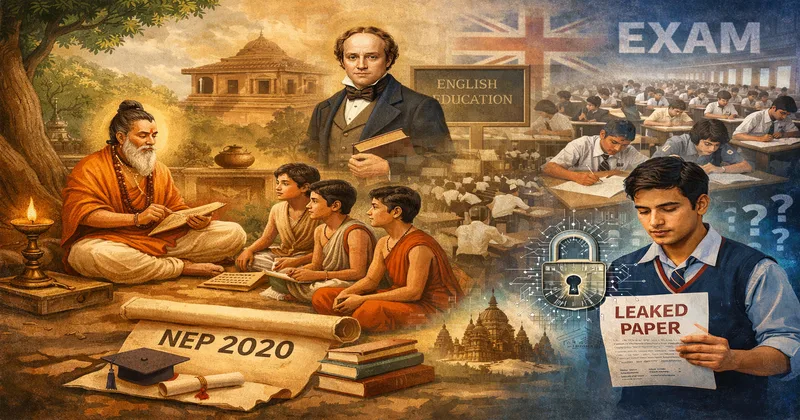
From recruitment examinations to entrance tests, paper leaks have emerged as one of the biggest challenges facing India’s education system today. Every major examination controversy raises the same question: how can a system designed to reward merit repeatedly become vulnerable to organized cheating networks, coaching mafias, and corruption? While authorities continue to strengthen security measures and introduce technological safeguards, a parallel debate is gaining attention among educators, historians and policy thinkers. The discussion is not merely about better surveillance or stronger encryption but about whether the deeper crisis lies in the gradual erosion of ethics and character-based learning that once formed the foundation of education in India.
An Ancient System Built on Character Before Knowledge
In ancient India, education was not viewed solely as a pathway to employment. Knowledge was considered a responsibility, and students were expected to demonstrate moral discipline before they were entrusted with advanced learning. Traditional texts such as the Dharmasutras and educational traditions associated with the Guru-Shishya system placed significant emphasis on personal conduct. The educational journey often began with the Upanayana ceremony, which symbolized the formal acceptance of a student into a life of learning, discipline, and responsibility.
Students were expected to adhere to principles such as Satya (truthfulness) and Asteya (non-stealing). These values extended beyond material possessions and included intellectual honesty, respect for knowledge, and integrity in learning. According to traditional education practices, teachers had the authority to decide whether a student was ready for higher learning. Along with knowledge, qualities such as good character, discipline, honesty, and dedication were also considered important. In those times, knowledge was earned through learning and effort, not through unfair means.
The Forgotten Importance of Ethical Screening
Today, students are mainly judged through written examinations, with little focus on their character or values. In ancient education systems, teachers closely guided students and assessed them over time based on their knowledge, behaviour, discipline, and conduct. Supporters of this system believe that continuous evaluation reduced the chances of cheating because learning was judged through regular interaction rather than a single high-pressure exam. The belief was that knowledge should be accompanied by good character, as wisdom without ethics could be harmful.
Why do modern paper-leak cartels flourish? Because anyone with money can buy their way into an exam hall, regardless of character/ethical stability.
The ancient system had a rigorous pre-qualification protocol based on Ethical Auditing before a student was even allowed near…
— Parimal (@Fintech03) May 31, 2026
How Knowledge Survived Without Modern Technology
One of the biggest strengths of ancient Indian education was its ability to preserve knowledge for centuries, even during invasions and political changes. Scholars often highlight the strong oral tradition used to pass down Vedic knowledge, where information was carefully memorized and recited to reduce mistakes. Among the most notable techniques were:
- Jata Patha
- Shikha Patha
- Ghana Patha
Students were trained to recite verses in different patterns, which helped them to identify mistakes and prevent changes to the original text. These methods preserved knowledge accurately for generations. Experts believe this was a highly advanced system for storing and checking information long before the digital age.
The Colonial Shift and the Rise of Mass Examinations
The transformation of India’s educational landscape accelerated during British colonial rule. A major turning point came in 1835 with the introduction of policies associated with Thomas Babington Macaulay and his famous Minute on Education. Macaulay advocated the expansion of English-language education and the creation of a class of Indians who could assist in the administration of the colonial state.
The colonial model gradually shifted education away from individualized learning and character formation toward standardized instruction and examinations. The Guru-Shishya relationship gave way to classroom-based mass education. Oral assessments and continuous observation were increasingly replaced by written examinations conducted at scale. This led to new vulnerabilities. When success becomes dependent on a single written examination, the examination itself becomes a high-value target.
In traditional education systems, students were assessed over a long period through regular interaction with their teachers. Today, a student’s performance is often judged through a single examination conducted over a few hours. This means that if a question paper is leaked before the exam, the fairness of the entire process can be affected. Since competitive exams and recruitment tests decide the future of lakhs of candidates, the high stakes create opportunities for people seeking unfair advantages.
Many education experts believe that the paper leak problem is linked to increasing competition in education. Today, academic success is often seen as the key to a good job, higher income, and a better life. In such an environment, some people may focus more on results than on the way they achieve them.