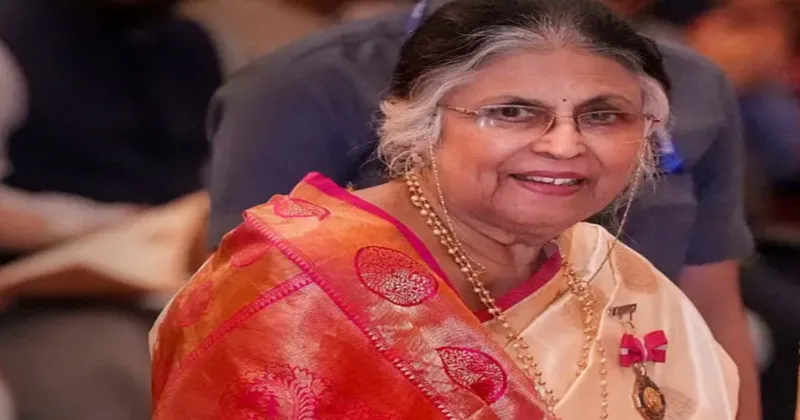
MUMBAI: The passing of veteran and revered singer Suman Kalyanpur at the age of 89 marks the quiet end of one of Indian music’s most graceful chapters. The veteran singer breathed her last on the evening of May 31, 2026, at her Mumbai residence, surrounded by the familiar comfort of a life steeped in melody.
Deeply saddened by the passing of Suman Kalyanpur, a legendary voice who defined an era. Her melodious voice always touched my heart & soul.
My heartfelt condolences to the family, and the entire music fraternity. I pray for her departed soul. Om Shanti 🙏 #RIP #SumanKalyanpur pic.twitter.com/eaAA8ZD2Ax— Kiren Rijiju (@KirenRijiju) May 31, 2026
"न तुम हमें जानो..न हम तुम्हें जाने..मगर लगता.."
"न न करते प्यार तुम्हीं से कर बैठे.."
हिंदी फिल्मों को ऐसे सैकड़ों यादगार गाने देने वालीं सुमन कल्याणपुर जी का निधन हो गया। "पद्म भूषण" से सम्मानित सुमन जी की आयु 89 वर्ष थी। भावपूर्ण श्रद्धांजलि। pic.twitter.com/mqzb1Znzwv— Ashok Shrivastav (@AshokShrivasta6) May 31, 2026
In her final days, she is said to have listened to her own songs, as though retracing a journey that had spanned more than six decades and touched millions of hearts.
Prime Minister Narendra Modi posted, “Anguished by the passing of the popular singer Suman Kalyanpur Ji. Her melodious voice and soulful renditions enriched our cultural world. Through her songs, she created a special place among music lovers and admirers of Indian cinema. Condolences to her family and admirers. Om Shanti.”
Anguished by the passing of the popular singer Suman Kalyanpur Ji. Her melodious voice and soulful renditions enriched our cultural world. Through her songs, she created a special place among music lovers and admirers of Indian cinema. Condolences to her family and admirers. Om… pic.twitter.com/xCGswIq0s6
— Narendra Modi (@narendramodi) June 1, 2026
Her death has drawn tributes from across the country, from political leaders to fellow artistes, each remembering not just a singer, but a voice that carried an uncommon purity and emotional depth. With her passing, an era of understated brilliance in Indian playback singing recedes further into memory.
https://twitter.com/i/status/2061146270279041387
A voice that carved its own identity
Suman Kalyanpur was born on January 28, 1937, as Suman Hemmady in Dhaka in undivided India. Her father Shankar Rao Hemmadi hailed from a Saraswat Brahmin family belonging to Hemmadi, a village in Kundapur Taluk of Udupi District, Karnataka. He served on a top post in the Central Bank of India and was posted to Dhaka for a very long period. That is how Kalyanpur was born in undivided pre-Independence India’s Dacca, now in Bangladesh.
सुमन कल्याणपुर जी नहीं रहीं। दूसरी सुमन कल्याणपुर होना मुश्किल है।
"मेरे महबूब न जा, आज की रात न जा"… ब्लैक एंड व्हाइट टीवी पर नूरमहल फिल्म के इस गीत को सुन जिस आवाज़ का जादू मेरे बचपन में मुझपर छा गया था, यह किसकी आवाज थी! यह आवाज़ लता जी की नहीं किसी और की है, यही बात सुमन… pic.twitter.com/Ulytb7ZZPm— मालिनी अवस्थी Malini Awasthi (@maliniawasthi) June 1, 2026
Kalyanpur’s journey into music was both organic and extraordinary. She grew up in a culturally rich environment and eventually made Mumbai her home, where her destiny in playback singing began to unfold.
In an industry dominated by towering voices, particularly that of Lata Mangeshkar, Suman Kalyanpur often found herself compared for her tonal similarity.
At the age of 84, hear Suman Kalyanpur render an amazing song ‘Yaad kiya dilne kaha ho tum.’ pic.twitter.com/ecU3d7UxcL
— Harsh Goenka (@hvgoenka) January 8, 2022
She recorded songs for movies in several languages besides Hindi, Bengali, Marathi, Assamese, Gujarati, Kannada, Angika, Bhojpuri, Rajasthani, Odia and Punjabi. Her voice has often been mistaken to be that of Lata Mangeshkar due to their similar tone and texture.
Many of her fans feel that Kalyanpur, unfortunately never got her due place or opportunities and adulation despite singing in 11 languages, and allege that the established nightingale of Indian cinema playback Lata Mangeshkar perceived her to be threat.
Yet, what could have been a limitation became the foundation of her quiet resilience. Through perseverance and a steadfast commitment to her craft, she built an identity that was entirely her own, marked by clarity, restraint and emotional nuance.
Her voice did not demand attention. It drew listeners in gently, allowing the poetry and melody to breathe. That quality would go on to define some of the most memorable songs of her era.
A career shaped by serendipity and skill
Kalyanpur’s entry into the film industry carries the charm of a cinematic anecdote. It was the legendary ghazal singer Talat Mahmood who first recognised her potential after hearing her perform at a public event. Impressed by her voice, he offered her an opportunity to sing in films, setting the stage for a remarkable career.
The last of our iconic singers from that golden era of music breathed her last yesterday 31st of May. She hailed from a Saraswat Brahmin family belonging to Hemmadi, a village in Kundapur Taluk of Udupi District, Karnataka. She started her career singing for Marathi movies. She… pic.twitter.com/nlsvjNgUip
— Shekar Iyer (@SHEKARSUSHEEL) June 1, 2026
Her early songs quickly resonated with audiences. Tracks like “Na Na Karte Pyar Tumhi Se” and “Tumne Pukara Aur Hum Chale Aaye” became enduring favourites, while “Aajkal Tere Mere Pyar Ke Charche” secured her a lasting place in the golden era of Hindi cinema.
Even within the competitive ecosystem of playback singing, Kalyanpur’s consistency stood out. She worked with some of the finest composers of her time and adapted seamlessly across genres, from romantic duets to devotional compositions.
A rich legacy across languages
While Hindi cinema gave her national recognition, Suman Kalyanpur’s contribution to regional music, especially Marathi, remains deeply cherished. Her Marathi songs carried an intimacy that resonated strongly with listeners.
Classics such as “Ketakichya Bani Tithe,” “Sang Kadhi Kalnar Tula,” and “Nimbonyachya Jhadamaghe” continue to be sung across generations. Her voice lent itself beautifully to bhavgeet, devotional music, and traditional compositions, preserving the emotional essence of each form.
She also recorded songs in Bengali, Odia and other languages, demonstrating a versatility that few could match. Her diction, always precise, ensured that language never became a barrier between the song and the listener.
The artistry behind the voice
What set Suman Kalyanpur apart was not merely her technical skill, but her sensitivity to the emotional core of a composition. Rooted in classical training, she approached each song with discipline, yet never allowed technique to overshadow feeling.
Her singing was marked by restraint rather than flourish. She understood silence as much as sound, allowing pauses and subtle inflections to enhance the lyrical experience. This quality made her songs timeless, capable of evoking nostalgia even decades after their release.
Listeners often describe her voice as soothing, almost meditative. It is this understated quality that ensured her songs remained relevant even as musical trends evolved.
Tributes pour in
The news of her passing prompted an outpouring of grief and remembrance. Maharashtra Chief Minister Devendra Fadnavis described her as a divine voice that enriched India’s musical heritage. Veteran leader Sharad Pawar called her demise the end of a golden chapter in Indian music, while Maharashtra Deputy Chief Minister Eknath Shinde noted that her songs had touched hearts across linguistic boundaries.
Union Minister Nitin Gadkari termed her passing an irreparable loss, echoing a sentiment shared widely across the country. Many recalled not just her music, but her humility and grace as a person.
On social media, admirers revisited her songs, sharing lines that had once defined moments of love, longing and reflection in their own lives. For many, her music is intertwined with memory itself.
A life beyond the spotlight
Despite her immense success, Suman Kalyanpur remained a deeply private individual. She stayed away from excessive publicity, letting her work speak for itself. In an industry often driven by visibility, her quiet dignity set her apart.
Her biography, “Suman Sugandh” by Mangala Khadilkar, offers glimpses into a life devoted to music without the trappings of stardom. Even in her later years, she remained connected to her art, listening to her recordings and reflecting on a journey that had shaped Indian music in subtle but lasting ways.
The end of an era
Suman Kalyanpur’s passing is more than the loss of a celebrated singer. It is the fading of a musical sensibility rooted in simplicity, discipline and emotional honesty. She belonged to a generation that valued the song above the singer, where the voice served the composition rather than overshadowing it.
As her mortal remains are consigned to flames at Mumbai’s Santacruz crematorium, her music continues its journey, unbound by time. Her songs remain etched in the collective memory of a nation, played in quiet homes, on long drives, and in moments of solitude.
In an age of fleeting trends, Suman Kalyanpur’s legacy endures as a reminder of music’s enduring power to comfort, to heal and to connect.
Her voice may have fallen silent, but its echo will linger for generations to come.