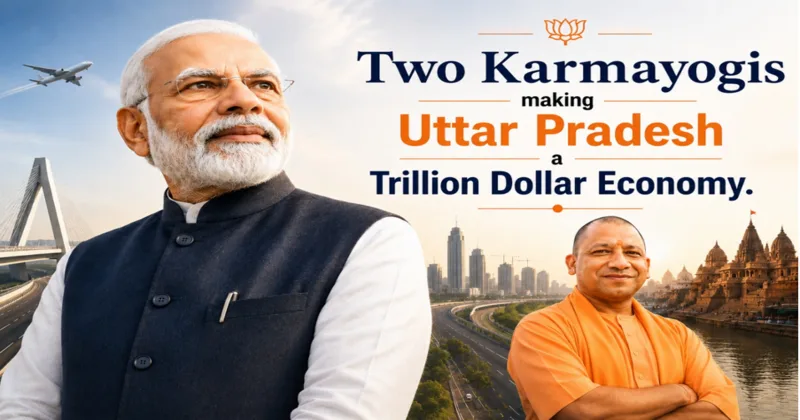
There are rare moments in history when the right leadership and the right policy converges. Uttar Pradesh stands at a historic crossroads today. In New Delhi, Prime Minister Narendra Modi works tirelessly with an unwavering resolve to make India the world’s third-largest economy. In Lucknow, Chief Minister Yogi Adityanath sits in pre-dawn review meetings, personally holds officers accountable and drives Uttar Pradesh toward a one-trillion-dollar economy with the discipline of a monk and the precision of an administrator.
This is not a political alliance it is a shared yajna, a sacred endeavour undertaken by two Karmayogis. Where the Centre engine provides policy, finance and infrastructure, the State engine ensures last-mile delivery and uncompromising accountability. When both engines run on the same track, the result is not just progress it is transformation.
Karmayoga: Governance as sacred duty
The Bhagavad Gita says ‘Karmanye vadhikaraste ma phaleshu kadachana’ you have the right to perform your duties, but not to the fruits thereof. This is not a philosophical verse, it is a governing philosophy. And it is precisely this philosophy that both Narendra Modi and Yogi Adityanath have internalised and expressed through their public lives.
Prime Minister Modi Karmayoga is well-documented in the sweep of his political journey from rebuilding earthquake-ravaged Gujarat in 2001 to steering India through a global pandemic, from leading the nation’s fastest infrastructure expansion to presiding over a third consecutive mandate. He wakes before dawn, reviews ministries with minute details, has visited over a hundred nations because he understands that a Karmayogi work is never done until the mission is complete.
“When the Centre’s vision and the State’s will walk together, no goal remains out of reach” — Yogi Adityanath
Yogi Adityanath’s Karmayoga is equally extraordinary. A saint who became a Chief Minister and proved that spiritual discipline and administrative efficiency are not opposites but complements. Every morning, he reviews the energy department, Power Corporation and Discoms. Every week, he tracks power supply timelines for farmers, traders, industries and ordinary citizens. For Yogi governance is not a job it is seva, selfless service.
There is a set of data that tells the story of Uttar Pradesh better than any political slogan can. In 2017, when Yogi Adityanath assumed the chief ministership of India’s most populous state, its Gross State Domestic Product stood at approximately ₹13 lakh crore, a figure that a state had taken seventy years after Independence to reach. That GSDP has now climbed to ₹36 lakh crore in nine years, with a target of ₹40 lakh crore in 2026–27. The distance between those two numbers is not statistical. It is the distance between a state that investors fled and one they are competing to enter a BIMARU cautionary tale and what Prime Minister Narendra Modi has called “Express Pradesh”.
Addressing the Confederation of Indian Industry’s Annual Business Summit 2026, Chief Minister Yogi Adityanath declared that Uttar Pradesh had received investment proposals worth ₹50 lakh crore since 2017 and was on course to become a $1 trillion economy by 2029–30. CII President Rajiv Memani, placing the achievement in independent context, noted that UP accounts for 9% of India’s GDP, is the country second-largest state economy, posted a revenue surplus of ₹37,000 crore in FY25 and is projected to post ₹80,000 crore in FY26.
The architecture of this transformation rests on three interlocking pillars a historic infrastructure push driven by the shared resolve of Modi and Yogi, a manufacturing diversification supported by corridors and investment summits, and the conversion of Uttar Pradesh ancient spiritual geography into a hard economic engine.
Building the Backbone: Roads, runways and corridors
When PM Modi dubbed UP “Express Pradesh”, the label was empirically earned. The state had one expressway in 2017, now it has more expressway kilometres than any other Indian state. Four major expressways were completed or substantially advanced: the Purvanchal Expressway (341 km), the Bundelkhand Expressway (296 km), the Gorakhpur Link Expressway and the Ganga Expressway (594 km) the longest in India. The total outlay across expressway projects commissioned or under construction since 2017 stands at ₹80,000 crore. These corridors carries an industrial spine alongside it. The state allocated ₹7,000 crore for the development of industrial corridors along five expressways with more than 30 sites identified across 5,800 hectares.
The transformation of UP aviation map has been equally important. From three functional airports in 2017, UP moved to nine by 2024, with the greenfield Noida International Airport at Jewar designed to be among Asia’s largest under active construction. That project Phase 1 of the Noida International Airport at Jewar was inaugurated on 28 March 2026 Prime Minister Modi, also laying the foundation stone of 40 acres of Maintenance, Repair and Overhaul (MRO) facilities. Developed at a total investment of ₹11,200 crore, the airport is designed as a net-zero emissions facility and will serve as a major international gateway for the NCR region. In its first phase, with one runway and one terminal, it will handle around 12 million passengers annually. Upon completion of all four phases, capacity will reach 70 million passengers per year. Statewide, airports have now multiplied from two to sixteen under the Yogi government.
The Defence Manufacturing Corridor, announced by PM Modi at the 2018 Investors Summit and built steadily, it now ranks among the most significant industrial achievements. Spread across six regions Lucknow, Kanpur, Jhansi, Agra, Aligarh and Chitrakoot the corridor is producing arms, ammunition and equipment related to fighter aircraft, with major companies having established manufacturing units across the state. By December 2025, the corridor had attracted investments worth ₹35,000 crore, expected to generate around 52,000 jobs. Units including a BrahMos missile production facility, BEL radar system and air defence manufacturing plant at Chitrakoot. UP today accounts for 60 % of the country electronic component manufacturing and 55 %of mobile manufacturing, while MSMEs have created employment for 3 crore youth.
The 2026–27 state budget of ₹9.12 lakh crore is the largest in UP history, with capital expenditure prioritised at around 19.5 % of total spending. UP contribution to national tax revenue was 9.9 %in 2022–23, rising to 10.5 % in 2023–24 and projected at 11.6 %in 2024–25, a fiscal trajectory that tracks exactly the state’s rising economic weight. The debt-to-GSDP ratio has fallen from around 30 %to approximately 26 per cent.
Religious tourism rewrites the economic map
If infrastructure is the backbone of UP transformation, religious tourism is increasingly its circulation carrying economic life into every corner of the state. The Yogi government systematic redevelopment of the state pilgrimage circuit has produced results that have stunned even optimistic observers.
Uttar Pradesh recorded 64.90 crore tourists in 2024 an increase of over 17 crore compared to 2023. In 2025, within just six months (January to June), total tourist arrivals exceeded 1.21 billion, with foreign tourists crossing 3.3 million. The state’s share of national tourism has grown from 13.1 %in 2016 to over 19–20 per cent in 2024.
Ayodhya has been the epicentre of this surge. From 2.84 lakh tourists in 2017, to 20 crore visitors in early 2025, an 85-fold increase. Between January and September 2024, the Shri Ram Temple registered 13.55 crore domestic visitors surpasses even the Taj Mahal in Agra, which recorded 12.51 crore visitors in the same period. Varanasi has an equally compelling statistic. Domestic footfall rose from 30.7 lakh in 2021 to over 10.97 crore in 2024, while the first half of 2025 alone recorded 12.96 crore visitors surpassing the total for all of 2024. Foreign tourist arrivals in UP jumped from 16 lakh in 2023 to over 22 lakh in 2024, with Varanasi contributing a major share.
UP Tourism Minister Jaiveer Singh has described Ayodhya, Mathura, Prayagraj and Kashi as forming “a religious tourism triangle attracting visitors throughout the year” a circuit made accessible by the very expressways and airports described above. The Kashi Vishwanath Corridor, inaugurated in December 2021, connected the ancient Vishwanath temple directly to the ghats of the Ganga. Ayodhya’s new international airport named after Lord Ram has turned what was once a difficult pilgrimage into a smooth one-day journey from any Indian city. The infrastructure of devotion and the infrastructure of development have been built together.
Mahakumbh 2025: The largest economic event in human history
The Mahakumbh of 2025, held at Prayagraj from 13 January to 26 February, was the moment when UP spiritual and economic ambitions fused into something the world had never witnessed at this scale.
With 660 million attendees from 76 countries, the gathering generated ₹3 lakh crore in transactions approximately $36 billion. The investment in infrastructure to support it was substantial and deliberate. The UP government allocated ₹7,500 crore with the central government contributing an additional ₹2,100 crore a combined public investment of nearly ₹10,000 crore.
The Confederation of All India Traders (CAIT) provided a granular sector-by-sector breakdown of economic activity generated at and around the mela. Accommodation and hospitality contributed ₹40,000 crore, food and beverages added ₹20,000 crore, religious items and offerings contributed another ₹20,000 crore, transportation and logistics accounted for ₹10,000 crore and media and advertising generated ₹10,000 crore. Direct and indirect revenue generation from the hospitality, transport and retail sectors exceeded ₹25,000 crore, while financial transactions at the mela site alone ranged between ₹2 lakh crore and ₹3 lakh crore.
Top brands including ITC, Coca-Cola, Adani Group, Hindustan Unilever, Dabur, Bisleri, Reliance Consumer Products and Bank of Baroda bought branding rights worth ₹3,600 crore. Corporate India, in other words treated Mahakumbh 2025 not as a religious event to be cautiously observed but as the largest consumer congregation on earth which is precisely what it was.
The infrastructure investments for Mahakumbh were not temporary expenditures. One of the most significant takeaways from the Mahakumbh has been the lasting impact of infrastructure investments development visible across the length and breadth of Uttar Pradesh. Roads built for pilgrims now serve industries, the Prayagraj ring road, the beautified riverfront ghats, the upgraded rail connections all remain. In 2025, Prayagraj alone recorded 66.96 crore pilgrims, accounting for nearly one-third of all tourists across the entire state.
The transformation in broader perspective
The transformation of Uttar Pradesh is most accurately understood as a demonstration of what happens when national vision and state governance move in the same direction simultaneously. PM Modi set the architecture the Defence Corridors, the PM Gati Shakti framework, the expressway financing, the airport policy and Chief Minister Yogi Adityanath built within it restoring law and order as the foundational pre-condition for investment, redeveloping the pilgrimage circuit as a generator of broad-based economic activity and executing summits that converted proposals into ground-level factories.
GSDP has risen from ₹12.88 lakh crore to ₹35–36 lakh crore, per capita income has tripled from ₹43,000 to around ₹1,20,000 and investments have created 60 lakh jobs. The economy of UP is now the second largest among states in India and the state is revenue-surplus for the first time in its modern history.
The trillion-dollar target $1 trillion in GSDP remains the stated destination, now projected for 2029–30. The state is already producing more expressway kilometres than any other, airports multiplied eightfold, a defence corridor producing BrahMos missiles and AK-203 rifles, a religious tourism circuit drawing over a billion visitors in a single half-year and a Mahakumbh that injected ₹3 lakh crore into the national bloodstream in 45 days.
Prime Minister Modi gave India the governing philosophy of ‘Sabka Saath, Sabka Vikas, Sabka Vishwas, Sabka Prayas’. Yogi Adityanath carried this philosophy to the most challenging implementation environment in India.
History has shown us time and again, that when India finds the right leadership at the right moment, the seemingly impossible becomes inevitable. Uttar Pradesh is living through one such moment. Two engines are on the same track, speed is building and the destination is a prosperous, self-reliant and energised Uttar Pradesh.