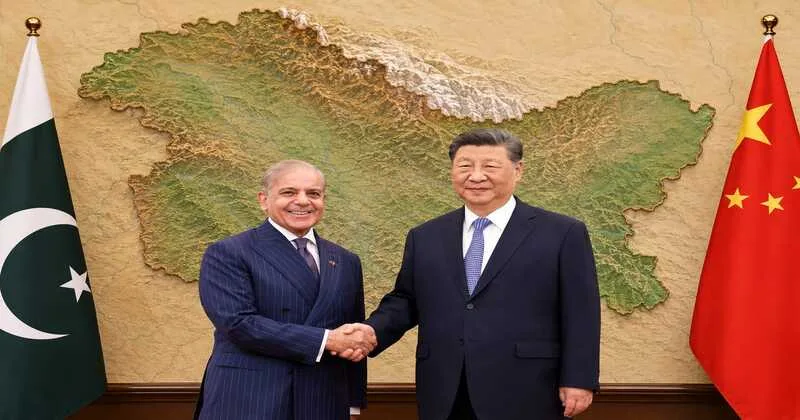
China’s repeated references to J&K in joint statements with Pakistan are no longer isolated diplomatic remarks. They have become part of a visible geopolitical pattern. Every time India expands its strategic influence globally, strengthens its partnerships in the Indo-Pacific, deepens its role in global manufacturing chains, or consolidates its domestic position in Jammu and Kashmir, Beijing returns to the Kashmir narrative alongside Islamabad.
The latest example came after talks between Pakistani Prime Minister Shehbaz Sharif and Chinese President Xi Jinping in Beijing on May 26. In the joint statement issued by Pakistan’s Ministry of Foreign Affairs, China once again described Jammu and Kashmir as an issue “left over from history” and said it should be resolved in accordance with the UN Charter, relevant UN Security Council resolutions, and bilateral agreements. The language was almost identical to the China-Pakistan joint statement issued in 2024. India reacted sharply then, and it reacted sharply again this week. India’s Ministry of External Affairs spokesperson Randhir Jaiswal stated unequivocally that “the Union Territories of Jammu & Kashmir and Ladakh have been, are and will always remain integral and inalienable parts of India.” He further added that “no other country has the locus standi to comment on the same.” The response was not merely diplomatic signalling. It was also a reminder that India increasingly views such interventions not as neutral observations, but as part of a larger Chinese strategy aimed at slowing India’s geopolitical rise.
Kashmir reappears whenever India’s global standing expands
China’s renewed Kashmir remarks are arriving at a time when India’s international profile is undergoing rapid expansion across multiple theatres simultaneously. India today occupies a far more influential position in the Indo-Pacific architecture than it did a decade ago. The QUAD framework involving India, the United States, Japan, and Australia has steadily evolved from a loose consultation platform into a strategic mechanism focused on maritime security, supply-chain resilience, emerging technologies, and regional stability. At the same time, global manufacturing diversification away from China has opened major opportunities for India. Several multinational companies are increasingly viewing India as a strategic production alternative amid concerns over excessive dependence on Chinese supply chains. India’s growing semiconductor ambitions, expanding electronics manufacturing ecosystem, and infrastructure push have further elevated its economic relevance.
Prime Minister Narendra Modi’s recent outreach across Europe, including engagements linked to the Netherlands, Italy, Sweden, and Norway, further reinforced India’s emergence as a trusted economic and strategic partner at a time when several European nations are seeking to reduce excessive dependence on China. As concerns over supply-chain vulnerabilities, economic coercion, and strategic overreliance on Beijing grow across Europe, India is increasingly being viewed as a stable alternative for manufacturing, technology partnerships, clean energy cooperation, and critical supply chains, a shift that has clearly unsettled China’s long-term economic calculus.
Our response to media queries regarding unwarranted references to Indian Union Territory of Jammu & Kashmir in the Joint Statement between China and Pakistan ⬇️
🔗 https://t.co/HfkNLnQU9L pic.twitter.com/RLJfT5E1Tx
— Randhir Jaiswal (@MEAIndia) May 26, 2026
Simultaneously, New Delhi has strengthened its standing across the Global South. India’s G20 presidency, its development partnerships, digital public infrastructure model, vaccine diplomacy legacy, and increasing strategic engagements across West Asia, Africa, and Southeast Asia have contributed to a broader perception of India as an emerging balancing power in a fragmented world order. It is precisely during these moments of expanding Indian influence that Beijing repeatedly revives the Kashmir issue alongside Pakistan.
The pattern reflects a deeper Chinese discomfort. Beijing recognises that India is no longer operating merely as a regional actor confined to South Asia. India is increasingly shaping conversations around connectivity, technology, maritime security, energy corridors, and geopolitical balancing.
For China, this rise directly intersects with its own long-term strategic ambitions. Beijing’s attempt to internationalise Kashmir through carefully worded joint statements therefore serves a dual purpose, reinforcing Pakistan diplomatically while simultaneously signalling that China retains leverage points against India.
But the frequency of these references also reveals something else, strategic anxiety.
Pakistan as China’s low-cost strategic pressure point
China’s use of Pakistan has evolved into one of the most cost-effective geopolitical arrangements in Asia.
For Beijing, Pakistan functions as a permanent pressure point against India without requiring direct military confrontation. By backing Pakistan diplomatically on Kashmir, supporting the China-Pakistan Economic Corridor (CPEC), and amplifying narratives related to Jammu and Kashmir, China ensures that India remains strategically occupied on its western front while Beijing pursues larger ambitions in the Indo-Pacific. The latest joint statement again demonstrated this alignment.
The Pakistani side “briefed” China on developments in J&K, after which Beijing repeated its standard position. The statement also referred to “trans-boundary water resources cooperation” between China and Pakistan, a phrase India immediately rejected.
India’s MEA pointed out the contradiction directly: “As the two countries do not share any boundary, the question of so-called ‘trans-boundary water resources cooperation’ does not arise.” The statement was important because it exposed an emerging Chinese attempt to gradually widen the scope of the Kashmir discourse beyond territorial politics into water-resource narratives.
India also reiterated that it has “never recognised the so-called 1963 boundary agreement between Pakistan and China.”
That reference carries major geopolitical significance.
Just completed a productive QUAD FMM with colleagues @SecRubio of the US, @SenatorWong of Australia, and FM @moteging of Japan.
Three major takeaways:
➡️ Agreed on Indo-Pacific Maritime Surveillance Initiative and on a Common Operating Picture in the maritime domain. Will… pic.twitter.com/4b0dFtiAHC
— Dr. S. Jaishankar (@DrSJaishankar) May 26, 2026
In 1963, Pakistan illegally ceded 5,180 square kilometres of territory in the Shaksgam Valley to China. India has consistently rejected the arrangement. Yet Beijing’s long-term strategy has relied on deepening its physical and strategic presence across territories claimed by India through projects linked to CPEC. This is where the deeper motive behind CPEC becomes clearer.
China’s investments are not merely economic infrastructure projects. They are instruments for legitimising Beijing’s footprint in Pakistan-occupied territories while simultaneously countering India’s regional influence. India has repeatedly objected to projects under CPEC because several pass through territory that New Delhi considers under Pakistan’s illegal occupation.
The strategic importance of this corridor extends far beyond roads and energy pipelines. China also wants Pakistan to operationalise Gwadar as a long-term Chinese naval access point in the North Arabian Sea near the mouth of the Persian Gulf. This would significantly strengthen Beijing’s maritime reach in the Indian Ocean Region while complicating India’s strategic environment. The China-Pakistan axis therefore operates on multiple interconnected levels, territorial, military, maritime, and diplomatic. Kashmir becomes the political language through which these broader strategic objectives are continuously reinforced.
China’s strategic contradiction on sovereignty
Beijing’s repeated comments on Jammu and Kashmir also expose one of the biggest contradictions in Chinese foreign policy. China aggressively opposes external commentary on Tibet, Xinjiang, Taiwan, Hong Kong, and the South China Sea. It routinely describes such matters as internal affairs and warns foreign governments against interference.
Yet the same Chinese state openly comments on India’s sovereign matters through joint statements with Pakistan.
The contradiction becomes even sharper when viewed alongside Pakistan’s reaffirmation of the “One China Policy” during Shehbaz Sharif’s visit. Pakistan was once again compelled to reiterate that Taiwan is part of China. Beijing consistently ensures that all high-profile visiting leaders publicly endorse this position.
茂木敏充日本外務大臣をお迎えし、大変嬉しく思います。インド太平洋地域及びその先の平和、安定、繁栄を推進する上で、インド・日本特別戦略的グローバル・パートナーシップが果たす重要な役割を再確認しました。@moteging pic.twitter.com/0LHR9UrMUU
— Narendra Modi (@narendramodi) May 26, 2026
China demands absolute sensitivity regarding its territorial claims and sovereignty concerns, but refuses to apply the same principle to India.
This asymmetry is central to Beijing’s strategic behaviour. China is not intervening in Kashmir because of any sudden humanitarian concern or diplomatic neutrality. It is intervening because the issue remains geopolitically useful in managing Pakistan and strategically pressuring India.
The irony is that India has largely maintained consistency on sovereignty-related issues internationally. New Delhi does not publicly interfere in China’s domestic territorial debates in the manner Beijing repeatedly intervenes through Pakistan-linked statements.
This is why India’s responses have become increasingly direct and uncompromising. The MEA’s statement that “no other country has the locus standi to comment” was not routine diplomatic language. It was a declaration that New Delhi increasingly views such remarks as deliberate strategic provocations rather than incidental diplomatic phrasing.
Post-2019 reality and China’s anxiety over India’s consolidation
One of the most significant reasons behind Beijing’s continued emphasis on Kashmir lies in the changing realities after 2019. India’s constitutional reorganisation of Jammu and Kashmir fundamentally altered the diplomatic trajectory of the issue. Pakistan’s efforts to internationalise Kashmir after the abrogation of Article 370 failed to generate sustained global momentum.
Most major powers ultimately treated the matter as India’s internal issue despite periodic rhetoric from Islamabad. Over time, the global diplomatic space available to Pakistan on Kashmir narrowed considerably.
That shift has strategic implications for China. A politically and administratively consolidated Jammu and Kashmir weakens Pakistan’s long-standing narrative internationally. It also complicates Chinese efforts to normalise CPEC-related territorial claims. As Pakistan’s own international leverage on Kashmir declines, China increasingly appears willing to amplify the narrative itself.
The latest joint statement therefore signals less confidence than concern.
Beijing understands that India today enjoys greater global strategic acceptance than at any point in recent decades. India is simultaneously engaging the United States, Russia, Europe, West Asia, Africa, ASEAN, and the Global South without becoming subordinate to any single bloc.
Its economy continues expanding. Its technological ambitions are growing. Its military modernisation is accelerating. Its diplomatic relevance is widening.
For China, this creates a long-term strategic challenge. The repeated resurrection of Kashmir in China-Pakistan statements is therefore not merely about solidarity with Islamabad. It reflects Beijing’s attempt to retain strategic pressure points against a rising India whose global influence is steadily expanding beyond South Asia.