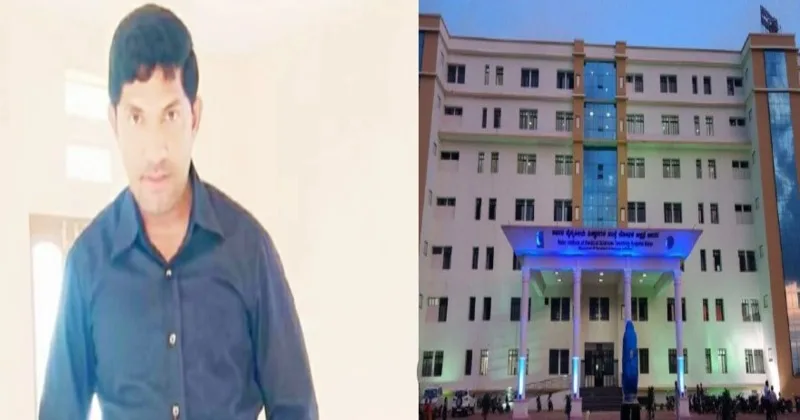
Bidar: A deeply disturbing incident at the Bidar Institute of Medical Sciences (BRIMS) has triggered widespread public outrage after a mortuary attendant was arrested for allegedly photographing nude female bodies during post-mortem examinations and storing the images on his mobile phone. The accused, identified as Muneer Ahmed(40), is also alleged to have committed the act repeatedly over several years, raising serious concerns about systemic failure and oversight within the hospital’s mortuary section.
The incident came to light after hospital authorities received credible information about the misconduct and initiated an internal inquiry. A subsequent inspection of the accused’s mobile phone reportedly revealed multiple photographs of female corpses taken without consent or authorization. The discovery has shocked hospital staff, law enforcement officials and the public alike, prompting demands for immediate and stringent legal action.
According to preliminary reports, the accused had been working as an attendant in the mortuary section for several years. During this period, he allegedly used his access to post-mortem procedures to secretly capture photographs of female bodies. Investigators suspect that the misconduct may not have been a one-time incident but a repeated violation carried out over an extended period without detection.
The revelation has sparked anger and grief among citizens, with many condemning the act as a gross violation of human dignity. Social activists, legal experts and members of the public have expressed strong condemnation, stating that such behaviour is not only unethical but also criminal in nature. They have emphasized that even after death, individuals deserve dignity, respect & privacy and any violation of that sanctity must be dealt with severely under the law.
Hospital authorities, upon receiving the complaint, acted promptly and informed the police. BRIMS Director Dr. Mohsin Ul Haq lodged an official complaint with the New Town Police Station in Bidar, following which the accused was taken into custody. Police officials have since begun a detailed investigation into the case, including forensic analysis of the seized mobile phone and digital data.
Law enforcement agencies are now examining whether the accused acted alone or whether there were lapses in supervision that allowed such activities to continue undetected for years. Authorities are also investigating whether any of the images were shared with others or stored on external devices, which could widen the scope of the investigation further.
The incident has also raised serious questions about monitoring mechanisms in sensitive hospital areas such as mortuaries and post-mortem units. Critics argue that there is an urgent need for stricter protocols, including surveillance systems, restricted mobile phone usage, and regular audits to prevent such violations in the future.
Public anger has been particularly intense due to the nature of the offence, with citizens calling it a betrayal of trust placed in healthcare institutions. Many have demanded that the accused be given the harshest punishment possible under law to set an example and deter similar misconduct in the future.
Advocate and social activist Hanumanthappa point out that the case involves not just criminal trespass and privacy violations but also serious ethical breaches within a medical environment. They emphasize that institutional accountability must also be examined to ensure that negligence or lack of supervision does not contribute to such incidents.
Meanwhile, police officials have confirmed that the investigation is ongoing and that further legal action will be taken based on forensic findings and witness statements. Authorities have assured that no angle will be overlooked and that the case will be pursued with utmost seriousness.
The BRIMS incident has left the community shaken, with widespread calls for justice and institutional reform. As the investigation continues, public attention remains firmly focused on ensuring accountability and preventing any recurrence of such disturbing violations in healthcare institutions.