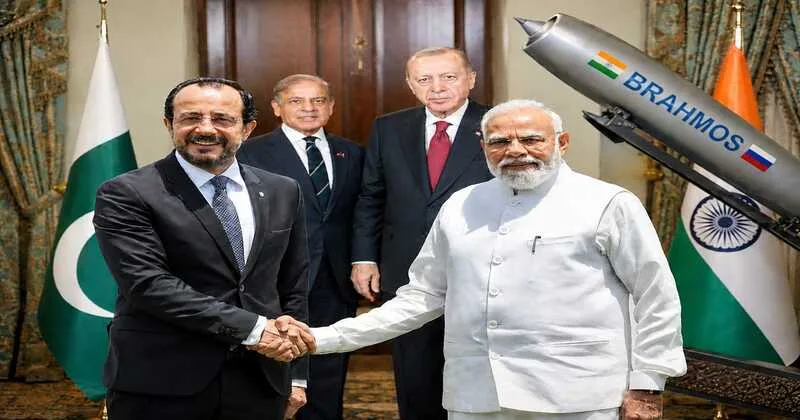
The elevation of ties between India and Cyprus to a full Strategic Partnership marks one of the most consequential geopolitical developments linking the Indo-Pacific and the Eastern Mediterranean in recent years. During Cypriot President Nikos Christodoulides’s state visit to New Delhi from May 20 to 23, India and Cyprus unveiled an ambitious framework spanning defence, counter-terrorism, cybersecurity, maritime cooperation, trade, technology and connectivity. Backed by a five-year Roadmap for Bilateral Defence Cooperation (2026–2031), the partnership reflects New Delhi’s growing willingness to project strategic influence far beyond South Asia.
The timing of the pact is equally significant. It comes amid the emergence of a rapidly consolidating Turkey-Pakistan-Saudi Sunni strategic alignment, often described as the “Islamic Nato”, and follows Turkey’s open support to Pakistan during Operation Sindoor after the April 2025 Pahalgam terror attack. Against this backdrop, India’s engagement with Cyprus is not merely bilateral diplomacy. It represents a larger geopolitical recalibration aimed at building partnerships with countries concerned about Ankara’s expanding regional ambitions, Pakistan-backed cross-border terrorism, and the growing militarisation of Islamist geopolitical blocs.
Security and counter-terrorism become the core of the partnership
Security and defence formed the centrepiece of the upgraded India-Cyprus relationship. Prime Minister and President unequivocally condemned terrorism in all its forms, including cross-border terrorism. The two sides strongly condemned the April 2025 terrorist attack in Pahalgam, Jammu and Kashmir, as well as the November 2025 terror incident near Red Fort in New Delhi. The two leaders welcomed the conclusion of the Roadmap for Bilateral Defence Cooperation (2026–2031) between the defence ministries of both countries. The framework institutionalises defence industrial cooperation, military exchanges, training, technology partnerships and capacity building. It also reflects India’s expanding defence diplomacy with European partners following the India-EU Defence and Security Partnership signed on January 27, 2026.
Happy to have met President Nikos Christodoulides in Delhi. We held extensive deliberations on further strengthening the India-Cyprus friendship. Considering the close ties between our nations, we have decided to elevate our friendship into a Strategic Partnership. Ours is indeed… pic.twitter.com/36unkio3YK
— Narendra Modi (@narendramodi) May 22, 2026
One of the most significant developments was the establishment of a Joint Working Group on Counter-Terrorism. Both countries rejected all forms of double standards on terrorism and emphasised coordinated efforts against extremist networks. The agreement also included a new Cybersecurity Dialogue and expanded maritime cooperation to strengthen maritime domain awareness in the Eastern Mediterranean. For India, the message was unmistakable. New Delhi is increasingly building a global network of security partnerships with countries affected by radical extremism and regional instability. Cyprus, positioned strategically near critical maritime routes connecting Europe, West Asia and North Africa, provides India with an important foothold in a geopolitically volatile theatre.
BrahMos diplomacy and India’s expanding strategic footprint
Cyprus’s growing interest in Indian defence platforms has added a powerful military dimension to the partnership. Since 2022, Nicosia has shown interest in acquiring India’s BrahMos supersonic cruise missiles as well as kamikaze drones such as Nagastra-1 and Skystriker. These systems attracted global attention following their demonstrated effectiveness during Operation Sindoor. Should these procurements materialise, they would mark the first deployment of Indian-made weapons systems in the Eastern Mediterranean region. Such a development would significantly expand India’s defence footprint into Europe’s strategic neighbourhood and establish India as an emerging military supplier in the Mediterranean theatre.
List of outcomes (14 in total) : State Visit of President @Christodulides to India ⬇️
🇮🇳 🇨🇾 pic.twitter.com/nxVbaByls3
— Randhir Jaiswal (@MEAIndia) May 22, 2026
The prospect of Cyprus deploying BrahMos missiles has reportedly triggered serious concern within Turkish strategic circles. Turkish media outlet TRHaber claimed that India and Cyprus have already reached a broad defence cooperation understanding, potentially paving the way for Indian missile systems and unmanned aerial vehicles in the region. Reports suggest that a possible BrahMos acquisition could fall under a defence package of nearly euro 1.2 billion allocated to the Greek Cypriot administration through the European Union’s SAFE programme.
Turkish analysts fear that the deployment of BrahMos missiles or Indian-origin kamikaze drones in the Mediterranean could fundamentally alter the regional military balance. Such concerns are understandable from Ankara’s perspective. Countries around the world witnessed the destructive precision of BrahMos systems during the May 2025 India-Pakistan conflict, where India targeted key Pakistani terror and military infrastructure. India’s defence cooperation with Cyprus, therefore, carries significance far beyond commercial exports. It signals the arrival of India as a multidirectional strategic actor capable of shaping power balances in regions extending from the Indian Ocean to the Mediterranean.
Turkey-Pakistan alignment and the rise of the “Islamic Nato”
The India-Cyprus strategic partnership cannot be separated from the rapidly evolving Turkey-Pakistan strategic nexus. During Operation Sindoor, Turkey openly backed Pakistan diplomatically, militarily and politically. Reports indicated that Ankara secretly dispatched hundreds of drones and military personnel to support Pakistan during the conflict. Turkey’s support reinforced India’s concerns about the expanding Turkey-Pakistan defence partnership, which has grown significantly over the past decade in areas such as drone warfare, naval cooperation, military modernisation and intelligence coordination. Ankara and Islamabad have also consistently coordinated positions on Kashmir in multilateral forums.
The strategic environment became even more complicated following the September 2025 Saudi-Pakistan Strategic Mutual Defence Agreement (SMDA). The pact formalised collective defence provisions between Riyadh and Islamabad and intensified speculation regarding the emergence of a larger Sunni geopolitical bloc stretching from the Gulf to the Mediterranean. Reports later emerged that Pakistan stationed thousands of troops and fighter aircraft in Saudi Arabia amid the regional conflict involving Iran, Israel and the United States. Turkey’s reported interest in joining this defence alignment further deepened concerns about a coordinated Turkey-Pakistan-Saudi axis with increasingly ideological overtones. This emerging alignment, often referred to as the “Islamic Nato”, has generated anxiety among countries concerned about radical Sunni extremism and regional destabilisation. Turkey’s continued occupation of northern Cyprus since 1974 adds another dimension to this geopolitical confrontation. Ankara’s disputes with Cyprus over maritime boundaries and energy exploration in the Eastern Mediterranean have already created deep tensions with Greece and the European Union. India’s growing partnership with Cyprus therefore, sends a clear signal that New Delhi is willing to strengthen ties with countries affected by Turkish regional assertiveness.
The emerging Mediterranean security architecture
The India-Cyprus partnership is also becoming part of a wider Mediterranean strategic architecture involving Greece, Israel and other regional actors. Cyprus and Greece already maintain close cooperation on defence, maritime security and energy issues. India’s deepening ties with both countries are gradually creating a broader network of partnerships surrounding Turkey.
Israeli Prime Minister ’s February 2026 articulation of a “Hexagon of Alliances” fits directly into this emerging framework. Netanyahu envisioned a flexible strategic grouping involving India, Greece, Cyprus, select Arab countries, African partners and other Asian states to confront both the “radical Shia axis” led by Iran and the “emerging radical Sunni axis”.
VIDEO | Delhi: Addressing a joint press meet with PM Modi, President of Cyprus Nikos Christodoulides says, "In our discussions today, the Prime Minister and I reaffirmed that our relations have entered a new era. Over the past year, accelerated by Prime Minister Modi's visit to… pic.twitter.com/ReltxOEbbK
— Press Trust of India (@PTI_News) May 22, 2026
The framework aims to enhance cooperation in defence, intelligence-sharing, maritime security and economics among countries facing common security challenges. India’s inclusion reflects its growing status as a major strategic power with expanding defence capabilities and technological influence. For Cyprus and Greece, India provides a powerful Indo-Pacific partner capable of contributing to regional stability and balancing Turkish ambitions. For India, the Mediterranean partnerships complement broader maritime goals linked to the India-Middle East-Europe Economic Corridor (IMEC), supply chain diversification and sea lane security. Prime Minister Modi emphasised that India and Cyprus would work together on connectivity initiatives such as the Indo-Pacific Oceans Initiative and IMEC. Cyprus’s strategic location makes it an ideal logistical and connectivity bridge between Europe, West Asia and the Indo-Pacific. The Mediterranean is increasingly becoming important for India due to maritime trade, energy corridors and strategic naval mobility. India’s partnerships with Cyprus, Greece and France align with its broader maritime vision extending beyond the Indian Ocean.
India’s new geopolitical assertiveness
The India-Cyprus Strategic Partnership ultimately reflects the transformation of India’s foreign policy into a more multidimensional and geopolitically assertive framework. New Delhi is no longer restricting itself to reactive diplomacy confined to South Asia. Instead, India is building strategic relationships across multiple theatres where its security interests intersect with larger geopolitical developments.
Strategic affairs experts observe that India is steadily building strategic partnerships around Turkey through its ties with Greece, Cyprus and Armenia. This reflects India’s growing ability to project influence far beyond its immediate neighbourhood. India’s closer ties with Cyprus also demonstrate how regional conflicts are increasingly interconnected. Turkey’s backing of Pakistan during Operation Sindoor directly influenced New Delhi’s strategic calculations in the Mediterranean. Similarly, maritime disputes in the Eastern Mediterranean now intersect with Indo-Pacific geopolitics, energy security and global supply chains.
The partnership extends beyond defence into trade, technology and people-to-people engagement. India and Cyprus signed agreements covering innovation, higher education, cultural cooperation, diplomatic training, fintech, shipping, clean energy, logistics and research collaboration. Both countries also committed to advancing negotiations on migration and social security agreements. Cyprus’s presidency of the Council of the European Union during the first half of 2026 further increases the strategic value of the partnership. As chair of key EU legislative and diplomatic processes, Cyprus can play an important role in strengthening India’s engagement with European institutions. The India-Cyprus Strategic Partnership, therefore, represents much more than bilateral cooperation. It marks the emergence of a new geopolitical alignment linking the Indo-Pacific and the Mediterranean in response to evolving security challenges, maritime competition and ideological power blocs. By deepening defence cooperation with Cyprus and strengthening partnerships with Greece, Israel and other Mediterranean actors, New Delhi is signalling that India is prepared to shape the strategic balance well beyond South Asia.