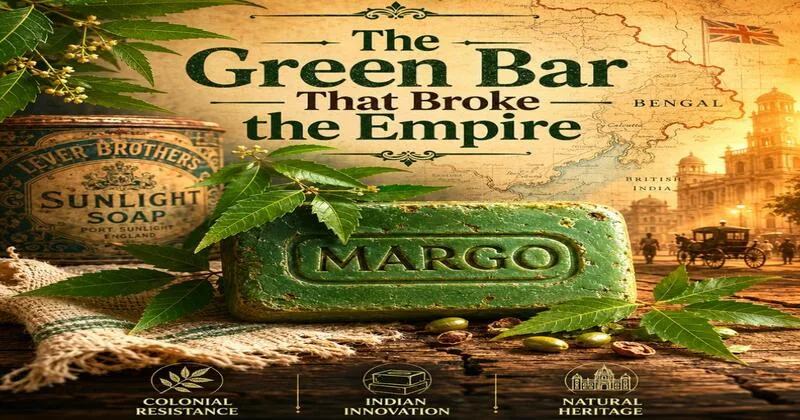
In 1920, Lever Brothers had a problem that they could not formulate their way out of. Their perfumed, rose-water soaps could charm English drawing rooms, but they were failing on Indian skin. The tropical heat, the bacterial rashes, the fungal infections that flourished in Bengal’s humid delta, these were adversaries that Victorian chemistry had not anticipated. Into that gap stepped a Stanford-educated Bengali chemist, armed not with imported glycerine or synthetic fragrance, but with the bitter oil of a tree that every Indian peasant already kept outside their front door. His name was Khagendra Chandra Das. What he built would outlast the British Empire itself.
A Chemist Raised on Rebellion
K.C. Das was born into a Baidya family in Bengal, the son of Rai Bahadur Tarak Chandra Das, a judge and Mohini Devi, a staunch Gandhian activist who would later serve as President of the Mahila Congress. The household was saturated with Swadeshi sentiment, the idea that Indian economic salvation lay in rejecting British goods and building indigenous enterprise in the Das home table conversation.
Das went abroad for his education, graduating in Chemistry from Stanford University, as documented in the institution’s Twentieth Annual Register for 1910–11. He could have accepted any number of lucrative offers from multinational companies upon his return. He chose, instead, to come back to Calcutta and start something his country could call its own.
In 1916, with the Swadeshi movement in Bengal still a living political force in the aftermath of the 1905 Partition. Das, together with friends R.N. Sen and B.N. Maitra, registered the Calcutta Chemical Company at 35 Panditiya Road. Their factory came up in Tiljala, in South Kolkata. The company’s founding was an act of nationalist resistance.
The Science Behind the Tree
For four years after founding his company, Das turned his attention to a problem that was at once scientific and civilisational, how to extract, stabilise and formulate the medicinal properties of Azadirachta indica, the neem tree, into a product that could be manufactured at scale, priced for every Indian and trusted on the most vulnerable surface of the human body- skin.
Das was working with a pharmacological tradition that stretches back over 4,500 years. The Charaka Samhita, one of the foundational texts of Ayurveda, describes neem as Sarva Roga Nivarini, “the curer of all ailments,” and as Arishtha, meaning “perfect and imperishable.” Its Sanskrit name, Nimba, derives from Nimbati svasthyamdadati “to give good health.” In Indian villages, neem had long been called the Village Pharmacy, its bark, leaves, seeds, oil and flowers each documented in classical texts, including the Sushruta Samhita, for treating infections, skin conditions, fever, dental disease and parasitic invasions.
Modern science has since validated what Ayurveda encoded in verse. Research published in Pathogens and Disease (Oxford Academic, 2013) confirms that Azadirachta indica has a long history of usage in various ailments in Indian traditional medical systems, Ayurveda, Unani, Tibetan, since time immemorial, and identifies its compounds as effective against pathogens including Staphylococcus aureus, Escherichia coli, Pseudomonas aeruginosa and Candida albicans. A narrative review published in the Biomedical and Pharmacology Journal (2022) catalogues neem’s active phytochemicals azadirachtin, nimbin, nimbidin, quercetin and tannins as agents that disrupt microbial cell membranes, inhibit metabolic enzymes, and prevent biofilm formation. A further study published in Cosmetics (MDPI, 2022) specifically examined neem applicability in dermocosmetic formulations, establishing a scientific basis for its use in acne, dandruff, eczema and skin infections, the exact conditions plaguing Indians in a pre-antibiotic tropical climate.
Attacking the Empire Through the Skin Soap
The strategic insight behind Margo was elegantly precise. K.C. Das had identified the point where British consumer goods were most exposed. Lever Brothers soaps were designed for a temperate climate for English skin that did not sweat through monsoons, did not contend with tropical fungi and with bacterial load that centuries of Ayurvedic practice had learned to neutralise.
Indian skin had different needs. The subcontinent peasants and farmers who bathed with neem-infused water, applied neem paste to rashes, planted neem trees beside their homes to purify the air and chewed neem twigs at dawn had a sophisticated, empirically validated relationship with the tree. They did not need to be persuaded of its efficacy. They already believed in it.
After four years of research into neem extraction techniques, Das launched Margo soap in 1920. The name itself was a quiet assertion of identity; neem’s botanical synonym is margosa, and Das chose to anglicise that word into a brand name in its sound, entirely indigenous in its origin.
The product was marketed for what it was: a herbal soap with antibacterial and antifungal properties, capable of treating itching, redness, fungal infections, parasite-related skin conditions and the persistent bacterial skin load of a tropical population.
The Peasant Remedy Becomes a Luxury Essential
British soap brands of the era operated on a colonial hierarchy of goods: imported was superior, indigenous was inferior. To buy foreign soap was to signal class aspiration. Margo reversed this entirely. Das priced Margo so that consumers from every stratum of Indian society could afford it, a conscious democratisation that contrasted with the premium positioning of imported brands. At the same time, by extracting, standardising and presenting neem’s medicinal properties in a manufactured bar with professional packaging, he elevated what had been a village folk practice into an article of grooming, an item of domestic necessity that appeared in homes across the social spectrum.
Margo became India’s first brand to take a remedy that Indian peasants had practised for millennia and market it as something a city-dweller would place on their bathroom shelf, not in spite of its rustic origins, but because of them. The Peasant Remedy did not need to shed its history to become a luxury essential. It needed only to be made legible to an urban consumer whose skin, regardless of income, faced the same tropical adversaries.
The company simultaneously produced Lavender Dew Powder for a more upmarket clientele, demonstrating that Das understood market segmentation, but Margo was never a poor man’s compromise. It was the primary product, the flagship, one that would prove India could compete.
Green, Bitter and Alive: The Colour and Scent of Survival
Margo’s iconic green colouring was made to connect with the original colour. In a marketplace cluttered with white, beige and pastel soaps from British and European manufacturers, the distinctive deep green of Margo’s bar was a visual declaration. An immediate signal of its botanical identity, its neem content, its difference from everything else on the shelf. The brand built a green, herbal aesthetic associated with purity and nature and positioned itself as a natural alternative to imported luxury soaps. Green was not merely a colour; it was an indigenous code.
The smell of Margo is harder to describe to those who have not encountered it: sharp, bitter, medicinal, unmistakably vegetal, and this too became part of its identity. Consumer testimonials across a century consistently describe it as herbal, sometimes as an acquired taste, but always as unmistakable. In a country that had spent generations burning neem leaves in sickrooms, boiling them in bath water during smallpox outbreaks and applying the oil to wounds, that smell was not strange. It was the smell of protection.
This association carried particular weight during the Indian epidemic years. The early twentieth century was among the most medically brutal periods in Indian history. The bubonic plague had ravaged the subcontinent since 1896. Cholera was endemic. The influenza pandemic of 1918–19, arriving on troop ships in Bombay and spreading inland, killed an estimated 20 million people in India alone, roughly a quarter to a third of the global death toll of 40 to 50 million.
As historian David Arnold documented in Colonising the Body (University of California Press, 1993), Western medicine in colonial India remained a site of deep contestation, with limited acceptance even among Indian medical graduates who frequently combined Western and traditional approaches. In this environment, neem was not folklore; it was the frontline. Classical Ayurvedic traditions held that neem trees planted around homes could purify the surrounding air and prevent the spread of communicable disease. During smallpox and other epidemic outbreaks, neem leaves were specifically used as both a topical treatment and an environmental disinfectant.
When Margo launched in 1920, precisely at the tail end of this influenza catastrophe, in a population that had watched millions die its scent arrived with the weight of that lived memory. It smelled like the thing that had kept people alive.
What Outlasted the Empire
In 1988, Margo was among the top five selling soap brands in India, holding a market share of 8.9%. By 2001, the brand was valued at Rs 75 crore. By 2018, the Margo toilet soap brand turnover had reached Rs 175 crore, and when the COVID-19 pandemic arrived a century after the Spanish flu, Jyothy Laboratories (which acquired the brand in 2011) extended the Margo portfolio to include face wash, hand wash and sanitisers. The logic remained the same: an epidemic was no time for perfume. It was time for neem.
The Calcutta Chemical Company itself changed hands several times, from the Dasgupta family, who managed it through much of the twentieth century, to Shaw Wallace, then to the German conglomerate Henkel. Margo survived every transition not because of any single owner, but because the idea embedded in it was correct that India’s oldest botanical knowledge, properly extracted and professionally offered, was more suited to Indian skin than anything a British factory could manufacture.
K.C. Das gave up MNC salaries to prove a point. The point has now been proven for over a century. It turns out the peasant was right all along, and it took a Stanford chemist to make the rest of the world notice.