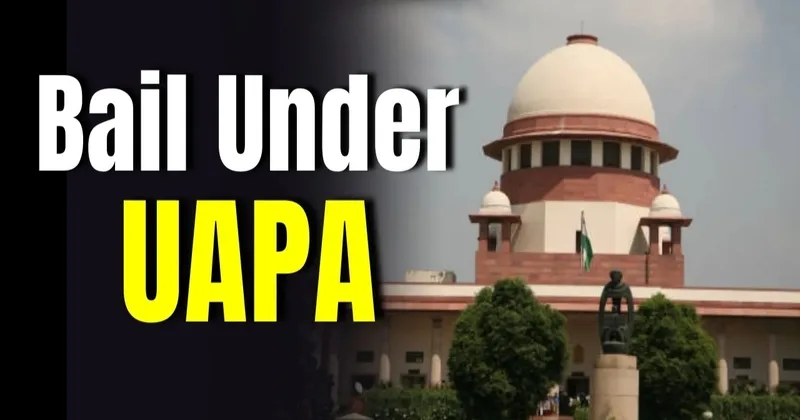
The recent observation of the Hon’ble Supreme Court that “bail is the rule and jail is the exception” even in cases under the Unlawful Activities (Prevention) Act (UAPA) has triggered an important national debate. While personal liberty is undoubtedly a constitutional value, the implications of applying this principle mechanically in matters concerning terrorism and national security need serious consideration.
As someone who has spent decades in policing, intelligence coordination, anti-terror operations and internal security management, I believe that the issue cannot be viewed merely through the narrow prism of individual liberty. The larger question is national security, public safety and protection of innocent citizens.
Terrorism is not an ordinary crime. A terrorist act is not comparable to a routine criminal offence. Terror networks operate through deep-rooted sleeper cells, overground workers, cross-border handlers, covert funding channels and highly secretive communication systems. Such networks are extremely difficult to detect and dismantle. Intelligence agencies, state police forces, central agencies and field operatives spend months and sometimes years tracking suspicious movements, monitoring communication patterns and developing human intelligence before a module is finally exposed.
Those who have never worked in operational policing may not fully understand the amount of effort involved in identifying and arresting a terror suspect. Often, agencies work under tremendous pressure and risk. Officers spend sleepless nights gathering intelligence and coordinating with multiple agencies. One small error can cost innocent lives. Therefore, when such accused persons are arrested after painstaking efforts, releasing them easily on bail can seriously undermine national security operations.
The concern is simple and practical. Once out on bail, many accused linked to terror activities may attempt to revive the same network, destroy evidence, influence witnesses or abscond. In terror-related offences, the possibility of regrouping and reactivating sleeper cells is very high. Unlike ordinary criminals, terror operatives are often ideologically motivated and are directly operating under the command of organised networks like ISI that function beyond state and even national boundaries.
The biggest question is this: why should the nation take such a dangerous chance? If even one accused released on bail succeeds in carrying out a terror strike, the consequences can be catastrophic. Hundreds of innocent civilians may lose their lives. Security personnel may become targets. Public infrastructure may be attacked. Social harmony may be disturbed. In such matters, the State cannot afford to think only in terms of the rights of the accused while ignoring the rights of ordinary citizens who become potential victims of terrorism.
Human rights cannot become selective. The human rights of innocent citizens are equally important.
There appears to be a growing tendency in some quarters to look at UAPA cases primarily from the perspective of prolonged incarceration while paying insufficient attention to the gravity of national security threats. No doubt, delays in trials are a matter of concern and judicial reforms are certainly needed to ensure speedy trials. However, the solution cannot be to make bail a routine principle in terrorism-related offences.
The Supreme Court, while granting bail in a recent UAPA matter, reiterated that prolonged delay in trial could justify bail and observed that “bail is the rule and jail is the exception.” The court also referred to constitutional protections under Article 21. Constitutional safeguards are important in a democracy, but national security is equally a constitutional obligation of the State.
In fact, in serious offences concerning terrorism, the principle should operate differently. Bail should remain an exception and not a rule. Courts should certainly retain the discretion to grant relief in cases where evidence appears weak, prosecution is malicious, or there are extraordinary humanitarian circumstances. Judicial discretion must always exist. But converting bail into a broad principle in UAPA matters will send a wrong signal and may unintentionally weaken the deterrent framework against terror activities. It may further reinforce the earlier perception of India as a soft state on terrorism, an image from which the country has consciously sought to distance itself over the past decade.
One must also remember that terror investigations are highly complex. Evidence is often technical, digital, transnational and intelligence-based. Gathering admissible evidence takes time. Coordination with foreign agencies, forensic examination of devices, decoding encrypted communication and tracking financial transactions cannot happen overnight. Delays are not always due to inefficiency. Many times, the very nature of terrorism-related investigations makes them lengthy and complicated.
During my service career, I have personally seen many hardened criminals obtain bail and then repeat similar crimes. In murder and rape cases, there are several instances where accused persons, after coming out on bail, attempted to eliminate witnesses or intimidate complainants. If this happens in ordinary heinous crimes, the danger becomes far greater in terrorism-related cases where organised networks actively support the accused.
This is why national security offences cannot be treated at par with ordinary criminal matters.
The UAPA was enacted precisely because terrorism poses an extraordinary threat to the sovereignty and integrity of the nation. Diluting the strictness of such laws through liberal bail principles may demoralise investigating agencies and operational units working in extremely difficult conditions. Officers who risk their lives to capture terror suspects expect that the legal system will support national security efforts, not weaken them.
It must also be understood that India continues to face multiple security challenges. Cross-border terrorism, radicalisation, narco-terrorism, cyber recruitment and sleeper cell activation remain serious concerns. Pakistan and its ISI continue to follow its policy of proxy war against India. In such an environment, the country cannot afford legal interpretations that may unintentionally create operational vulnerabilities.
The debate, therefore, is not about denying justice. It is about balancing liberty with national survival.
Nobody is suggesting that innocent persons should remain in jail indefinitely. Speedy investigation and speedy trial should become the priority. Special courts dealing with UAPA matters should function more efficiently. Vacancies in courts must be filled. Prosecution systems should be strengthened. But until such structural reforms are fully implemented, making bail a near-universal principle in national security cases may prove counterproductive and dangerous.
National security cannot be viewed through an abstract academic lens. Those who have worked on the ground understand that one wrong decision can cost countless innocent lives. A democratic nation survives not merely because rights are protected, but also because security is ensured. Without national security, the very foundation of democracy itself may be at risk.
India must remain both democratic and secure. But whenever there is a conflict between the liberty of a terror accused and the safety of innocent citizens, the nation must always place national security first.