
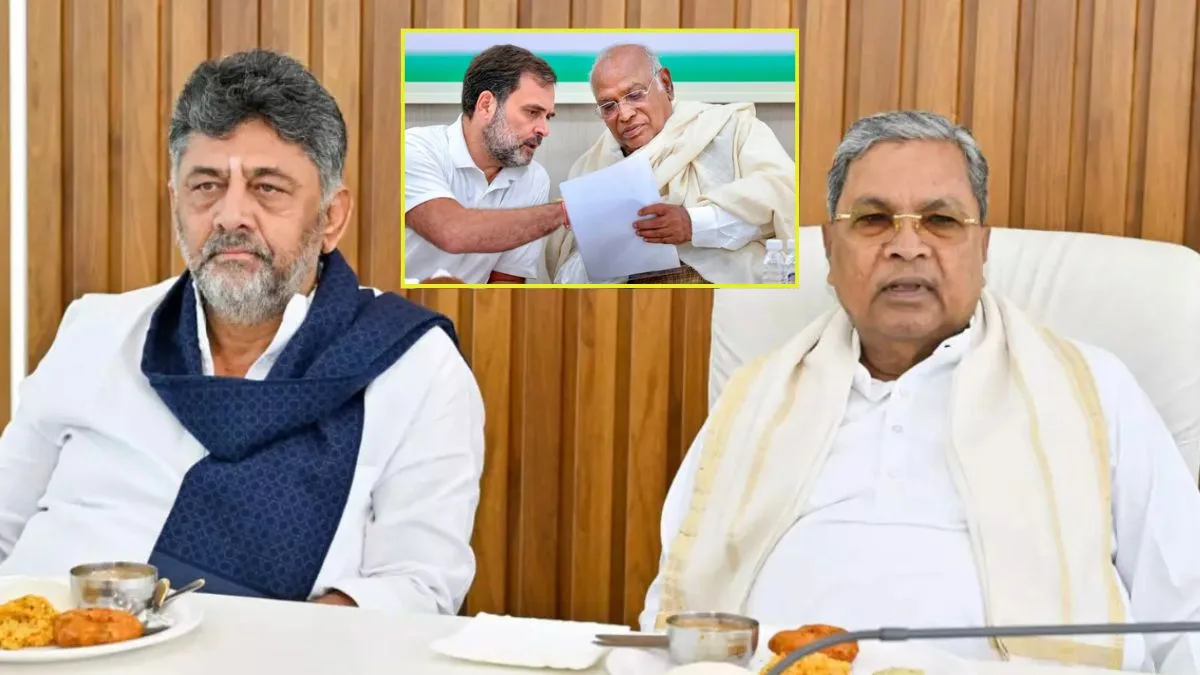
karnataka cm news: In a dramatic yet planned move that ends months of speculation, Karnataka Chief Minister Siddaramaiah has announced his decision to resign. This allows Deputy Chief Minister D.K. Shivakumar to take over as the state’s next leader. The transition, long rumored as part of an informal 2.5-year power-sharing deal made after Congress’s 2023 victory, reached its peak today amid intense political drama.
Karnataka has often faced political turmoil whenever Congress comes to power. The struggle for the CM position has also been dramatic this time. The power leaders, Siddaramaiah and D.K. Shivakumar, have frequently clashed within the party over control in the state.
As Siddaramaiah signalled his willingness to step down as CM in favour of DK Shivakumar, a fresh political storm has erupted in Karnataka. In this fresh twist, Governor Thawar Chand Gehlot left for Mumbai late on Wednesday night amid intensifying speculation over a possible leadership change in the state. No what is the situation of this leadership change in the state? Will Siddaramiah be able to resign and elevate DK as the next CM?
What is the Current Scenario in Karanataka?
After the Delhi High Command meeting, Siddaramaiah held a breakfast meeting at his residence where he reportedly informed leaders about his decision to step down as Karnataka Chief Minister. Sources said he sought an appointment with Governor Thaawarchand Gehlot after the party leadership allegedly indicated the need for a change in leadership. Siddaramaiah is also expected to speak on the issue on Thursday.
However, amid the growing political buzz, Reports suggest that the Governor is currently out of Bengaluru and has travelled to Indore for personal reasons. The 77-year-old Congress veteran was expected to meet the Governor later in the day to reportedly submit his resignation.
Constitutional Question: Can a CM Submit Resignation Without the Governor Present?
According to the Constitution of India, the Chief Minister holds office during the pleasure of the Governor under Article 164. Consequently, the formal and constitutional resignation of a Chief Minister must be submitted to the Governor of the state. While it is common political practice for a CM to first announce his decision or tender his resignation to the party high command (high command) or the Congress Legislature Party, such a step carries no legal effect on its own.
Constitutional experts note that while the Governor’s physical presence is conventional, the resignation can still be processed through the Raj Bhavan office. Shivakumar’s swearing-in could take place this weekend, possibly May 30 or 31, once the formalities are completed.
The official end of the Chief Minister’s tenure occurs only when the resignation letter is formally accepted by the Governor or his office. In the ongoing Karnataka developments, sources indicate that Siddaramaiah is expected to submit his official resignation to Governor Thaawarchand Gehlot’s office later today, even as the Governor is currently out of station, following which DK Shivakumar is likely to be invited to form the government.
The Power Tussle between Siddaramaiah and DK Shivakumar
The power struggle between Siddaramaiah, a longtime AHINDA leader representing Backward Classes, Minorities, and Dalits, and Shivakumar, a strong Vokkaliga figure and Congress’s organizational leader in the state, has been widely known since 2023. Shivakumar played a crucial role in rebuilding the party after its setbacks in 2019.
He received significant credit for the numbers that helped Congress regain power. The Congress high command, led by Mallikarjun Kharge and Rahul Gandhi, seems to have finally found a way to prevent open rebellion and avoid a crisis like what happened in Rajasthan before the 2028 Assembly elections.
Siddaramaiah is reportedly being offered a Rajya Sabha seat along with a broader national role as a way to ease the situation.
What This Means for Karnataka and Congress
Siddaramaiah’s possible exit has opened a fresh phase of political uncertainty in Karnataka, exposing the Congress party’s unresolved power-sharing tensions and leadership struggles. For the Congress, the transition is not just about replacing a Chief Minister but managing factional equations between Siddaramaiah loyalists and DK Shivakumar supporters without damaging governance or public perception.
For Siddaramaiah, stepping down under pressure could affect his image as a mass leader who has dominated Karnataka politics for decades majorly by Muslim and other Minority appeasement. It is highly visible that the development is a proof of Congress’ “internal instability” and “high-command politics,” arguing that the state government has remained consumed by power tussles instead of governance. It is also evident that Congress governments are driven more by compromise formulas and factional bargaining than administrative stability.
The Road Ahead for Karnataka Congress and the High Command
While visuals today project harmony, underlying tensions persist. Some Siddaramaiah loyalists are unhappy, and caste equations in Karnataka’s complex politics will test the new leadership. With Rajya Sabha elections looming and 2028 polls on the horizon, Shivakumar will need to quickly consolidate the party, deliver on governance, and manage factional expectations.
For now, Karnataka’s power corridors are buzzing with anticipation. The “power tussle” that dominated headlines for months appears headed toward resolution — not with a bang, but with an emotional breakfast. The story of Karnataka politics, however, is rarely simple. The coming days will reveal whether this transition heals old wounds or merely opens new ones.