The Supreme Court’s SIR verdict is a decisive reaffirmation of constitutional democracy and electoral integrity. By upholding the Election Commission’s authority under Article 324, the Court has made it clear that free and fair elections cannot exist without clean, credible, and verified electoral rolls. In doing so, the judgment strengthens not just the Election Commission, but the constitutional spine of Indian democracy itself.
In one of the most consequential constitutional verdicts in recent years, the Supreme Court of India has decisively upheld the legality of the Election Commission’s Special Intensive Revision (SIR) of electoral rolls, reaffirming the constitutional authority vested in the Election Commission under Article 324. More importantly, the judgment restores constitutional clarity to a debate that had been deliberately buried beneath political rhetoric, ideological alarmism, and manufactured fear.
For nearly a year, the SIR exercise was portrayed by sections of the Opposition and activist circles as an assault on democracy itself. Terms such as “backdoor NRC,” “mass disenfranchisement,” and “suspended citizenship” were aggressively circulated to create public anxiety around what was fundamentally an electoral verification exercise. The attempt was obvious: transform institutional scrutiny into political victimhood and project electoral verification as constitutional persecution.
The Supreme Court has now dismantled that narrative with remarkable constitutional precision.
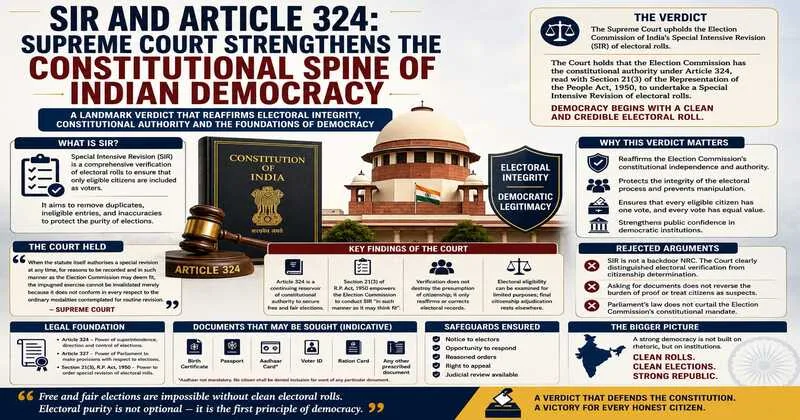
The Bench comprising Chief Justice Surya Kant and Justice Joymalya Bagchi unequivocally held that the Election Commission possesses the authority under Article 324 of the Constitution, read with Section 21(3) of the Representation of the People Act, 1950, to undertake a Special Intensive Revision of electoral rolls. In doing so, the Court has reaffirmed a foundational democratic principle that often gets ignored in India’s increasingly politicised public discourse free and fair elections are impossible without clean, credible, and accurate electoral rolls.
This is the central constitutional message of the verdict.
The Court rightly recognised that democracy does not merely begin at the polling booth, it begins with the integrity of the electoral roll itself. Electoral rolls are not routine administrative registers. They are the constitutional gateway to sovereign political participation. If that gateway becomes vulnerable to duplication, illegal inclusion, impersonation, demographic distortions, or systemic inaccuracies, the legitimacy of the entire democratic structure weakens.
For decades, this uncomfortable reality remained politically inconvenient.
Successive additions, deletions, migrations, urban expansion, and administrative negligence created enormous pressure upon the integrity of electoral databases across states. Yet serious institutional correction was often avoided because any attempt at scrutiny immediately triggered political accusations. The Election Commission’s decision to undertake a Special Intensive Revision after decades was therefore not merely an administrative exercise, it was an institutional assertion that democratic legitimacy requires periodic purification of electoral systems.
The Supreme Court correctly appreciated this constitutional necessity.
One of the most important aspects of the judgment is its reaffirmation of the true scope and character of Article 324. The petitioners argued that once Parliament legislates under Article 327 through the Representation of the People Act, the Election Commission becomes restricted to mechanically implementing statutory provisions. The Court firmly rejected this narrow interpretation.
Drawing upon landmark precedents such as Mohinder Singh Gill, Kanhiya Lal Omar, Sadiq Ali, and the Gujarat Assembly Election Reference, the Court observed that Article 324 is not a weak residual provision surviving only in legislative gaps. Rather, it is a continuing constitutional reservoir of supervisory authority designed to protect the sanctity of the electoral process.
This observation carries enormous constitutional significance.
The framers of the Constitution consciously vested broad authority in the Election Commission because India’s democracy is dynamic, vast, and constantly evolving. Electoral challenges cannot always be anticipated through rigid statutory frameworks. Migration patterns evolve.
Technology evolves. Electoral manipulation evolves. Institutional safeguards therefore also require operational flexibility.
The Court correctly held that parliamentary legislation and the Commission’s constitutional mandate are complementary, not adversarial. Parliament may regulate electoral procedures, but statutory law cannot be interpreted in a manner that paralyses or extinguishes the Commission’s constitutional responsibility to secure free and fair elections.
That constitutional balance lies at the heart of the judgment.
Equally important is the Court’s interpretation of Section 21(3) of the Representation of the People Act, 1950. The provision authorises the Election Commission to direct a “special revision” of electoral rolls “in such manner as it may think fit.” The Bench correctly recognised that the language was consciously drafted in broad and enabling terms. The non-obstante clause frees the Commission from the ordinary revision framework and empowers it to act whenever electoral integrity demands intervention.
The phrases “at any time” and “in such manner as it may think fit” were rightly interpreted as deliberate legislative recognition of the Commission’s need for procedural flexibility during extraordinary electoral circumstances.
This completely demolishes the argument that the SIR exercise was legally excessive or constitutionally unauthorised.
The Court also dealt firmly with the politically charged claim that the SIR exercise reverses the presumption of citizenship. Petitioners repeatedly argued that asking electors to furnish supporting documents effectively transforms citizens into suspects. The Bench rejected this contention with balanced constitutional reasoning.
Verification, the Court observed, does not negate the presumption of citizenship; it merely provides a lawful procedural mechanism to reaffirm or correct electoral records where necessary. The presumption remains, but it is not irrebuttable.
This is an extremely important constitutional clarification.
In every functioning state system, verification is a basic administrative necessity. Passports require verification. Welfare systems require verification. Taxation systems require verification. Educational admissions require verification. To suggest that electoral systems alone must remain permanently insulated from documentary scrutiny was never a constitutional argument; it was a political argument disguised as civil liberties discourse.
The Court rightly refused to constitutionalise administrative helplessness.
At the same time, the judgment carefully maintained constitutional safeguards by distinguishing electoral eligibility from final citizenship adjudication. The Bench clarified that while the Election Commission can examine questions bearing upon citizenship for the limited purpose of electoral inclusion under Section 16 of the Representation of the People Act, it cannot conclusively determine citizenship status under the Citizenship Act.
This distinction is constitutionally elegant and institutionally balanced.
The Commission’s scrutiny remains confined to electoral purposes. Final adjudication regarding nationality continues to lie with competent authorities under citizenship law. In doing so, the Court decisively destroyed the repeated attempt to equate SIR with an NRC-style citizenship exercise.
What stands exposed today is not merely a failed legal challenge, but a deeper political mindset that treats institutional verification as dangerous whenever it threatens entrenched electoral arithmetic.
For years, conversations surrounding illegal inclusions, duplication of voter identities, demographic manipulation, and compromised electoral rolls were either dismissed or politically suppressed. Entire ecosystems of vote-bank politics benefited from that opacity. Therefore, when the Election Commission finally undertook a structured verification exercise after decades, resistance emerged instantly under the language of “constitutional fear.”
The Supreme Court has now separated constitutional principle from political theatre.
Importantly, the judgment does not grant unchecked authority to the Election Commission. The Court repeatedly emphasised that the Commission remains subject to constitutional discipline, recorded reasons, judicial review, procedural safeguards, notice requirements, and statutory limitations. This is precisely why the verdict carries constitutional legitimacy. It strengthens institutions without placing them above accountability.
That is the true maturity of constitutional governance.
Ultimately, this judgment will likely be remembered as a defining moment in India’s electoral jurisprudence. At a time when democratic discourse is increasingly consumed by emotional slogans and institutional suspicion, the Supreme Court has restored attention to first principles: democracy requires credible institutions; credible institutions require constitutional authority, and constitutional authority requires institutional confidence.
The message emerging from this verdict is unmistakable.
Electoral integrity is not hostility to democracy. Verification is not persecution. Constitutional institutions cannot be reduced to powerless observers merely because political narratives demand it. Article 324 was never intended to be ornamental constitutional language. It was designed to function as the constitutional spine of India’s democratic machinery.
The Supreme Court’s SIR judgment is ultimately a victory of constitutional discipline over political hysteria. At a time when electoral verification was being painted as oppression and institutional scrutiny as persecution, the Court has firmly reaffirmed that democracy is sustained not by slogans, but by credible institutions and clean electoral rolls. By strengthening the Election Commission’s authority under Article 324, the judgment protects the very foundation of representative democracy. Electoral purity is not optional in a republic, it is the first condition of democratic legitimacy.