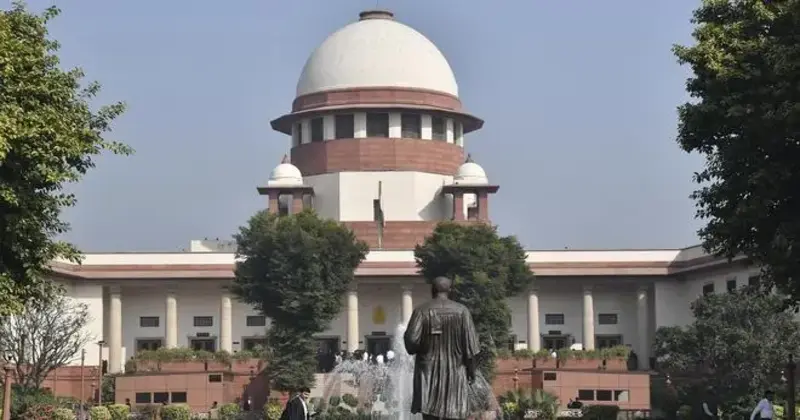
The Supreme Court on May 27, upheld the constitutional validity of the Election Commission of India’s Special Intensive Revision (SIR) exercise, ruling that the process was legally sustainable and aimed at preserving the integrity, accuracy and completeness of electoral rolls.
A bench headed by Chief Justice Surya Kant and comprising Justices Joymala Bagchi and Vipul M Pancholi delivered the verdict on a batch of petitions challenging the legality of the SIR exercise conducted in Bihar and several other states.
The court observed that the exercise advances the constitutional objective of conducting free and fair elections and held that the Election Commission had acted within its statutory powers while carrying out the revision process.
“The object sought to be achieved by the SIR bears a direct nexus to the constitutional goal of free and fair elections,” the bench observed while pronouncing the judgment.
The court further stated that the SIR exercise “does not distract from the constitutional obligation of free and fair elections” and instead strengthens the democratic process by ensuring cleaner and more accurate electoral rolls.
Court examined four key questions
While delivering the verdict, the bench said it had shortlisted the main controversy arising from the SIR notification and framed four broad legal questions for determination.
These included whether the Election Commission had the authority to conduct the SIR exercise, whether the process was proportionate and legally justified, whether it violated provisions of the Representation of the People Act, 1950, and whether the poll body could scrutinise citizenship issues during electoral roll verification.
After hearing extensive arguments, the court ruled in favour of the Election Commission on all major issues and held that the SIR process was constitutionally and legally valid.
“We hold that the electoral SIR advances the constitutional imperative of free and fair elections,” the bench stated.
Supreme Court upholds proportionality of exercise
The Supreme Court also upheld the proportionality of the SIR exercise, rejecting arguments that the process was excessive or arbitrary.
According to the judgment, the measures adopted by the Election Commission were reasonably connected to the objective of maintaining accurate electoral rolls and preventing wrongful inclusion or exclusion of voters.
“We are therefore satisfied that the impugned exercise meets the requirements of proportionality,” the court observed.
The bench further stated that the measures introduced under the SIR process were not “manifestly excessive” and included adequate procedural safeguards to prevent arbitrary deletions from voter lists.
“The measures adopted bear a reasonable nexus to the objectives sought to be achieved, are not manifestly excessive and are accompanied by sufficient procedural safeguards to prevent arbitrary exclusion,” the court noted.
The judgment also clarified that the process included the requirement of issuing show-cause notices before deletions, thereby addressing concerns raised by petitioners regarding wrongful removal of names from electoral rolls.
Court says ECI acted within statutory powers
The Supreme Court rejected the argument that the Election Commission had exceeded its legal authority by introducing the SIR mechanism.
The bench held that merely because the exercise differed from ordinary electoral roll revisions did not make it unconstitutional or ultra vires.
“It cannot be said that the Election Commission acted outside its statutory powers merely because the SIR process differs from ordinary revision exercises,” the bench observed.
The court also ruled that the SIR process did not violate provisions of the Representation of the People Act or related electoral rules.
“Since SIR is legally tenable, it is not in violation of the RP Act,” the judgment stated.
The bench added that the Election Commission retained discretion in framing verification procedures, although such powers were “not unbounded” and must maintain a rational connection with the objective of preserving electoral integrity.
Petitions challenged Bihar SIR exercise
The case arose from multiple petitions challenging the SIR exercise conducted in Bihar, where the Election Commission revised electoral rolls and reportedly removed around 65 lakh names from draft voter lists.
Petitioners argued that the Election Commission lacked powers under Article 326 of the Constitution and the Representation of the People Act, 1950, to undertake such a large-scale revision process.
One of the major petitions was filed by the NGO Association for Democratic Reforms (ADR).
The petitioners argued that the exercise resembled an “NRC-like process” because citizenship verification was effectively being carried out during voter verification. They contended that citizenship determination falls within the domain of the central government and not the Election Commission.
Senior advocate Prashant Bhushan, appearing for ADR, had also questioned the timeline of the exercise and challenged the basis on which lakhs of voters were categorised as dead, migrated or shifted to other constituencies.
The petitions further raised concerns over documentation requirements imposed during the verification process.
Election Commission defended exercise
The Election Commission defended the SIR exercise before the court and maintained that the process was necessary to ensure clean and accurate electoral rolls.
The poll body argued that Aadhaar cards and voter identity cards alone could not be treated as conclusive proof of citizenship.
Under the SIR notification, voters whose names were not present in the 2002 or 2003 electoral rolls were required to establish ancestral linkage with individuals whose names appeared in those rolls.
The Election Commission argued that such measures were aimed at preventing illegal entries and ensuring the integrity of electoral records.
The Supreme Court ultimately accepted the broad legal framework adopted by the Election Commission while clarifying that verification mechanisms must remain reasonable and linked to the constitutional objective of maintaining accurate electoral rolls.
Major relief for Election Commission
The verdict is being seen as a major legal and institutional victory for the Election Commission, especially amid growing political and legal debate over voter verification exercises.
The judgment also carries wider implications for future electoral roll revisions and verification drives across India.
By upholding the constitutional validity of the SIR process, the Supreme Court has effectively affirmed the Election Commission’s authority to undertake intensive voter verification exercises aimed at preserving electoral integrity.
The ruling is also likely to influence ongoing political debates surrounding voter list revisions, citizenship-linked verification concerns and allegations of illegal voter inclusion in border states.
The court’s emphasis on free and fair elections, procedural safeguards and the constitutional responsibility of maintaining accurate voter rolls is expected to shape future electoral reforms and verification mechanisms in the country.