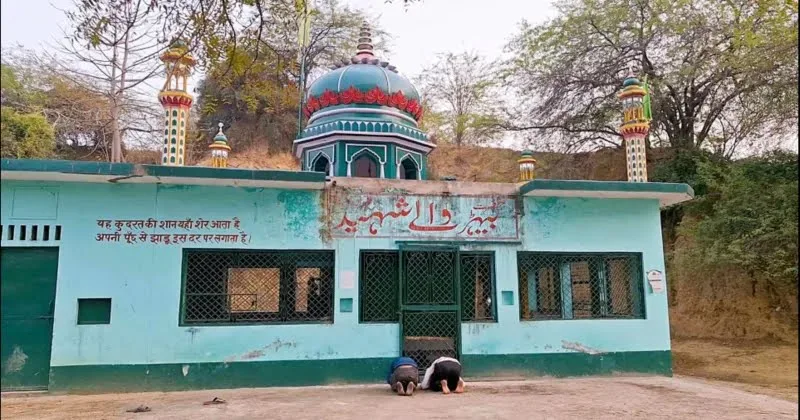
Etawah: In a significant ruling after more than 64 days of hearings, a court has declared a mazar allegedly linked to Shamsuddin as an illegal encroachment on reserved forest land and ordered its eviction. The judgment came after a detailed examination of land records, historical claims, and submissions from both the Forest Department and the mazar committee.
After over 64 days of hearings, the court declared the mazar linked to Shamsuddin is an illegal encroachment on reserved forest land and ordered its eviction.
According to the Forest Department, the land has been recorded as reserved forest in official records dating back to… pic.twitter.com/gjF4GnU07V
— Shashank Shekhar Jha (@shashank_ssj) May 26, 2026
The case had drawn considerable public attention due to the religious nature of the structure and competing claims over the ownership and history of the land. While the mazar side argued that the shrine was nearly 800 years old and held spiritual importance for devotees, the court ultimately ruled that no documentary evidence was produced to substantiate those claims.
Forest Department Relied on Historical Records
According to the Forest Department, the disputed land has consistently been recorded as a reserved forest in official government records dating back more than a century. Authorities presented documents from 1916, 1939, and 1946 to establish that the land was part of protected forest territory under government control.
Officials argued that the classification of the land as a reserved forest predates any modern claims surrounding the shrine and that no legal permission had ever been granted for construction or occupation at the site. The department maintained that encroachments on forest land cannot be regularised merely on the basis of religious usage unless supported by valid legal documentation. The court reportedly accepted the department’s argument that official land records carry legal weight and remain binding unless overturned through due process.
Mazar Committee Claimed Ancient Religious Significance
Representatives of the mazar maintained that the structure had existed for nearly 800 years and was associated with Shamsuddin, whom devotees regard as a spiritual figure. They argued that the site had long been visited by followers and formed part of local religious tradition. However, during the lengthy hearings, the committee was unable to provide documentary proof establishing either the age of the structure or legal ownership rights over the land. The absence of revenue records, title documents, or historical notifications supporting the shrine’s status weakened the claim before the court.
Legal observers noted that while courts often take religious sensitivities into consideration, documentary evidence remains central in disputes involving public or protected land.
Court Orders Eviction
After reviewing submissions from both sides, the court concluded that the structure constituted an illegal encroachment on reserved forest land. It subsequently directed authorities to proceed with eviction in accordance with the law. The ruling is being viewed as part of a broader judicial emphasis on the protection of forest land and strict enforcement against unauthorised occupation, regardless of the nature of the encroachment.
At the same time, the case is likely to generate debate over the balance between religious traditions and environmental or land protection laws. Similar disputes involving shrines, temples, mazars, and other religious structures on government land have surfaced in different parts of the country in recent years.
The judgment highlights the increasing importance of documentary evidence in land-related religious disputes. Courts across India have repeatedly stressed that historical or oral claims alone are insufficient when weighed against official land records and statutory protections.
Environmental experts say such rulings reinforce the legal sanctity of reserved forests, which are protected under stringent conservation laws. Forest land, once officially notified, enjoys special protection and cannot be diverted or occupied without approval under relevant statutes. Meanwhile, supporters of the mazar may explore legal remedies, including appeals before higher courts, if they choose to challenge the verdict. The case is expected to remain closely watched because of its implications for future disputes involving religious structures situated on public or ecologically protected land.