JALGAON: In a remarkable example of fuel conservation and sustainable management at a time of Global crisis, Rashtriya Swayamsevak Sangh (RSS) swayamsevaks at the Paschim Kshetra Karyakarta Vikas Varg (Pratham) in Jalgaon, Maharashtra have adopted eco-friendly and cost-effective stoves powered by renewable fuel sources, significantly reducing cooking expenses while promoting environmental protection.
The training camp is being organised at MJ College of the Khandesh Education Society in Jalgaon, where 255 swayamsevaks are undergoing training. Along with them, around 40 to 50 swayamsevaks are engaged in various arrangements. Managing daily meals for nearly 500 to 600 people posed a significant logistical responsibility before the training camp.
In line with the Sangh’s emphasis on environment-friendly, swadeshi, and economical systems, swayamsevaks implemented an innovative fuel-saving initiative that has become a subject of discussion and appreciation.
Ordinarily, preparing food for such a large number of participants would require at least two large LPG cylinders every day, resulting in a huge expenditure. Over the 21-day training camp, the total fuel expense was expected to exceed Rs 1.25 lakh. However, swayamsevaks found an alternative indigenous solution.
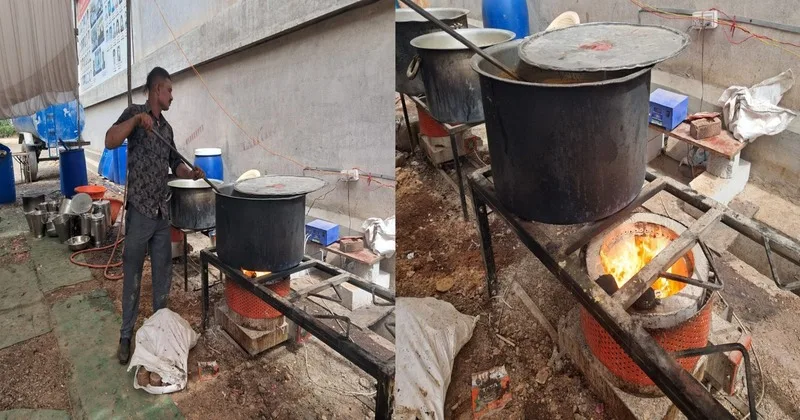
Swayamsevak and entrepreneur Rahul Kulkarni from Dhule developed a specially designed stove that uses renewable energy-based fuel. The stove operates on “wood blocks” prepared from dried cotton or tur (arhar) crop residue mixed with cow dung. These eco-friendly fuel blocks are easily available in the market at approximately Rs 3 per kilogram or Rs 150–200 per sack.
Due to this innovation, the daily fuel expenditure for cooking has reduced dramatically from nearly Rs 6,000 to around Rs 300. The initiative has not only resulted in substantial fuel savings and reduced expenditure but has also emerged as an environmentally sustainable alternative. Agricultural residue, which is often discarded as waste, is being converted into useful fuel, thereby contributing to environmental conservation as well.
RSS Sarkaryavah Dattatreya Hosabale stayed at the training camp venue for three days and reviewed various arrangements and activities in detail. He personally observed the functioning of the innovative stove system and appreciated the initiative.
He remarked that such experiments could also be implemented in Sangh Shiksha Vargas and other organisational programmes being conducted across the country.
A similar stove system is also being used at the Sangh Shiksha Varg of Devgiri Prant being conducted in Jamner. The experiments in Jalgaon and Jamner have presented an effective model of “efficient management with minimal expenditure.”
The initiative is being viewed as an inspiring example of the harmonious integration of environmental protection, fuel conservation, and indigenous technology. It also demonstrates how sustainable and low-cost alternatives can be effectively utilised in rural areas, large community gatherings, and various social initiatives.