Prime Minister Narendra Modi’s recently concluded five-nation diplomatic tour through the United Arab Emirates, Netherlands, Norway, Italy and Sweden revealed far more than ceremonial diplomacy. The visit sequence itself reflected a carefully structured geopolitical outreach that combined trade, technology, energy security, defence cooperation and strategic diversification. But among all the engagements, Modi’s Norway visit and the third India-Nordic Summit in Oslo emerged as the most strategically consequential component of the entire European outreach.
This was not simply another bilateral visit. It marked a decisive shift in India’s foreign policy thinking where the Nordic region is no longer viewed as a peripheral European cluster but as a critical strategic corridor connecting technology, climate transition, maritime security, Arctic governance and future industrial systems. In many ways, Norway became the anchor through which India attempted to institutionalise a long-term Nordic strategy.
The symbolism alone was significant. Modi became the first Indian Prime Minister to visit Norway in over four decades. Yet the outcomes went far beyond symbolism. A Green Strategic Partnership was launched, multiple sectoral agreements were signed, Norway formally joined India’s Indo-Pacific Oceans Initiative, and the India-Nordic relationship itself was elevated into a broader framework centred around green technology and innovation cooperation. At a time when Europe is reassessing global supply chains, searching for trusted economic partners and adapting to geopolitical fragmentation after the Ukraine conflict, India’s growing engagement with the Nordic countries reflects a deeper convergence of strategic interests.
Norway was not a ceremonial stop, it became a strategic gateway
For decades, India’s engagement with Europe remained heavily concentrated around larger continental powers such as France, Germany and the United Kingdom. The Nordic region often remained diplomatically under-engaged despite its enormous strengths in technology, innovation, sustainability and maritime industries. PM Modi’s Oslo visit changed that equation. During bilateral talks with Norwegian Prime Minister Jonas Gahr Store, discussions centred around renewable energy, hydrogen technology, green shipping, digital infrastructure, healthcare cooperation, space collaboration and maritime systems. The visit culminated in the launch of the India-Norway Green Strategic Partnership, which significantly upgraded the relationship beyond traditional trade ties.
Held fruitful talks with PM Jonas Gahr Støre in Oslo. One of the key highlights was the upgrading of our bilateral partnership to a Green Strategic Partnership, which will deepen synergy in clean energy, sustainable growth, the blue economy, green shipping and more. We also… pic.twitter.com/yIlqNWNVcp
— Narendra Modi (@narendramodi) May 18, 2026
The timing of this partnership is important. Norway today possesses one of the world’s strongest capabilities in renewable technologies, sustainable shipping systems, offshore energy infrastructure and climate-focused industrial innovation. India, meanwhile, represents one of the fastest-growing major economies with massive demand for green infrastructure, industrial transition and clean energy investment.
The partnership therefore creates a natural strategic complementarity. Norway also carries enormous financial weight. Norway’s Government Pension Fund Global, one of the world’s largest sovereign wealth funds, had invested nearly USD 28 billion in Indian capital markets by the end of 2025. This transforms Norway from merely a diplomatic partner into a significant long-term capital stakeholder in India’s economic growth story. Unlike transactional relationships focused purely on trade balances, the India-Norway relationship is increasingly centred around structural economic cooperation involving technology transfer, industrial partnerships, sustainable infrastructure and future-oriented investments.
The India-Nordic Summit signalled a larger geopolitical shift
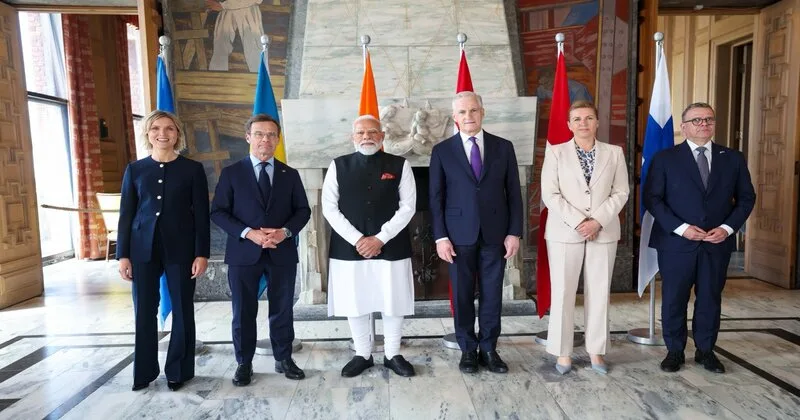
The third India-Nordic Summit in Oslo demonstrated that India’s Nordic outreach is no longer episodic diplomacy. It is now institutional, sequenced and strategically integrated into India’s long-term foreign policy architecture. Alongside Norway, Prime Minister Modi held bilateral engagements with leaders from Denmark, Finland, Iceland and Sweden. Collectively, these countries represent one of the world’s most technologically advanced and innovation-driven regions despite their relatively small populations.
The combined Nordic economy exceeds USD 2 trillion. More than 700 Nordic companies currently operate in India while nearly 150 Indian firms maintain a presence across the Nordic region. Bilateral trade between India and Nordic countries touched nearly USD 19 billion in 2024, but the strategic importance of the relationship goes far beyond trade volumes.
The Nordic countries occupy a disproportionately influential position in advanced manufacturing, telecommunications, green industrial systems, climate innovation, digital governance, Arctic research and maritime infrastructure.
This explains why Modi’s outreach focused heavily on technology ecosystems and industrial partnerships rather than conventional diplomacy alone. The summit also reflected Europe’s evolving geopolitical calculations. As supply-chain vulnerabilities, technological competition and strategic dependencies increasingly shape global politics, Nordic countries are actively seeking diversified partnerships beyond traditional Atlantic frameworks. India’s rise as a major economic and geopolitical actor fits directly into that strategic requirement.
At the same time, India itself is diversifying economic partnerships beyond older alignments. Strengthening Nordic engagement allows India access to advanced technologies, trusted supply chains, innovation ecosystems and green industrial expertise without entering rigid geopolitical blocs.
Green technology became the core strategic theme
The strongest unifying thread across Modi’s Nordic outreach was green industrial transformation. Climate diplomacy today is no longer confined to environmental negotiations. It has become deeply connected with economic competitiveness, industrial restructuring and strategic influence. Countries that dominate renewable systems, hydrogen technologies, battery infrastructure, carbon capture and sustainable shipping will shape the next generation of global economic power.
India clearly recognises this transition.
During the India-Norway Business and Research Summit, Prime Minister Modi repeatedly emphasised green growth, renewable energy cooperation, sustainable infrastructure and environmental innovation. Norway emerged as a particularly valuable partner because of its expertise in offshore energy systems, maritime sustainability, ocean economy infrastructure and clean industrial technologies.
List of outcomes (8 in total) : PM @narendramodi’s participation at the 3rd India-Nordic Summit ⬇️ pic.twitter.com/9H4GMUCbVf
— Randhir Jaiswal (@MEAIndia) May 19, 2026
The Green Strategic Partnership specifically targets cooperation in hydrogen technology, climate-friendly infrastructure, sustainable shipping, circular economy systems and renewable energy development.
This aligns directly with India’s own long-term economic priorities. India is attempting one of the world’s largest energy transitions while simultaneously expanding manufacturing capacity, urban infrastructure and industrial output. Achieving both growth and decarbonisation requires advanced technologies and long-term investment, areas where Nordic countries possess exceptional capabilities. Norway’s entry into India’s Indo-Pacific Oceans Initiative also added a maritime strategic dimension to the partnership. Cooperation on green shipping corridors, port modernisation, ocean energy and maritime sustainability now connects climate policy directly with Indo-Pacific strategic architecture. This is particularly significant because maritime trade routes and shipping infrastructure will increasingly become central to global energy transitions and industrial supply chains.
Technology, innovation and digital partnerships drove the summit
Another major shift visible during the Oslo summit was the growing role of technology diplomacy. India’s Nordic outreach is increasingly focused on future technologies rather than traditional trade sectors alone. The partnerships now include artificial intelligence, 6G systems, quantum computing, semiconductors, digital public infrastructure and advanced research collaboration. Sweden emerged as India’s most comprehensive Nordic technology partner during the visit. The India-Sweden Strategic Partnership established cooperation frameworks involving AI, critical minerals, space cooperation, sustainable mining, telecom systems and defence innovation. The Sweden-India Technology and Artificial Intelligence Corridor further institutionalised this technology relationship.
Finland similarly became central to India’s digitalisation agenda. The India-Finland Strategic Partnership in Digitalization and Sustainability prioritised 5G, 6G, AI, quantum technologies, semiconductors and high-performance computing.
Norway complements this ecosystem through strengths in digital governance, maritime technology, clean industrial systems and sustainable infrastructure.
Together, the Nordic region offers India access to one of the world’s highest concentrations of innovation capability.
This matters because India’s long-term geopolitical influence will increasingly depend not merely on economic size but on technological competitiveness. Partnerships with Nordic economies allow India to accelerate industrial modernisation while reducing overdependence on any single technology bloc. The India-EFTA Trade and Economic Partnership Agreement, which entered into force in October 2025, further strengthens this process. The agreement is expected to facilitate nearly USD 100 billion in investments and generate one million direct jobs in India over fifteen years. The Oslo summit explicitly connected India-Nordic relations to this broader economic integration framework.
Strategic security and Arctic cooperation added a hard geopolitical edge
Although climate and technology dominated headlines, Modi’s Nordic outreach also carried an important strategic security dimension. Following the Ukraine war, the Nordic region has acquired greater geopolitical significance within Europe. Finland joined NATO in 2023 while Sweden formally entered the alliance in 2024. The entire Nordic arc is now deeply integrated into European security architecture. India is not entering alliance politics. However, engagement with Nordic countries strengthens India’s partnerships in areas such as cyber resilience, maritime security, supply-chain protection and defence-industrial cooperation. The Oslo summit specifically highlighted cooperation on maritime security, countering illegal maritime activities, seafarer safety, defence innovation and blue economy systems. Sweden’s defence manufacturing presence in India, including Saab’s Carl-Gustaf facility in Haryana, reflects the practical expansion of strategic industrial cooperation.
Participated in the 3rd India-Nordic Summit in Oslo, which reflected the growing depth and dynamism of India’s partnership with the Nordic region.
Our discussions focused on several aspects, including sustainability, innovation, clean energy, emerging technologies and… pic.twitter.com/4mk3YdTGxv
— Narendra Modi (@narendramodi) May 19, 2026
The Arctic dimension adds another layer of importance. India has maintained the Himadri research station in Svalbard since 2008 and has held observer status in the Arctic Council since 2013. Nordic leaders welcomed deeper Indian engagement in Arctic scientific cooperation, climate research and environmental governance during the summit. This is strategically significant because Arctic changes increasingly influence global climate systems, trade routes, maritime dynamics and energy competition. Indian policymakers have repeatedly linked Arctic transformations to monsoon variability and long-term climate effects on South Asia.
Thus, the Nordic relationship now simultaneously intersects with Europe, the Arctic and the Indo-Pacific, three increasingly connected geopolitical theatres.
Why Norway visit became the strategic centrepiece
What made Modi’s Norway visit particularly important was that it combined every major dimension of India’s emerging foreign policy priorities into one diplomatic platform.
Trade and investment cooperation expanded through the India-EFTA framework. Technology partnerships accelerated through innovation agreements and research collaboration. Climate diplomacy deepened through the Green Strategic Partnership. Maritime and Arctic cooperation added geopolitical depth. Digital infrastructure and healthcare partnerships widened institutional engagement. Norway therefore became more than a bilateral stop. It became the strategic convergence point of India’s broader Nordic policy.
The awarding of Norway’s highest civilian honour, the Grand Cross of the Royal Norwegian Order of Merit, further reinforced the diplomatic symbolism surrounding the visit. The honour recognised Modi’s contribution toward strengthening India-Norway relations and reflected the growing strategic importance Norway attaches to India.
The back-to-back Nordic honours from Norway and Sweden also illustrated how Europe increasingly views India as a critical long-term partner in an era of geopolitical uncertainty. Importantly, India’s Nordic outreach differs from older forms of diplomacy centred purely around political alignment. The partnership is being built around practical convergence in technology, sustainability, innovation, resilient supply chains and industrial transformation.
That makes the relationship potentially more durable.
The Nordic countries bring technological depth, climate expertise, institutional stability and capital strength. India brings scale, manufacturing capacity, market size, digital infrastructure and strategic relevance in the Indo-Pacific.
Together, the relationship creates a powerful complementarity.
As global politics increasingly revolves around clean technologies, maritime systems, digital infrastructure and resilient industrial ecosystems, India’s outreach toward Norway and the broader Nordic region may eventually prove to be one of the most strategically consequential components of New Delhi’s evolving Europe policy.
What appeared at first glance as a ceremonial European tour was in reality a carefully calibrated strategic expansion. Norway became the clearest example of how India is repositioning itself within the changing architecture of global power, not merely through speeches or symbolism, but through technology partnerships, green industrial cooperation, maritime strategy and long-term institutional integration.