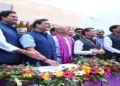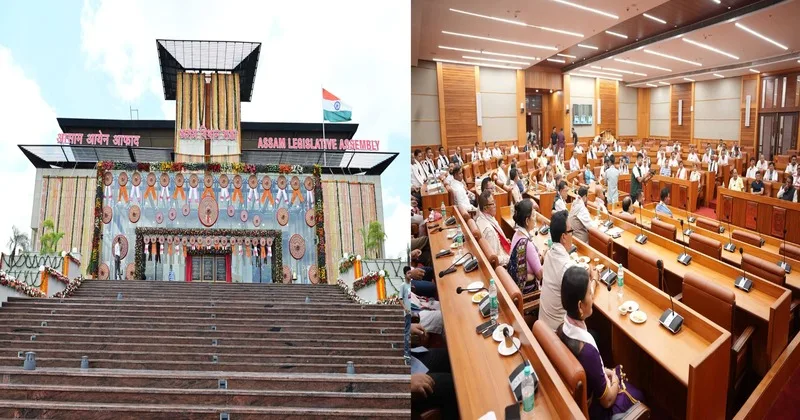
Guwahati: What was different in Assam assembly when it assembled for the oath taking of newly elected MLAs on May 21. The opening day of the 16th Assam Legislative Assembly echoes the cultural diversity of Assam and Bharat, which was a true reflection of decolonising the assembly procedure in modern day India.
One hundred and twenty-four newly elected MLAs took their oaths. They did so in nine different languages. Some of those languages have never echoed inside an Indian legislative assembly before. It was, by any measure, a historic afternoon.
17 BJP-NDA MLAs took oath in Sanskrit
Probably for the first time in the history of Assam assembly 17 ruling party MLAs took oath in Sanskrit language.
In doing so, they made a quiet but unmistakable political and cultural statement. Sanskrit, the ancient language of the Vedas and the foundation of India’s classical civilisation, is not commonly chosen for legislative oath-taking. Seventeen MLAs choosing it simultaneously — in a single session — is unprecedented in Assam’s assembly history and rare in the country.
The legislators who took oath in Sanskrit include former Speaker Biswajit Daimari, senior BJP leaders Bimal Bora, Jayant Malla Baruah, Bhavesh Kalita and Dr. Mridul Kumar Dutta, AGP’s Prithviraj Rava, tea community BJP MLA Sanjay Kisan, Ahom community BJP weMLA Mayur Bargohai, and others including Neelima Devi, Victor Kumar Das, Vijay Kumar Gupta, Amia Kanti Das, Dr. Milan Das, Dr. Paramananda Rajbanshi, Krishna Kamal Tati, Rajdeep Gowla and Sanjay Kisan.
The diversity within this Sanskrit group is itself significant — a Bodo community MLA, an Ahom MLA, a tea community MLA, and legislators from plains communities all choosing the same ancient language as their oath-taking medium. It was an assertion of a shared civilisational identity cutting across ethnic lines.
Oath in Tribal languages
If Sanskrit was the headline number, the real historical breakthrough of the oath taking session lay elsewhere — in three languages that had never been used in an Indian legislative assembly before.
Five BJP MLAs took oath in Karbi — for the first time in Assam assembly history. Three MLAs took oath in Rajbongshi language — also for the first time. One MLA took oath in Rabha — again, a first.
Karbi, Rajbongshi and Rabha are living languages spoken by hundreds of thousands of people in Assam. They are not recognised under the Eighth Schedule of the Constitution. They have no official status in the eyes of the law. And yet, they were spoken from the floor of the Assam Legislative Assembly as the language of an oath of constitutional office. For the communities that speak these languages, that moment was not a procedural footnote. It was recognition.
124 MLAs, nine languages
The complete breakdown of Thursday’s oath-taking reflects the extraordinary linguistic mosaic that Assam genuinely is. Seventy-five MLAs took oath in Assamese — the dominant language of the state. Seventeen chose Sanskrit. Nine took oath in Bengali, including six from BJP and two from Congress. Eight BPF MLAs took oath in Bodo. Five BJP MLAs took oath in Karbi. Three MLAs — one each from BJP, BPF and AGP — took oath in Rajbongshi. Four took oaths in English. One took an oath in Hindi. One took an oath in Rabha language.
Rules should never become a barrier
Lauding the history created inside Assam assembly CM Himanta Biswa Sarma said the decision was taken in advance — in deliberate consultation with Parliamentary Affairs Minister Atul Bora and Pro-tem Speaker Chandra Mohan Patowary — specifically so that MLAs could take their oaths in whichever language they felt most comfortable and confident in.