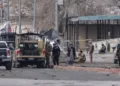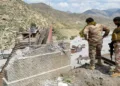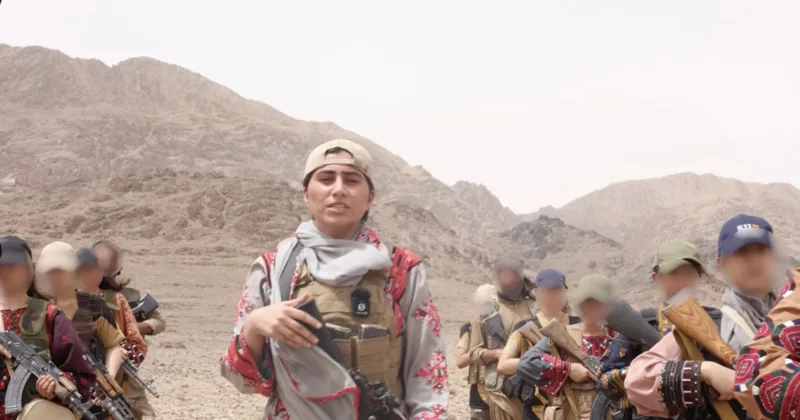
At an undisclosed location in Balochistan, a woman dressed in combat gear stands among a formation of armed female fighters. The footage moves between training scenes and rugged mountainous terrain, showing armed cadres travelling on foot and alongside vehicles before the woman at the centre of the video addresses the camera directly. The Baloch Liberation Army (BLA), through its media outlet Hakkal, identifies her as “Commander Shaynaz Baloch” — appearing to mark the first time a woman has publicly emerged as a commander within the organisation’s ranks.
In a lengthy recorded message, Shaynaz speaks about the role of Baloch women in history, politics and armed struggle, describing the conflict in Balochistan as entering what she calls a decisive phase. The emergence of Shaynaz comes after a series of increasingly visible roles played by women within the Baloch insurgency over recent years.
The first major turning point came with Shari Baloch, who carried out a suicide attack in Karachi in April 2022 and became the first known female “fidayeen” associated with the BLA. Her attack marked a major symbolic shift in the insurgency and generated widespread debate across Pakistan and beyond. In the attack carried out at a van near the University of Karachi’s Confucius Institute, three Chinese academicians and their Pakistani driver were killed. That day, Shari, an educated woman, became BLA’s first woman suicide bomber.
Since then, names of several Baloch women, including Sumaiya Qalandran Mahal Baloch, Drosham Baloch, Hatham Naaz, Banadi Baloch, Zareena Baloch, Maryam Buzdar and Asifa Mengal have emerged as rebel combatants. Coming from different social and educational backgrounds, these women have taken part in direct combats, as well as have carried out “fidayeen” attacks, according to a report in The Balochistan Post.
Analysts, however, say the public emergence of a woman explicitly presented as a “commander” represents a new and in a way something considered unusual development. While women had previously appeared as fighters, suicide attackers or political activists, Shaynaz’s presentation as someone occupying a command position suggests an organisational and symbolic evolution within the movement itself. She is seen interacting with several young Baloch girls carrying arms like AK-47 guns and following training instructions.
Commander Shaynaz Baloch
In the video, the woman is introduced as “Shaynaz Baloch”, while sources close to the organisation say her nom de guerre is “Sado”. Shaynaz Baloch belongs to the Tump area of Kech District, the district from which Shari also hailed. She is said to have received her early education at The Oasis School before completing her FSc studies at Tump Degree College.
Sources familiar with her background say she was associated during her student years with Baloch Students Organization-Azad (BSO-Azad), a student organisation that has historically played a prominent role in Baloch nationalist politics.
Her emergence as a commander is being viewed by observers as symbolically significant, not only because she is a woman occupying a senior role, but also because she publicly presents herself as confronting the authority of the Pakistani state and its military establishment. This challenge to one of the region’s largest and most powerful armed institutions by a Baloch woman is considered significant. Analysts say her appearance reflects a growing confidence within sections of the insurgency to place women in visible leadership positions once dominated entirely by men.
Commander’s Message to Baloch People
In her address, Shaynaz said history would “prove and testify” that Baloch women had historically held honour and dignity within Baloch society, arguing that women had long stood beside men in social and political life. She referred to Banadi Baloch, sister of Mir Chakar Khan Rind, describing her as one of the clearest historical examples of women participating in war and leadership centuries ago.
According to Shaynaz, that social position was later weakened under the British-era Sandeman system and subsequently under Pakistani rule, which she accused of dividing Baloch society politically, culturally and socially. It may be mentioned here that most Baloch armed rebels have come from good educational background. It seems the better educated the Baloch men and women become, the more they detest the Pakistani security establishment.
She said the BLA’s “revolutionary approach”, combined with the sacrifices of earlier fighters and what she described as the progressive thinking of the Baloch nation, had enabled women and men to struggle together “on one front and in one camp”. Till some years ago, the Baloch women were not to be seen outside their homes. This has changed entirely as more Baloch women now join protests against the atrocities of the Pakistani forces on the streets. More of them are joining the ranks of armed fighters also.
Shaynaz stated that she had been associated with the BLA for more than seven years, progressing from an ordinary fighter to command and leadership roles. During that period, she claimed she had never experienced gender discrimination within the organisation.
Addressing the Baloch public, she said she had taken up arms not for personal protection but for what she described as the protection and freedom of the Baloch nation. Throughout the message, Shaynaz repeatedly urged Baloch people not to remain silent, describing silence in the face of oppression as incompatible with the honour and dignity of the nation.
She also addressed Baloch women directly, encouraging broader participation in the movement while arguing that women should join not merely through emotion or symbolism, but through “knowledge, consciousness and wisdom”. In another section, she accused Pakistan of using women within state institutions, including the military, in support of what she described as an occupying system, while simultaneously portraying armed Baloch women as manipulated or exploited.
Addressing Pakistani forces, Shaynaz warned that Baloch women would no longer remain what she called “soft targets”. She further claimed that the BLA’s campaign had moved beyond a defensive phase and warned of future attacks against Pakistani forces in areas they had “never imagined”.
The speech concluded with Shaynaz describing BLA fighters as defenders of their homeland and asserting that the conflict would continue until the end of Pakistani rule in Balochistan.
Pakistan Pushing Baloch Women to Arms
Women have increasingly moved to the forefront of the broader Baloch movement through campaigns for political rights, protests against enforced disappearances and mobilisation around allegations of state abuses. Figures such as Dr Mahrang Baloch have emerged as leading voices in peaceful protest movements, demanding information about forcibly disappeared persons and calling for the identification of bodies buried in unmarked graves across Balochistan.
Many Baloch women are greatly disenchanted with the manner in which Dr Mahrang Baloch’s peaceful protesters of Baloch Yekjehti Committee (BYC) have been ill treated by the Pakistani security forces. This disenchantment has motivated them into moving towards picking up weapons and facing the security forces squarely. They are now choosing to take up guns against the men and women who wield batons and guns against them.
Other women, including Sammi Deen, Sabiha Baloch, Shalee Baloch and Beebow Baloch, have also become increasingly prominent through protests, arrests and political campaigns linked to the Balochistan’s issue. But their aura is diminishing among wider nationalist Baloch people who believe that peaceful protests have failed to get them more democratic rights.
Critics of the Pakistani state argue that increasingly hardline policies have contributed to further militant consciousness among sections of Baloch society, particularly women. They point to the detention of peaceful political activists such as Mahrang and Beebow, the issuing of warrants against women activists under laws including the 3MPO and Fourth Schedule, and what rights groups describe as a growing number of enforced disappearance cases involving Baloch women.
According to some analysts, such developments are pushing certain women towards seeking spaces where they can determine their own political future beyond the direct control of the state. In that context, some women appear to be turning towards armed organisations, “believing that the state only understands the language of force and confrontation.”
Women like Shaynaz therefore represent another dimension of female participation, one that extends beyond political mobilisation into direct armed confrontation with the Pakistani state.
Public Acceptance & Social Change
The growing prominence of women within both peaceful activism and armed organisations has also triggered noticeable social changes within the Baloch society. According to Baloch nationalist circles, Pakistani state narratives frequently portrayed Baloch society as tribal, conservative and resistant to women’s participation in politics and public life.
The rise of female activists, organisers and militant figures has challenged many of those assumptions and narratives taking the winds out of this propaganda. Across social media, political gatherings and public demonstrations, women leading marches, addressing crowds or appearing in militant videos increasingly receive admiration and public support from sections of Baloch society rather than social rejection.
A Complex Challenge For Pakistan
For Pakistani state institutions and the military establishment, analysts say these developments may represent a far more complicated challenge than the insurgency phases witnessed in previous decades. Because movements rooted simultaneously in political grievance, social change and collective identity are often harder to contain through security measures alone.
The public rise of women as organisers, negotiators, protesters and in this case, figures of command suggests that the conflict in Balochistan is no longer confined to the battlefield, but has entered the social fabric of an emerging generation that appears determined to define its own political future.