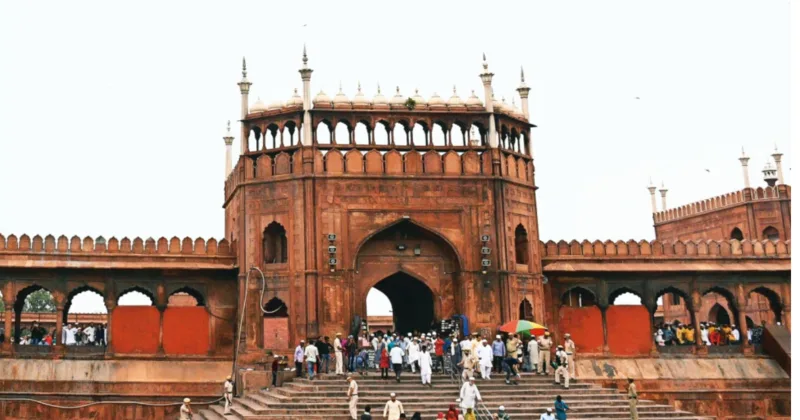
New Delhi: The focus around the Jama Masjid has now shifted from documentation to decision-making. The two-month window granted in January 2026 by the Delhi High Court for a comprehensive encroachment survey has elapsed, and the Municipal Corporation of Delhi is in the final stages of preparing its compliance report. This report will form the basis of the next phase of proceedings, where the court will assess the extent of unauthorised constructions and decide on the legality of structures identified across key zones, including the heavily congested access points around the mosque.
What HC had said in January 2026
In a significant development concerning urban management in Old Delhi, the Delhi High Court on January 8, 2026 directed the Municipal Corporation of Delhi to conduct a comprehensive survey of alleged illegal encroachments in and around the historic Jama Masjid. The directive followed petitions alleging widespread unauthorised occupation of public and Waqf land, including constructions linked to individuals associated with the mosque’s administration.
The survey focused on areas around Gates 3, 5, and 7 as well as adjoining public parks and market spaces, examining the proliferation of commercial stalls, hawkers, unauthorised parking zones and semi-permanent structures.
Encroachments Under Scrutiny
The petitioners had alleged that open spaces surrounding Jama Masjid, including key access points and public utility areas, had been encroached upon over time. These include not only informal vending zones but also more permanent constructions allegedly raised on land meant for public use. Claims were also made that certain structures were linked to the office of the Shahi Imam and his relatives, though these assertions are expected to be tested during subsequent hearings.
The issue is particularly sensitive given the location within Shahjahanabad, a dense and historically significant urban zone where civic planning, heritage conservation and livelihood concerns frequently intersect.
What Happens Now
The immediate next step is judicial scrutiny. Once submitted, the compliance report will be examined in detail by the court, with all stakeholders given an opportunity to respond. This is where the process is likely to slow down and become more contested.
Local committees, residents, traders’ bodies and religious stakeholders are expected to raise objections, particularly on questions of land ownership, long-standing usage, and Waqf-related claims. Many of these structures, though termed “encroachments,” have existed for years, even decades, which complicates enforcement. Legal challenges are therefore expected to dominate hearings through mid-2026, potentially delaying any swift executive action on the ground.
The Likely Restoration Phase
If the court upholds the findings of the survey, a calibrated “restoration phase” is expected to follow. This would involve removal of illegal structures, clearance of public pathways, and reclaiming of designated open spaces.
However, this is unlikely to be a blanket demolition drive. Given the sensitivities of the Shahjahanabad area, authorities may be required to adopt a phased and selective approach, prioritising high-risk encroachments that affect emergency access, fire safety, and pedestrian movement. Urban planners have repeatedly flagged that congestion around Jama Masjid is not merely an aesthetic issue but a public safety concern, especially in densely packed market stretches like Meena Bazaar.
Balancing Heritage and Ground Realities
At the heart of the matter lies a difficult balancing act. The Jama Masjid precinct is not just a protected heritage zone but also a living, economically active space that supports thousands of livelihoods.
Any attempt at large-scale removal of stalls or structures is likely to face resistance on both legal and humanitarian grounds. This makes it probable that authorities, under court supervision, may also explore rehabilitation measures or designated vending zones as part of a long-term solution.
A Continuing Judicial Focus
The latest order builds on a series of judicial interventions over the past few years concerning the Jama Masjid area. In 2022, the High Court had expressed concern over the deteriorating condition of public parks near Meena Bazaar, warning that unchecked encroachments could reduce them to “garbage land.” In 2024, the court acknowledged efforts by civic authorities and police in reclaiming two such parks. Later that year, it also sought clarity from the Archaeological Survey of India on the monument’s protected status, maintenance practices and revenue utilisation.
Taken together, these developments indicate sustained judicial observation and directions pertaining to one of Delhi’s most historically and culturally significant precincts. The coming months are expected to determine whether this translates into lasting structural and administrative change on the ground.
A Test Case for Old Delhi
The outcome of this case could set a precedent for handling encroachments across other parts of Old Delhi. With the judiciary maintaining consistent oversight in recent years, the coming months will be crucial in determining whether policy intent translates into visible change on the ground or remains tied up in prolonged litigation.
For now, the process has entered its most consequential stage where paperwork, legal argument, and administrative will must align before any physical transformation begins.