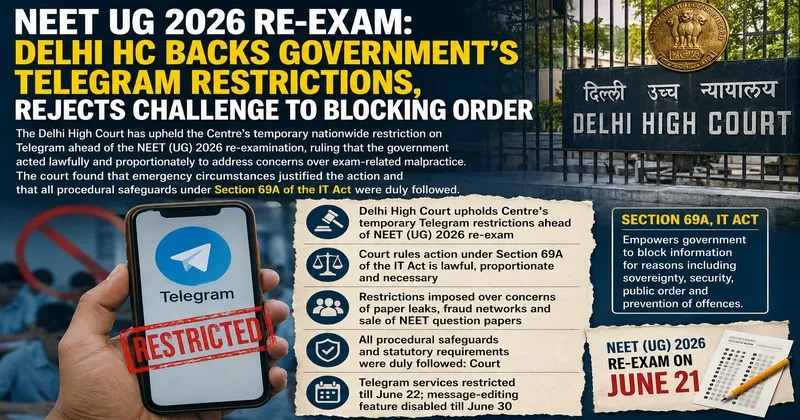
New Delhi: A temporary nationwide restriction on Telegram, imposed ahead of the NEET (UG) 2026 re-examination, will continue after the Delhi High Court upheld the Centre’s decision, ruling that the government acted within its legal authority and adopted proportionate measures to curb examination-related malpractice.
#BEEAKING: Delhi High Court has rejected Telegram's plea challenging the Indian Govt decision to temporarily ban Telegram before the Re-NEET exams.
"Government's order is well founded. A platform can be banned under Section 69A of the IT Act," Justice Tejas Karia rules.
— Aditya Raj Kaul (@AdityaRajKaul) June 19, 2026
In a significant judgment concerning one of India’s largest entrance examinations, Justice Tejas Karia dismissed Telegram’s challenge to the blocking order issued under Section 69A of the Information Technology Act. The court observed that the emergency situation cited by the government warranted immediate action and that all statutory safeguards and procedural requirements had been duly followed. The court held that the reasons cited by the authorities were sufficient, given the prevailing circumstances and found no procedural irregularities or lapses in the decision-making process.
Delhi High Court Rejects Telegram’s Proportionality Challenge
The Delhi High Court rejected Telegram’s contention that the Centre’s temporary restrictions amounted to a disproportionate and blanket curtailment of a platform used by millions of people across the country.
Telegram argued that alleged misconduct by a limited number of users could not justify restricting access to the entire platform. The company also stated that it had cooperated with law enforcement agencies and taken action against channels and groups accused of facilitating unlawful activities. Appearing for Telegram, Senior Advocate Dhruv Mehta submitted that less restrictive alternatives were available and that targeted action against specific channels and groups would have adequately addressed the government’s concerns.
The court, however, accepted the Centre’s argument that the temporary restrictions were carefully tailored to address a specific and urgent threat linked to the conduct of the NEET (UG) 2026 re-examination.
“The government’s measures are the least restrictive and cannot be considered disproportionate,” the court observed.
Justice Tejas Karia noted that the proportionality test had been satisfied, as the action pursued a legitimate objective, maintained a rational connection with that objective, and was necessary under the circumstances.
Platform Can Be Blocked Under Section 69A, Court Says
Another major issue before the court was Telegram’s claim that Section 69A of the Information Technology Act authorises the blocking of specific information rather than an entire intermediary platform.
Rejecting this interpretation, the High Court held that the law does not exclude a platform from the ambit of “information” and therefore permits platform-level restrictions where warranted. “We have also held that under the IT Act there is no reason to exclude the platform from the ambit of ‘information’,” the court observed.
Centre Defends Restrictions Over Examination Fraud Concerns
The Union government told the court that Telegram had emerged as a significant medium for the circulation of leaked examination material and the operation of scams related to NEET. According to the Centre, the restrictions were imposed following recommendations from the National Testing Agency (NTA) after repeated efforts to curb the problem through content-specific takedowns proved inadequate.
The government informed the court that several Telegram channels were allegedly involved in selling purported NEET question papers and facilitating examination fraud networks. These channels, groups and bots reportedly had a combined reach of nearly 1.46 lakh accounts.
The Centre also relied on reports submitted by the Indian Cyber Crime Coordination Centre (I4C), arguing that Telegram’s anonymity features, large subscriber-based channels, automated bots and cloud-based infrastructure posed significant enforcement challenges.
Solicitor General Tushar Mehta submitted that the decision was based on credible material indicating large-scale misuse of the platform and was necessary to safeguard the integrity of a nationwide examination involving lakhs of students. Additional Solicitor General Chetan Sharma and Advocate Ashish Dixit represented the Centre during the proceedings.
Temporary Restrictions to Continue
Telegram had challenged directions issued by the Ministry of Electronics and Information Technology (MeitY), under which the platform’s services were temporarily suspended across India until June 22, while its message-editing feature was disabled until June 30.
The Centre maintained that content-specific removals were insufficient because channels and bots could be recreated rapidly, making temporary platform-wide restrictions necessary in the run-up to the re-examination.
The NEET (UG) 2026 re-examination is scheduled for June 21 and will be conducted for more than 22 lakh candidates following allegations of question paper leaks in the original examination held on May 3. With the High Court declining to interfere, the Centre’s temporary blocking order will remain in force until the notified deadlines.