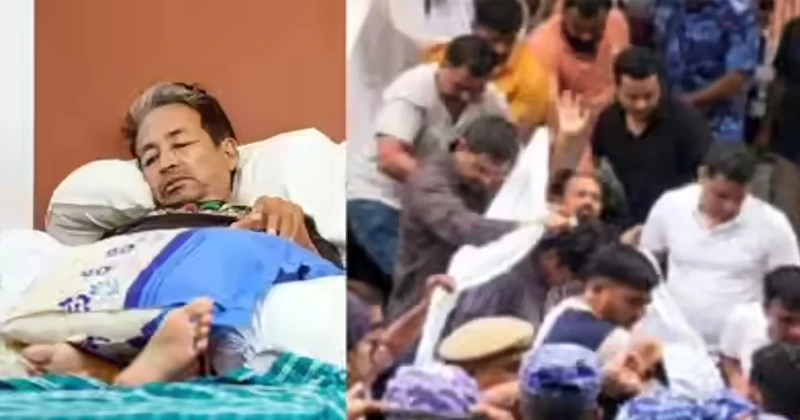
NEW DELHI: Delhi Police on June 18, shifted climate activist Sonam Wangchuk from Jantar Mantar to Safdarjung Hospital after he completed 20 days on an indefinite hunger strike, citing deteriorating health and acting in compliance with directions of the Delhi High Court.
The carefully planned operation, executed in the early hours of the morning, brought an abrupt end to Wangchuk’s prolonged fast at the national capital’s iconic protest site. Police said the decision was taken solely on medical grounds after expert opinion indicated that the activist’s health required immediate medical intervention.
BREAKING: Delhi police take Sonam Wangchuk from Jantar Mantar to hospital on High Court orders.
Doctor’s report indicates his vitals are stable, hydration and blood pressure ok, sugar slightly low.
Complaint of mild diarrhoea.
He seems to have refused consent for treatment or… pic.twitter.com/0LVdqJEvWV— Abhijit Majumder (@abhijitmajumder) July 18, 2026
According to the Delhi Police, Wangchuk has been admitted to Safdarjung Hospital, where he remains weak due to prolonged fasting and dehydration but is currently stable.
“Mr Sonam Wangchuk has been admitted at Safdarjung Hospital for required health care. He is weak due to prolonged fasting and dehydration. Although he is currently stable, he requires continuous observation, monitoring and treatment to restore his body parameters,” Delhi Police said.
Police said the action followed orders of the Delhi High Court and expert medical advice after Wangchuk’s health showed signs of deterioration during his prolonged fast. The Deputy Commissioner of Police (New Delhi) stated that the activist was shifted for essential medical care in compliance with judicial directions.
“As per orders of Hon’ble High Court and on expert medical advice due to the deteriorating health condition of Sonam Wangchuk, he has been shifted to the hospital for essential medical care,” the DCP posted on social media.
The police also appealed to protesters gathered at Jantar Mantar to vacate the protest site peacefully. Doctors who examined Wangchuk reported that his condition was stable despite the extended hunger strike. According to the medical assessment:
- His vital signs were stable.
- Blood pressure and hydration levels were within acceptable limits.
- Blood sugar was found to be slightly low.
- He complained of mild diarrhoea.
- He was advised continuous monitoring owing to weakness caused by prolonged fasting and dehydration.
Reports also indicated that Wangchuk may have declined consent for treatment or transfer initially, although this has not been officially confirmed. According to top police sources, the operation was finalised after a high-level strategy meeting following the assumption of office by newly appointed Delhi Police Commissioner Anurag Kumar.
Officials deliberately chose the early morning hours when the number of protesters at Jantar Mantar was at its lowest.
Police also identified what sources described as a strategic opportunity when Wangchuk’s close aide, Abhijit Dipke, briefly stepped away from the protest site, leaving the stage without its principal coordinator.
Around 30 to 35 personnel from the New Delhi district’s Special Staff and local police, dressed in plain clothes, quietly entered the barricaded protest area.
Sources said the mission was conducted on a strict “need-to-know” basis. Only a handful of senior officers were aware of the complete operational plan, while inspectors and personnel deployed on the ground were merely instructed to assemble at the protest site without being informed of the full strategy.
Police sources described the operation as being executed through a three-tier security arrangement. Plainclothes personnel first secured the stage before surrounding Wangchuk’s bed. Officers then covered the bed with large white sheets from all four sides while escorting him away from the protest site, a move aimed at preventing crowd mobilisation and avoiding confrontation.
The second security layer consisted of Central Reserve Police Force (CRPF) and Rapid Action Force (RAF) personnel, who restrained protesters outside the barricaded area and prevented any escalation.
In the third layer, senior Delhi Police officers supervised the entire operation from a control point located near the ambulance and police vehicles. Once Wangchuk was placed inside the ambulance, traffic police ensured an uninterrupted route to Safdarjung Hospital.
Shortly after the operation concluded, Wangchuk’s close associate Abhijit Dipke returned to the protest site and alleged that the activist had been taken away in his absence.
Dipke announced that he would continue the agitation by undertaking a hunger strike himself, signalling that the protest would not end with Wangchuk’s hospitalisation. Delhi Police, however, maintained that the operation was carried out with maximum restraint despite attempts by some protesters to obstruct the exercise.
#WATCH | Delhi: The police took activist Sonam Wangchuk, who had been on a hunger strike at Jantar Mantar for the past 20 days, to the hospital
DCP New Delhi tweeted, "As per orders of Hon’ble High Court and on expert medical advise due to the deteriorating health condition of… pic.twitter.com/o8HxPSzu0f
— ANI (@ANI) July 18, 2026
“While complying with the orders of Hon’ble High Court, the protestors tried to create obstruction, in which slight commotion ensued. However, police exercised maximum restraint and undertook the exercise safely,” the DCP said.