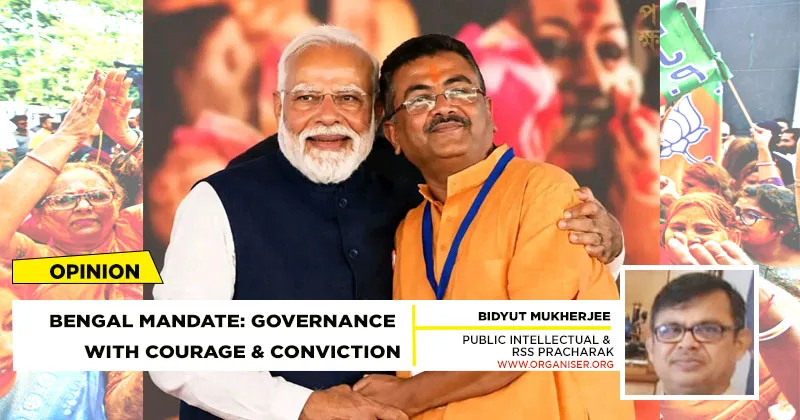
Although the new Government, taking shape in West Bengal, has received a five-year mandate, the true scope of its work will extend across an entire generation. The murder of the personal assistant of Suvendu Adhikari on May 6 2026 — one of the real fighters behind this victory — even before the new Government was fully formed, is proof of that reality.
For one hundred and fifteen years, four successive systems of rule — British, Nehruvian, Communist, and later Trinamool — suppressed one of the most creative and productive civilisations of the modern world. For the first time, the BJP now has a real opportunity to reverse that flow.
In December 1911, at the Delhi Durbar, the British announced that they were shifting their imperial capital away from Calcutta. Lord Curzon openly admitted in the House of Lords that they simply wanted relief from what he described as “the somewhat heated atmosphere of Bengal.” The voters of Bengal have now ended the system whose foundations were laid that very day. The BJP Government must understand that its task over the next five years is not merely to govern but to contribute to the revival of a civilisation that was systematically suppressed for decades.
For two generations, educated Indians were taught not to look towards that civilisation. Yet between 1820 and 1941, a single province of India created a tradition of intellectual and cultural achievement unmatched anywhere else in colonised Asia.
It was Bengal that produced the first non-European Nobel laureate in literature; the equation still used in modern astronomy to determine stellar temperatures; the branch of statistics that governs the behaviour of half the particles in the universe and after which those particles are named; the first demonstration of millimeter-wave wireless communication in 1894, two years before Marconi’s famous experiment; and India’s first indigenous pharmaceutical company, started in a small room with only seven hundred rupees of capital.
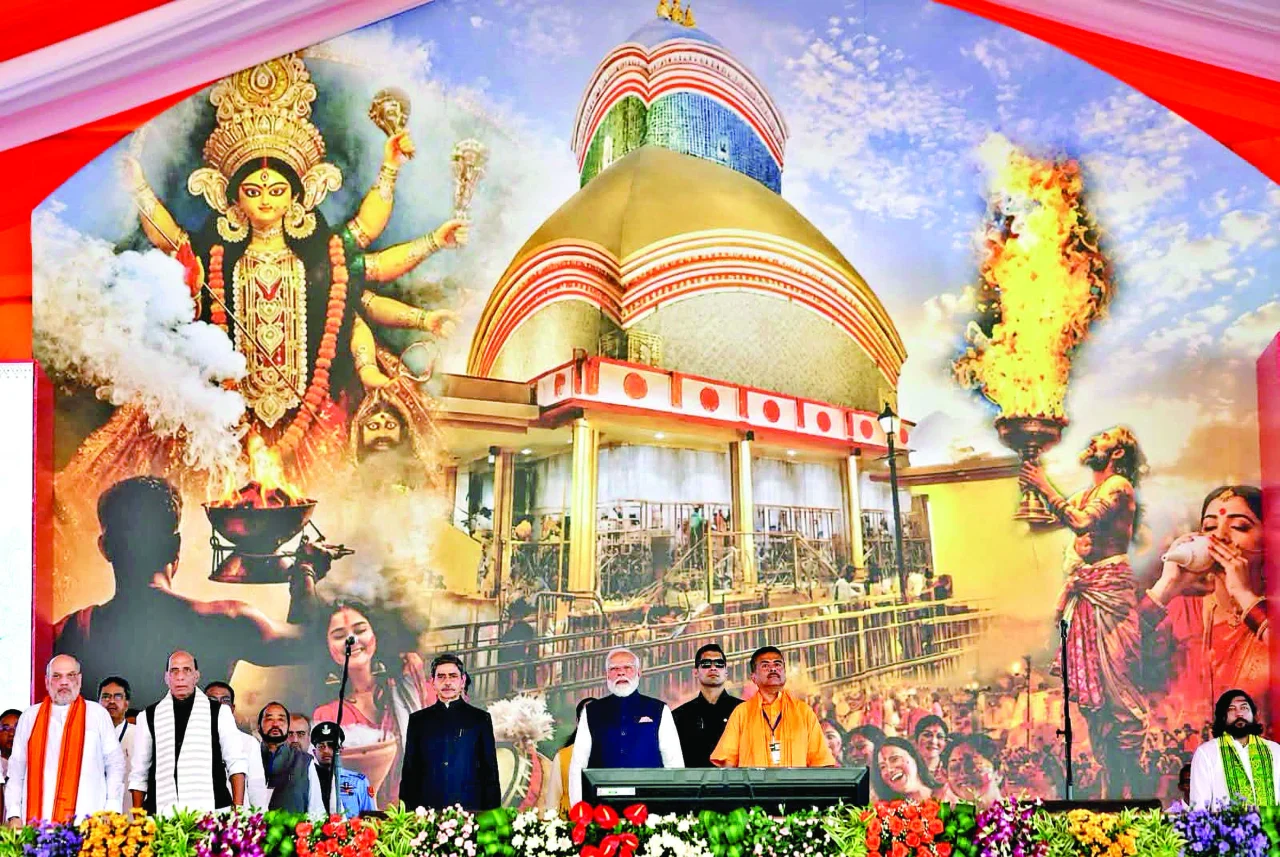
Bengal also produced a religious renaissance — Ramakrishna, Vivekananda, Aurobindo — who gave nineteenth-century Hinduism the confidence to debate Western Christianity in the language of the West without being intellectually defeated. Bengal produced revolutionaries — Bagha Jatin, Khudiram Bose, Surya Sen, Subhas Chandra Bose — whose sacrifices shook the British Empire more deeply than Gandhian fasts ever did.
Bengal gave India “Vande Mataram” and “Jana Gana Mana.” It also gave economic strength — in the 1910s, the Bengal Presidency accounted for more than half of British India’s foreign trade, and Calcutta was considered the second city of the Empire after London. In Curzon’s words, Calcutta had become “heated”; in simpler language, Bengal had begun winning arguments against the West, and that had become inconvenient.
What happened to Bengal between 1911 and 2026 was not a natural decline. It was the cumulative work of three governing systems, each of which had structural interests in keeping Bengal weakened.
In 1911, the British realised they could no longer control Calcutta and shifted the capital away. After 1947, the Nehruvian-Lutyens establishment deepened the inherited colonial structure. The Boundary Commission separated Calcutta from its natural eastern hinterland. Forty lakh Hindu refugees entered West Bengal without any long-term rehabilitation plan.
SP Mookerjee’s Unique Contribution
Syama Prasad Mookerjee — who almost single-handedly ensured that West Bengal did not become part of Pakistan, and whose political legacy is now returning to power — proposed a population exchange similar to Punjab’s to Nehru. However, Nehru rejected it. Mookerjee resigned from the Cabinet in 1950 and died in custody in Srinagar three years later under circumstances that were never properly investigated. Then came the “Freight Equalisation” policy, which administratively destroyed the industrial-geographic advantages of the Hooghly Valley by equalising transport costs for coal, iron, and steel across India. Bengal’s share of India’s industrial production fell from 27 per cent in 1947 to 17 per cent by 1961.
The same ruling establishment that adopted Vande Mataram and Jana Gana Mana as national symbols hollowed out the very land that produced them, while describing this suffocation as “natural market trends.”
Prolonged Communist Rule
In 1977 came the Communist Government, which went on to become the longest continuously elected Communist rule in the democratic world. Polite society remembers “Operation Barga” and forgets the rest. The “rest” included the Naxalite movement, in which Charu Mazumdar’s doctrine of class annihilation destroyed an entire generation of Bengal’s brightest students. It included the murder of the Vice-Chancellor of Jadavpur University in his own home by his own students in December 1970. It included the Marichjhapi massacre of January 1979, when thousands of Bengali Hindu Dalit refugees were blockaded on an island in the Sundarbans, denied food and water, and later fired upon on 31 January.
Three months later, the Information Minister who declared the island “refugee-free” was Buddhadeb Bhattacharjee — later Chief Minister — who is still remembered in elite circles as a “cultured, poetry-loving Marxist.” The official death toll was two. No formal investigation was ever conducted. Historian Ross Mallick once asked: if the victims had carried surnames like Banerjee or Mukherjee instead of Mandal or Sarkar, would the reaction have been the same? That question remains unanswered because everyone already knows the answer. The Trinamool Congress Government that came to power in 2011 did not stop the decline; it economically exploited it. Between 2011 and 2025, 6,688 registered companies shifted their headquarters out of West Bengal, according to data presented in the Rajya Sabha last July. Their main destinations were Maharashtra, Delhi, Uttar Pradesh, Chhattisgarh, and Gujarat. To Bengal’s East now stands Bangladesh — created by the Partition of Bengal in 1947 — whose per capita income has now surpassed that of West Bengal. The land that gave birth to Jagadish Chandra Bose now trails behind the country that includes his birthplace. There is little debate over these facts. The only debate was whether this situation could be changed. I would argue that it certainly can.The seventy-five years between 1947 and 2026 should be seen as an interregnum between two renaissances. The first renaissance ended with the death of Rabindranath Tagore in 1941. The second was delayed by three hostile systems of rule. Now, for the first time in one hundred and fifteen years, those structural obstacles have been removed.
Renaissance never proceed in straight lines. Even after the Sack of Rome in 1527, the Italian Renaissance did not end; Caravaggio and Galileo still emerged, and Venetian art still flourished. Renaissances are interrupted, but they do not die easily. What kills them is sustained civilisational hostility; what revives them is the end of that hostility. Bengal’s reservoir of strength still exists. Despite three suppressive systems, Bengal still produced Satyajit Ray, Amartya Sen, and Abhijit Banerjee. Bengali diasporas remain distinctly Bengali across the world even after decades of cultural fragmentation. Its institutions still survive — Presidency University, Jadavpur University, Visva-Bharati, IIT Kharagpur, the Indian Statistical Institute, Belur Math, and the Bose Institute. In 2023, Visva-Bharati became a UNESCO World Heritage site. In 2021, Durga Puja received UNESCO recognition as an Intangible Cultural Heritage — the first festival in Asia to receive that distinction. The cultural capital remains world-class. What has been missing for three generations is a State Government willing to utilise it. Therefore, the new Government’s responsibility has two parts. The first is administrative reconstruction — urgent and immediate: restoring law and order in border districts, dismantling the syndicate system, freeing universities from political cadre control and restoring academic autonomy, finally building the Tajpur deep-sea port after fifteen years of announcements, securing the Siliguri Corridor, and ensuring that the seminar rooms of RG Kar Medical College are safe for women studying there. None of these are glamorous tasks. But they are the precondition for the second responsibility — cultural renaissance — something no Indian state government has seriously attempted. That renaissance means rebuilding Bengal’s universities as real universities rather than political patronage centers; using Visva-Bharati, Belur Math, and the Bose Institute as civilisation-building institutions in line with their founders’ visions; recovering Subhas Chandra Bose, Vivekananda, and Aurobindo from the neglect of selective secular narratives; and above all, creating an environment in which an ambitious young Bengali can imagine a future without leaving Calcutta.
The decline that began with the Delhi Durbar of 1911 was one continuous process — managed by three different forces but united by the same outcome: a weakened Bengal. Generations of Bengalis have lived through that reality, and now they want it to end. What happens next depends on the people of Bengal and on the Government they have just elected — a Government whose responsibility is not merely to govern a difficult State for five years, but to participate in the restoration of a civilisation long held down. The new Government must be honest, firm, and uncompromising on questions of administration, law and order, and development. Bengal’s reservoir of strength still exists. After more than a century, Bengal finally has a favorable political moment once again. The rest is now a question of courage.