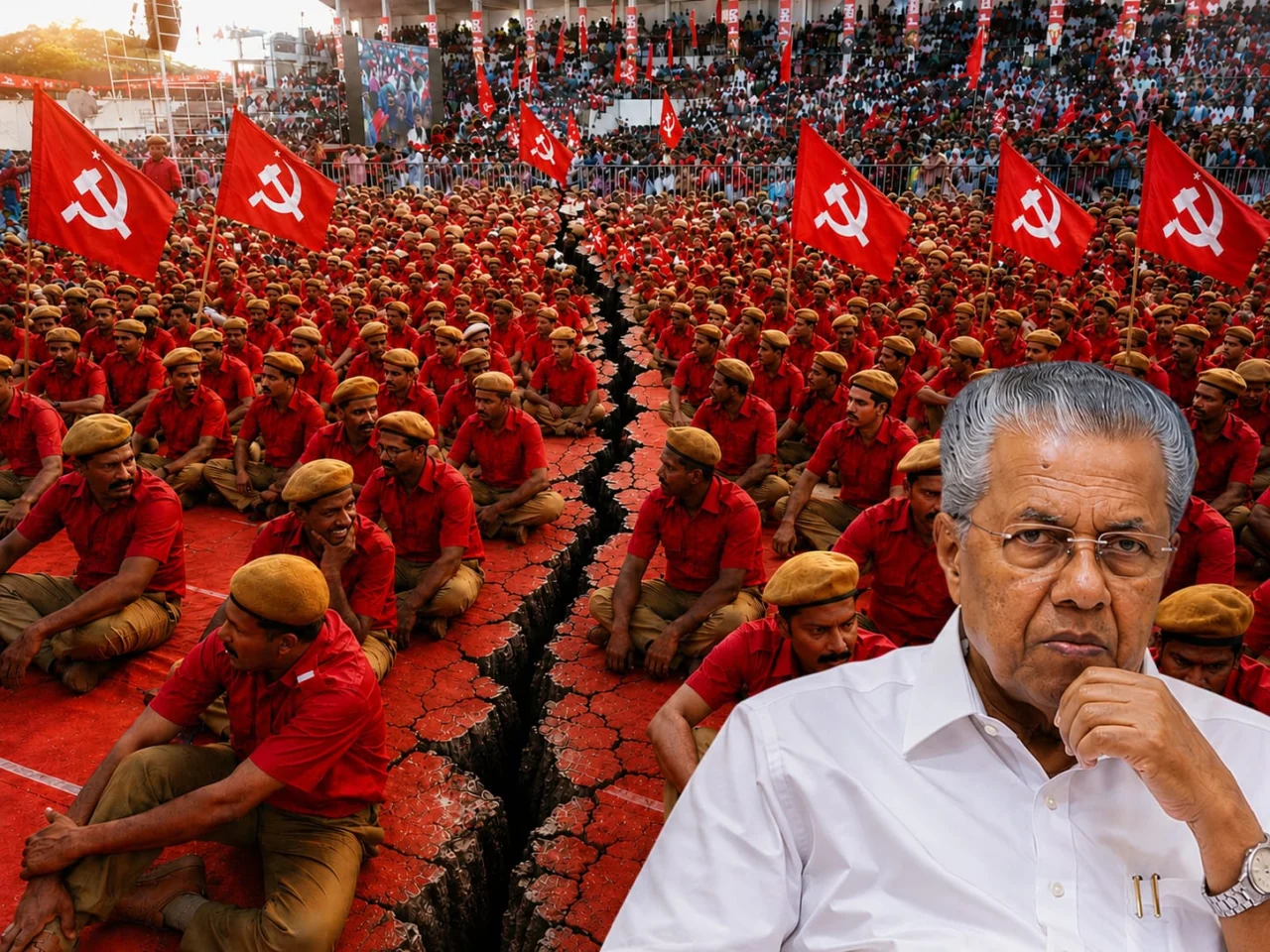
The Communist Party of India (Marxist) is facing far more than an ordinary electoral defeat in Keralam. The developments following the election results have exposed a deeper political, organisational and leadership crisis within the party, particularly in Kannur district, long considered the ideological and organisational fortress of the CPI(M). What has alarmed many within the party is not merely the scale of the defeat, but the apparent inability of the leadership to recognise the growing anti-incumbency sentiment, factionalism and erosion of confidence among grassroots workers before the election itself.
The Communist movement in Keralam officially began in December 1939 during a secret meeting at Parappuram in Pinarayi near Thalassery in Kannur district, where the Keralam unit of the Congress Socialist Party transformed itself into a unit of the Communist Party of India (CPI), laying the foundation for what would later become one of the strongest Communist political movements in the country. For decades, the Kannur unit of the CPI(M) was projected as the backbone of the party in Keralam and across India. The district was frequently showcased as a model of cadre discipline, ideological consolidation and organisational strength. Constituencies such as Taliparamba, Payyannur and Thrikkaripur were viewed as impregnable Left strongholds where the very possibility of defeat was politically unimaginable. The recent results, however, have shattered that perception and triggered intense criticism within the party structure.
Many party members and observers now believe that the crisis confronting the CPI(M) is not simply an electoral setback but part of a larger structural decline. The comparison with West Bengal has become unavoidable inside the party. The CPI(M), which ruled Bengal for 34 years uninterrupted, is today struggling to maintain even a marginal political presence there. At a time when the Bharatiya Janata Party has managed to establish at least a limited but steadily growing political space in Keralam, the setbacks suffered by the CPI(M) in its own traditional bastions have deepened anxieties regarding the future of the party.
Leadership accused of disconnect from grassroots reality
The criticism emerging after the election defeat has focused heavily on the leadership’s failure to understand the changing political mood on the ground. Party members argued during internal discussions that electoral defeat itself is not the greatest political failure. The more serious failure lies in not foreseeing the defeat despite possessing extensive organisational mechanisms, intelligence structures and experienced leadership networks.
Reports regarding interventions by senior leaders and central committee-level leadership during the candidate selection process have also raised uncomfortable questions inside the party. Critics argued that if such extensive organisational oversight still failed to detect anti-incumbency, organisational erosion and dissatisfaction among workers, it reflected a dangerous disconnect between the leadership and grassroots reality.
As the CPI(M) leadership initiated post-election assessment meetings, criticism against top leaders intensified sharply. During the Kannur District Committee meeting held after the district secretariat meeting, severe criticism was openly directed against the leadership. Even those who had earlier remained hesitant to speak out reportedly came forward and criticised the leadership with detailed reasons and examples.
Members openly mentioned the names of CPI(M) General Secretary MA Baby, former Chief Minister Pinarayi Vijayan and State Secretary MV Govindan while enumerating what they described as the general failures of the leadership. The criticism was no longer confined to informal discussions but became part of structured party deliberations.
There was particularly severe criticism against M.A. Baby. Members questioned his repeated public statements claiming there was no anti-government sentiment and that nothing significant had happened against Chief Minister Pinarayi Vijayan. Several members argued that such statements reflected the leadership’s inability to understand public anger and political dissatisfaction.
Since the election campaign had been conducted under collective leadership, criticism also emerged against Baby’s position that the Chief Minister alone should not be held responsible for the defeat. Members pointed out that the entire leadership structure had failed politically. However, many simultaneously criticised Pinarayi Vijayan directly, alleging that his “dictatorial style” had created resentment and disrespect among sections of the public and party workers alike. Some members reportedly stated that repeated statements such as “we are checking” and “we will correct things after studying the defeat” were meaningless when the scale of the defeat itself reflected a much deeper political crisis.
Demand for leadership changes intensifies
The Kannur District Committee reportedly demanded that the leadership decision regarding the Assembly be reconsidered and suggested that Pinarayi Vijayan should instead be made the Leader of the Opposition. Members also demanded that M.V. Govindan resign from the post of State Secretary. According to participants in the meeting, the core criticism was that these leaders themselves had become the principal reason for the defeat of the Left Democratic Front, rather than anti-government sentiment alone. Strong criticism was also raised regarding the appointment of an elderly and unhealthy opposition leader at a time when 62-year-old V.D. Satheesan had become Chief Minister. Some members reportedly described the decision as “making fun of the people”.
The district committee meeting, which followed the district secretariat discussions, witnessed unprecedented criticism against the functioning style of the leadership. Despite all the work carried out in party activities, members reportedly identified Pinarayi Vijayan’s political style as the central reason behind the miserable defeat suffered by the CPI(M). Several members argued that such a style required immediate correction if the party wished to survive politically.
Payyannur and Taliparamba become centres of revolt
The strongest internal confrontation reportedly took place over the humiliating defeats suffered in Payyannur and Taliparamba. Reports indicate that a sharp verbal exchange erupted among leaders during the Kannur district secretariat meeting regarding the disastrous performance in these constituencies. The meeting reportedly continued late into the night due to the intensity of the discussions.
District Secretary K.K. Ragesh faced severe criticism regarding his stand on the Payyannur and Taliparamba issues. Several members alleged that his handling of the situation further aggravated internal problems and contributed to the defeat. The meeting was held at Azhikodan Mandir in the presence of senior leaders including M.V. Govindan, E.P. Jayarajan, KK Shailaja and PK Sreemathy.
The shocking victories secured by the United Democratic Front in Payyannur and Taliparamba, both long regarded as impregnable CPI(M) strongholds, became the central issue of discussion.
The increase in BJP votes in these regions added further concern within the party. Members viewed the BJP’s growth as an indication that sections of traditional Left voters were drifting away from the CPI(M). The victory of V. Kunjikrishnan in Payyannur emerged as one of the biggest blows to the party. Kunjikrishnan had earlier left the CPI(M) after raising allegations regarding martyrs’ fund fraud. Contesting with UDF support, his victory was viewed as a direct political embarrassment for the leadership.
Similarly, the victory of district secretariat member T.K. Govindan in Taliparamba triggered intense discussion within the party. T.K. Govindan had left the CPI(M) in protest against the nomination of P.K. Shyamala, wife of State Secretary M.V. Govindan, as the candidate in Taliparamba. Contesting with UDF backing, he defeated the CPI(M) candidate and exposed the scale of internal rebellion within the organisation.
Factionalism and internal strife explode in Kannur
Members during the discussions pointed to long-standing factionalism in Payyannur, poor management by the local leadership and persistent internal strife as the primary reasons for the defeat. The huge leakage of votes from party workers and traditional supporters was also highlighted repeatedly during the discussions. The meeting also assessed the political consequences of shifting K.K. Shailaja from Mattannur to the Peravoor constituency, where she eventually suffered defeat. Discussions also focused on the embarrassing situation in Dharmadam, where Chief Minister Pinarayi Vijayan failed to secure the lead even after six rounds of counting.
There are now indications that the simmering factionalism within the Kannur unit could explode further in the coming days. The developments in Taliparamba especially have become symbolic of the crisis. Since the formation of the Taliparamba constituency in 1967, non-CPI(M) candidates had won there only once. Congress candidate C.P. Govindan Nambiar had secured victory in 1970. Apart from that exception, Taliparamba voters had consistently elected whoever the CPI(M) fielded. In 2021, M.V. Govindan had won Taliparamba by a margin of 22,689 votes. This time, however, CPI(M) rebel T.K. Govindan secured victory by 12,551 votes, marking one of the most shocking reversals in the constituency’s political history.
The state committee also reportedly criticised the decision to nominate M.V. Govindan’s wife despite opposition from multiple sections within the party. Members argued that the controversy damaged the CPI(M)’s credibility not only inside Kannur district but across Keralam.
When Taliparamba district secretariat member T.K. Govindan and Payyannur district committee member V. Kunjikrishnan raised concerns regarding self-serving politics, corruption allegations and leadership bias, the leadership allegedly attempted to downplay the issue rather than address the underlying dissatisfaction. Critics argued that the leadership completely failed to understand the minds of grassroots workers and ordinary cadre members.
A section of leaders from Kannur adopted a similar critical position during state committee discussions as well. The overall mood within the party now reflects deep uncertainty regarding the future direction of the CPI(M) in Keralam.
For the CPI(M), therefore, the crisis unfolding in Kannur is no longer simply about electoral arithmetic. It represents the weakening of a political structure once considered one of the most disciplined and formidable organisational machines in India. The election defeat has exposed widening gaps between leadership and cadre, intensified factionalism and raised serious questions regarding whether the party can politically recover from the crisis now unfolding inside its own strongest bastion.