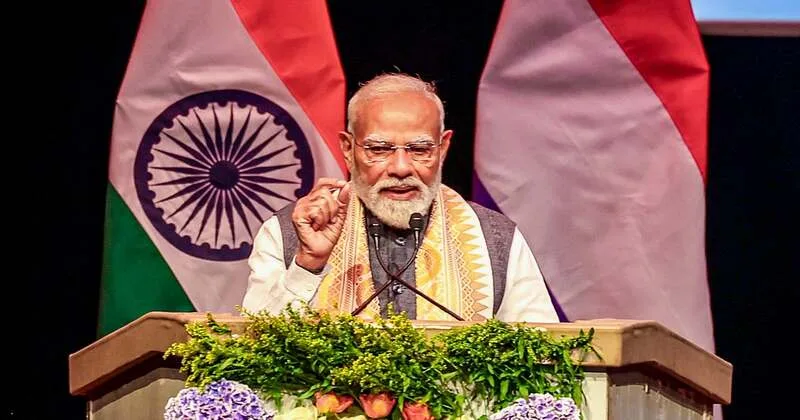
The Hague: Prime Minister Narendra Modi on May 16 delivered one of his strongest warnings yet about the mounting pressures on the global economy, cautioning that decades of progress in reducing poverty could be reversed if the world fails to contain ongoing geopolitical and energy crises.
Addressing members of the Indian diaspora at a community event in The Hague during the second leg of his five-nation European tour, Modi said the world was entering a dangerous phase marked by overlapping disruptions that threaten economic stability and human welfare. “The world is dealing with new challenges,” the Prime Minister said, referring to the lingering effects of the coronavirus pandemic, continuing wars, and the escalating global energy crisis triggered by tensions in West Asia.
‘A decade of disasters’
Speaking in Hindi, Modi described the present decade as one defined by compounding global shocks. “First came the corona(virus) pandemic; then wars began to break out, and now there is an energy crisis. This decade is turning into a decade of disasters for the world,” he said. Referring to the ongoing conflict in the oil-rich West Asian region following the United States and Israel’s attacks on Iran, Modi warned that the consequences could extend far beyond the immediate battlefield if the situation continues unchecked. “If these situations are not rapidly changed, achievements of the past many decades would be washed away, and a huge section of the world’s population would be pushed back into poverty,” he said.
The remarks come at a time of rising concern across global markets over disruptions in energy supplies and growing fears of economic slowdown.
🚨 BIG STATEMENT
🇮🇳 PM Modi warns over the global energy crisis: “This is becoming a decade of crisis for the world.”
“If things don’t CHANGE, the achievements of the last few decades could be ERASED and MASSIVE poverty may return.” pic.twitter.com/zSshrEiOmB
— Megh Updates 🚨™ (@MeghUpdates) May 16, 2026
Days before beginning his European tour, Modi had also appealed to Indians to adopt voluntary austerity measures to reduce pressure on the economy and conserve foreign exchange reserves.
Speaking in Hyderabad earlier this month, he urged citizens to work from home wherever possible, limit unnecessary overseas travel, reduce purchases of gold, and adopt fuel-saving habits.
Push for conservation measures
Calling fuel conservation an act of “patriotism”, Modi encouraged wider use of public transport, carpooling, and lower fertiliser consumption. Recalling behavioural changes adopted during the Covid pandemic, he said remote work and restrained consumption could help India manage short-term economic stress. “We must make efforts to use only as much as is needed to save foreign currency and reduce the adverse effects of war crises,” he said.
Several Asian countries have already introduced emergency conservation measures as energy supplies tighten. The Philippines has declared a national energy emergency, while South Korea has advised citizens to reduce electricity use. Japan has launched its largest-ever release of emergency oil reserves.
The crisis intensified after Iran closed the Strait of Hormuz, a strategic waterway through which nearly 20% of the world’s oil trade passes. The International Energy Agency has described the disruption as the largest supply shock in the history of the global oil market. India imports nearly 90 per cent of its crude oil requirements and depending on the Strait of Hormuz for roughly half of its regular crude supplies.