Sanatan Row in TN Assembly: CM Vijay’s silence sparks debate
July 21, 2026
  • Read Ecopy
  • Circulation
  • Advertise
  • Careers
  • About Us
  • Contact Us
Android AppiPhone AppArattai
Organiser
  • ‌
  • Bharat
    • Assam
    • Bihar
    • Chhattisgarh
    • Jharkhand
    • Maharashtra
    • View All States
  • World
    • Asia
    • Europe
    • North America
    • South America
    • Africa
    • Australia
  • Editorial
  • International
  • Opinion
  • RSS @ 100
  • More
    • Op Sindoor
    • Analysis
    • Sports
    • Defence
    • Politics
    • Business
    • Economy
    • Culture
    • Special Report
    • Sci & Tech
    • Entertainment
    • G20
    • Azadi Ka Amrit Mahotsav
    • Vocal4Local
    • Web Stories
    • Education
    • Employment
    • Books
    • Interviews
    • Travel
    • Law
    • Health
    • Obituary
  • Subscribe
    • Subscribe Print Edition
    • Subscribe Ecopy
    • Read Ecopy
  • ‌
  • Bharat
    • Assam
    • Bihar
    • Chhattisgarh
    • Jharkhand
    • Maharashtra
    • View All States
  • World
    • Asia
    • Europe
    • North America
    • South America
    • Africa
    • Australia
  • Editorial
  • International
  • Opinion
  • RSS @ 100
  • More
    • Op Sindoor
    • Analysis
    • Sports
    • Defence
    • Politics
    • Business
    • Economy
    • Culture
    • Special Report
    • Sci & Tech
    • Entertainment
    • G20
    • Azadi Ka Amrit Mahotsav
    • Vocal4Local
    • Web Stories
    • Education
    • Employment
    • Books
    • Interviews
    • Travel
    • Law
    • Health
    • Obituary
  • Subscribe
    • Subscribe Print Edition
    • Subscribe Ecopy
    • Read Ecopy
Organiser
  • Home
  • Bharat
  • World
  • Operation Sindoor
  • Editorial
  • Analysis
  • Opinion
  • Culture
  • Defence
  • International Edition
  • RSS @ 100
  • Magazine
  • Read Ecopy
Home Bharat

Insult to Sanatan in Tamil Nadu Assembly: Would CM Vijay have remained silent if Islam or Christianity were targeted?

The controversy in the Tamil Nadu Legislative Assembly has reignited a national debate on secularism, political silence, and perceived double standards in addressing religious sensitivities. With C. Joseph Vijay remaining silent during the remarks linked to Udhayanidhi Stalin, questions over political accountability and equal respect for all faiths have intensified

Adv Karan ThakurAdv Karan Thakur
May 16, 2026, 06:00 pm IST
in Bharat, Tamil Nadu
Follow on Google News
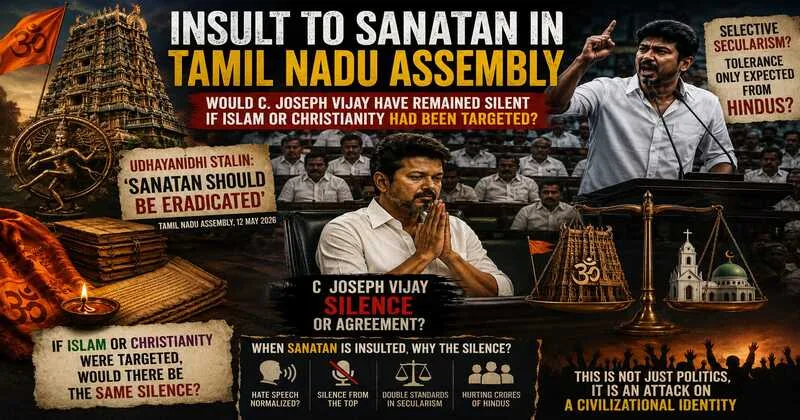
Tamil Nadu Assembly row has sparked debate on secularism and double standards, with C. Joseph Vijay’s silence during remarks linked to Udhayanidhi Stalin raising questions

Tamil Nadu Assembly row has sparked debate on secularism and double standards, with C. Joseph Vijay’s silence during remarks linked to Udhayanidhi Stalin raising questions

FacebookTwitterWhatsAppTelegramEmail

What unfolded in the Tamil Nadu Legislative Assembly on 12 May 2026 was not merely a political controversy. For many Indians, it represented a deeper civilisational and ideological conflict surrounding the place of Sanatan Dharma in modern Indian politics. The renewed remarks by DMK leader regarding the need to “eradicate Sanatan” reignited a debate that first erupted in 2023. Yet this time, the larger controversy was not only about the statement itself, but about the silence of the Chief Minister .

As the remarks were made in the Assembly, Vijay reportedly remained seated quietly, watching without publicly objecting or distancing his government from the statement. For critics, that silence became symbolic. They argue that when a constitutional office-holder chooses not to respond to remarks perceived as offensive toward the faith of millions, the silence itself acquires political meaning.

The central question being raised is straightforward: if a similar statement had been made against Islam or Christianity, would the political establishment, media, and civil society have reacted with the same restraint? Would such comments have been dismissed as “political expression” or “ideological criticism”? Or would there have been immediate outrage, condemnations, and demands for accountability?

This debate has intensified because the controversy is not occurring in isolation. In 2023, Udhayanidhi Stalin had compared Sanatan Dharma to diseases such as dengue, malaria, and COVID-19, arguing that it should not merely be opposed but “eliminated.” Those remarks had already triggered nationwide criticism. Supporters of the DMK defended the comments within the framework of social justice and opposition to caste hierarchy, while critics viewed them as an attack on Hindu civilizational identity itself.

Also Read: Tamil Nadu CM Vijay’s classmate Manu Joseph slams actor over ‘poor childhood’ claim, says he grew up privileged

The present controversy, therefore, reflects a broader ideological divide in Indian politics. Critics argue that attacks on Hindu symbols, temples, traditions, and Sanatan practices are frequently packaged as “progressive politics,” “rationalism,” or “social reform,” while equivalent language directed toward other religions would be considered unacceptable and intolerant. According to this viewpoint, India’s secular discourse has increasingly become selective, placing the burden of tolerance disproportionately upon Hindu society.

Tamil Nadu’s Dravidian political tradition has long maintained a confrontational relationship with aspects of Hindu religious symbolism, especially those associated with caste structures and Brahminical dominance. However, what concerns many observers today is the normalisation of language calling for the destruction or eradication of Sanatan itself. In that context, the conduct of Chief Minister C. Joseph Vijay has become central to the discussion.

Vijay had entered politics projecting himself as a symbol of “new politics” in Tamil Nadu — one that promised inclusivity, unity, and respect across communities. During his political campaign, he frequently emphasised harmony and a fresh political beginning beyond old ideological hostilities. Critics now argue that his silence during the Assembly controversy appears inconsistent with those promises.

In politics, silence can often become more consequential than speech. Supporters of the Chief Minister describe his conduct as parliamentary restraint or political decorum. Opponents, however, see it as tacit approval. That is why social media and political discussions are increasingly centred not only on what Udhayanidhi Stalin said, but also on why the Chief Minister did not publicly respond.

The controversy has also revived a larger national conversation about the meaning of hate speech and secularism in India. Many commentators argue that strong reactions emerge swiftly when remarks target minority religions, yet statements directed at Sanatan or Hindu traditions are often contextualised as ideological criticism or social commentary. For critics, this reveals a double standard within sections of politics, media, and intellectual discourse.

For millions of Hindus, “Sanatan” is not merely a theological term. It represents a civilizational continuity stretching back thousands of years and forms an essential part of India’s cultural identity. Therefore, calls for its eradication are interpreted not simply as political rhetoric but as attacks on a broader civilizational framework.

The scenes from the Tamil Nadu Assembly are therefore likely to remain politically significant. They symbolise more than a controversy over words. For many observers, they represent a clash between competing visions of secularism, identity, and cultural legitimacy in India.

Ultimately, the debate today is no longer confined to Udhayanidhi Stalin’s remarks alone. It is increasingly focused on whether Tamil Nadu’s new political leadership will genuinely uphold equal respect for all faiths, or whether criticism directed specifically at Sanatan traditions will continue to be treated differently within the framework of Indian secular politics.

 

Topics: Sanatan Dharma RowTamil Nadu AssemblyC Joseph VijayDMK controversySecularism debate IndiaReligious remarks politicsUdhayanidhi Stalin
ShareTweetSendShareSend
✮ Subscribe Organiser YouTube Channel. ✮
✮ Join Organiser's WhatsApp channel for Nationalist views beyond the news. ✮
Previous News

Uttarakhand: Mosque management begins demolishing illegal high minarets after district administration warns of sealing

Next News

Swa-based economy: The legacy of Veer Savarkar perpetuated by the RSS

Related News

Tamil Nadu CM Joseph Vijay (File Photo)

Tamil Nadu: TVK alleges DMK bid to poach its MLAs; DMK counters with horse-trading complaint against CM Joseph Vijay

Tamil Nadu govt challenges High Court cow slaughter ban in Supreme Court; BJP slams CM Joseph Vijay

Tamil Nadu: Hindu Munnani objects to portraits of Vijay being placed inside temple sanctums

Tamil Nadu: Zoho’s Sridhar Vembu recounts alleged bribery demands for school NOC approvals during DMK regime

Tamil Nadu: Assembly Speaker directs all bureaucrats to strictly follow warrant of precedence after Mayor-MLA row

Tamil Nadu Chief Minister Joseph Vijay in the Legislative Assembly

Tamil Nadu: CM Vijay seeks Centre’s intervention on Mekedatu dam, avoids confrontation with Congress ally in Karnataka

Load More

Latest News

Karnataka: Cops suspended over Rs 5,000 monthly hafta from illegal Bangladeshi immigrants

Plywood workshop (Representative image)

Keralam: Nine child labourers rescued from Perumbavoor plywood factories; organised child trafficking racket suspected

Fazal-ur-Rehman and Asim Munir

Pakistan: Fazal-ur-Rehman challenges Asim Munir to ‘take off uniform & fight election’; Slams for failure in Kargil war

MEA condemns MV Golden Leo attack, death of 4 Indians; Summons Russian diplomat over maritime security

Ayodhya: Three boatmen detained after viral video shows beer drinking, mutton consumption on sacred Saryu river

Karnataka: HC refuses to quash Rs 5.3 crore fake govt job scam case against Shamshad Begum, daughter of Mansur Ahmed

Hera Panchami marks Maa Lakshmi's symbolic anger with the ceremonial breaking of Bhagwan Jagannath's Nandighosha chariot

Hera Panchami: The divine story behind Maa Lakshmi’s anger and the breaking of Nandighosha chariot

Centre's SMILE scheme to cover 295 cities by 2030-31, aims to rehabilitate 35,000 persons engaged in begging

SMILE Scheme Expansion: Government plans to make 295 cities begging-free, over 10,200 already rehabilitated

Karnataka HC pulls up Congress govt for chasing tweets instead of criminals, stays FIR probe

Viral social media posts falsely claimed that India's first hydrogen-powered train suffered a technical failure

Fact Check: Routine servicing of India’s Hydrogen train misconstrued as indigenous tech failure in viral video

Load More
  • Privacy
  • Terms
  • Cookie Policy
  • Refund and Cancellation
  • Delivery and Shipping

© Bharat Prakashan (Delhi) Limited.
Tech-enabled by Ananthapuri Technologies

  • Home
  • Search Organiser
  • Bharat
    • Assam
    • Bihar
    • Chhattisgarh
    • Jharkhand
    • Maharashtra
    • View All States
  • World
    • Asia
    • Africa
    • North America
    • South America
    • Europe
    • Australia
  • Editorial
  • Operation Sindoor
  • Opinion
  • Analysis
  • Defence
  • Culture
  • Sports
  • Business
  • RSS @ 100
  • Entertainment
  • More ..
    • Sci & Tech
    • Vocal4Local
    • Special Report
    • Education
    • Employment
    • Books
    • Interviews
    • Travel
    • Health
    • Politics
    • Law
    • Economy
    • Obituary
  • Subscribe Magazine
  • Read Ecopy
  • Advertise
  • Circulation
  • Careers
  • About Us
  • Contact Us
  • Policies & Terms
    • Privacy Policy
    • Cookie Policy
    • Refund and Cancellation
    • Terms of Use

© Bharat Prakashan (Delhi) Limited.
Tech-enabled by Ananthapuri Technologies