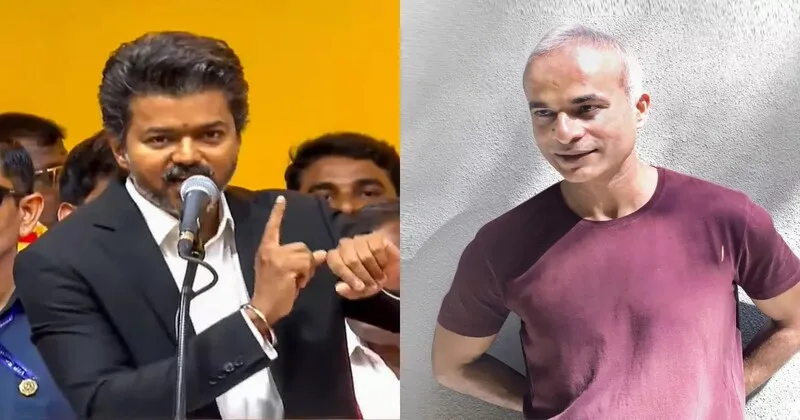
Chennai: A political storm has erupted in Tamil Nadu soon after the newly sworn-in Chief Minister C. Joseph Vijay spoke about understanding “poverty and hunger” during his inaugural address. The remark, intended to strike a chord with the masses, has instead drawn pointed criticism from noted author and screenwriter Manu Joseph, who claims to have shared a classroom with Vijay during their school days.
In his first speech as Tamil Nadu chief minister, Vijay said that he grew up in poverty, and that he even knows what hunger is. It's bullshit because he was my classmate in the third standard in Loyola School.
His father was a filmmaker who set up his son for a career in films.…— Manu Joseph (@manujosephsan) May 11, 2026
The Claim That Sparked the Debate
In his first major speech after assuming office, Vijay attempted to position himself as a leader who could empathise with the struggles of ordinary citizens. By invoking themes of poverty and hunger, he appeared to align himself with the lived realities of millions across the state. However, the statement quickly came under scrutiny, not from political rivals, but from someone who knew him personally.
Manu Joseph’s Public Rebuttal
Taking to social media, Manu Joseph directly challenged Vijay’s claim, dismissing it as inaccurate. He revealed that both he and Vijay studied at Loyola School, a reputed institution in Chennai, and suggested that Vijay did not grow up in circumstances that could be described as poverty.
Joseph further pointed to Vijay’s family background, noting that his father, S. A. Chandrasekhar, was an established filmmaker who played a key role in launching his son into the Tamil film industry. According to Joseph, while there may have been phases of financial uncertainty, as is common in the film world, this did not equate to the kind of deprivation implied in Vijay’s remarks.
BREAKING: Full speech of Tamil Nadu Chief Minister C. Joseph Vijay is here. pic.twitter.com/ksEtmBXtBV
— Actor Vijay Team (@SuchitraKarthi5) May 10, 2026
In a broader critique, Joseph argued that individuals from relatively privileged backgrounds sometimes conflate temporary financial struggles with genuine poverty, a distinction he suggested should not be blurred in public discourse.
The episode has sparked a larger debate about political storytelling. Leaders often use personal narratives to build emotional connections with voters, especially in a state like Tamil Nadu, where welfare politics and social justice movements have historically shaped electoral discourse.
So far, there has been no official response from Vijay or his office addressing Joseph’s criticism. This silence has left room for speculation, with some viewing it as a strategic move to avoid escalating the issue, while others see it as a missed opportunity to clarify his statement.
Beyond the personalities involved, the controversy raises an important question: what does it mean to “know poverty”? Is it a lived experience defined by sustained deprivation, or can it also include indirect exposure and understanding? The answer is not straightforward, but the debate underscores the sensitivity surrounding such claims.
The clash between C. Joseph Vijay and Manu Joseph have quickly evolved into more than a personal disagreement; it is now a reflection of the complex interplay between image, identity, and authenticity in modern politics. As Vijay begins his tenure as Chief Minister, the controversy serves as an early reminder of the scrutiny that accompanies public life. In an era where narratives are instantly examined and contested, even a single line in a speech can ignite a statewide and national conversation.