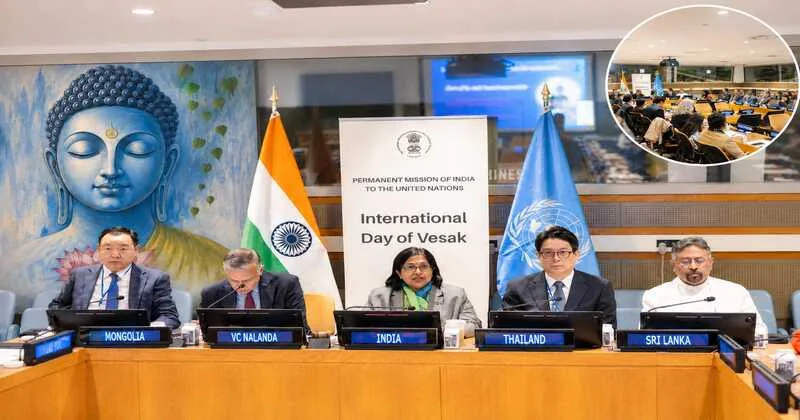
New York: A panel discussion on the International Day of Vesak was hosted at the United Nations Headquarters in New York under the theme “Leveraging Buddhist Heritage for Strengthening Global Peace and Cooperation,” in an event organised by the Permanent Mission of India to the United Nations with the participation of the Permanent Missions of Bhutan, Cambodia, Japan, Lao PDR, Mongolia, Nepal, Republic of Korea, Sri Lanka, Thailand and Viet Nam. Vesak, also known as Buddha Purnima in many parts of South Asia, is the most sacred day for Buddhists across the world as it commemorates the birth, enlightenment and passing away of Bhagwan Buddha. Observed on the full moon day of May, Vesak symbolises the core Buddhist teachings of compassion, non-violence, peace, moderation and wisdom.
The discussion recalled the United Nations General Assembly Resolution 54/115 adopted in 1999, through which the UN officially recognised the International Day of Vesak to acknowledge the contribution Buddhism has made for more than two and a half millennia to the spirituality of humanity. The day is commemorated annually at the UN Headquarters and other UN offices in consultation with relevant UN bodies and permanent missions.
The panel discussion held on April 30, 2026, focused on how the shared Buddhist heritage across Asia can help shape international cooperation at a time marked by conflict, instability and global discord. Delegates and speakers collectively highlighted Buddhist values such as compassion, moderation, interdependence, dialogue and peaceful coexistence as principles that remain deeply relevant for contemporary global governance and international cooperation.
India highlights shared Buddhist civilisational heritage
In her welcome remarks, Charge d’Affaires and Acting Permanent Representative of India to the United Nations Ambassador Yojna Patel underlined the deep civilisational connections linking societies from the Indian Ocean region to the Indo-Pacific through Buddhist traditions, art, culture, architecture and the historical exchange of ideas and values. She detailed India’s continuing efforts to revitalise Buddhist ties through the development of Buddhist tourism circuits, preservation and restoration of Buddhist heritage sites and monasteries, conservation of archaeological locations, and strengthening pilgrimage infrastructure in neighbouring partner countries. According to her remarks, these initiatives are contributing to the organic evolution of a transnational spiritual corridor rooted in shared cultural and civilisational heritage.
https://twiiter.com/i/status/2049854562551423013
The event placed particular emphasis on Buddhist heritage as a “bridge of civilisations” capable of fostering mutual trust, dialogue and cooperation among nations. Participants stressed that initiatives involving heritage conservation, pilgrimage connectivity, cultural exchanges and academic collaboration can strengthen people-to-people ties while also contributing to peacebuilding and long-term regional cooperation.
Nalanda University Vice Chancellor delivers keynote address
Professor Sachin Chaturvedi, Vice Chancellor of Nalanda University, delivered the keynote address at the gathering, reflecting on the enduring civilisational wisdom of Buddhist traditions and their contemporary relevance in addressing global challenges. He emphasised interdependence and collective welfare as foundational principles of Buddhism that remain central to modern global governance debates. Drawing on the philosophical ideal of Jagathita, meaning the well-being of the world, he articulated a civilisational framework rooted in Buddhist traditions to advance Global South solidarity and strengthen multilateral cooperation.
Professor Chaturvedi argued for a transition from sectoral and purely quantitative development models toward integrated and human-centric approaches for achieving the Sustainable Development Goals. He linked Buddhist philosophy to ethical development, sustainability and systems thinking, stressing that these ideas can contribute meaningfully to contemporary policy frameworks and international governance structures. His address highlighted the relevance of Buddhist thought in promoting cooperation-based approaches in a fragmented international environment and positioned Buddhist heritage as an intellectual and ethical resource for addressing emerging global crises.
Participating countries emphasise peace, moderation and dialogue
Representatives from participating countries also highlighted how Buddhist teachings continue to shape social and political values within their respective societies. Bhutan referred to its Gross National Happiness framework as an example of governance rooted in values of collective welfare and human well-being. Sri Lanka emphasised peaceful conflict resolution and dialogue, while Japan, Thailand and Vietnam stressed the importance of human dignity in contemporary international relations.
The Republic of Korea highlighted the continuing resonance of Buddhist teachings among younger generations. Mongolia, Lao PDR and Cambodia reaffirmed the enduring values and principles associated with Bhagwan Buddha, while Nepal emphasised the “Middle Path” as a framework for moderation, balance and peaceful coexistence.
Collectively, the participating member states reaffirmed that Buddhist heritage remains an important unifying force capable of strengthening trust, encouraging dialogue and promoting cooperative approaches to peace and development. Speakers repeatedly underscored that Buddhist values offer constructive pathways for addressing contemporary global challenges through compassion, moderation and mutual understanding. The discussions concluded with a broader reaffirmation of the relevance of Vesak and Buddhist teachings in the modern world. Participants noted that the International Day of Vesak serves not only as a spiritual observance, but also as a reminder of the continuing importance of peace, goodwill and cooperation in international affairs.
Ambassador Harish Parvathaneni calls Buddha’s teachings vital in a world marked by conflict and distrust
In a sperate statement on the International Day of Vesak on May 12, India’s Permanent Representative to the United Nations Ambassador Harish Parvathaneni described Bhagwan Buddha’s teachings as deeply relevant in a world marked by uncertainty, distrust, division and conflict. Thanking the Permanent Missions of Thailand and Sri Lanka for convening the event, he said the annual Vesak gathering transforms the ECOSOC Chamber into a “Chamber of Peace, Compassion and Loving Kindness.” Referring to the peace walk led earlier this year by Most Venerable Bhikkhu Pannakara, he said the initiative inspired people through its simple yet profound message of peace.
Ambassador Parvathaneni noted that the Four Noble Truths teach self-awareness and interdependence, principles that help societies identify the roots of discord and pursue mutually beneficial and sustainable solutions. Highlighting India’s efforts to preserve and promote Buddhist heritage, he referred to the exposition of the Holy Relics of Bhagwan Buddha in Thailand in 2024, Vietnam in 2025 and Bhutan later that year, which together drew millions of devotees. He also recalled India’s hosting of the 2nd Global Buddhist Summit in January 2026 under the theme “Collective Wisdom, United Voice and Mutual Coexistence,” with participation from Supreme Patriarchs, Buddhist Sanghas, scholars and dignitaries from around the world. He said the teachings of Bhagwan Buddha continue to offer an alternative framework rooted in compassion, coexistence and peace for addressing contemporary global challenges.
The United Nations annually commemorates Vesak on the first full moon in May to honour the teachings of Bhagwan Buddha and his enduring message of compassion and peace, recognising Buddhism’s continuing contribution to humanity and global harmony. The United Nations, jointly with member countries, hosted a commemorative event marking the International Day of Vesak 2026 on May 12 at the United Nations Headquarters in New York for this year’s observance.