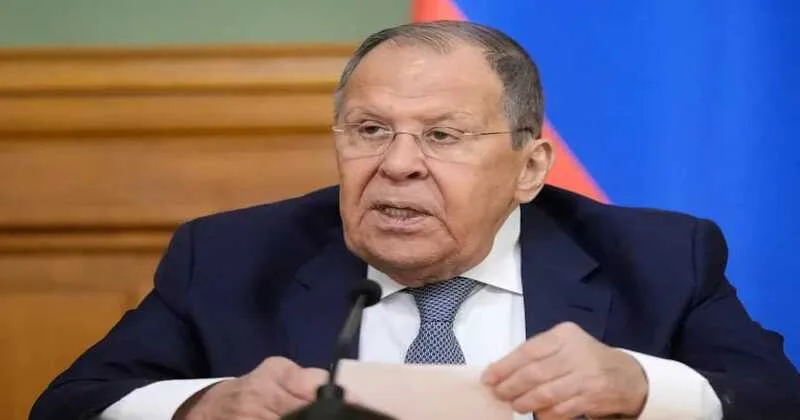
Moscow: Russian Foreign Minister Sergey Lavrov has asserted that Moscow will fully honour its commitments regarding energy exports to India despite what he described as unfair external pressure, while emphasising that India-Russia relations continue to rest on deep strategic trust and longstanding friendship.
In an interview with Russia Today-India? Ahead of his scheduled visit to New Delhi later this week, Lavrov said Russian energy supplies to India would continue uninterrupted regardless of attempts by outside powers to interfere with bilateral cooperation. He stated that Moscow would take every possible step to ensure that India’s interests in relation to Russian energy imports remain protected. “I can guarantee that India’s interests as they apply to Russian supplies will not suffer. We will do everything to ensure that this unfair and dishonest competition does not damage our agreements,” Lavrov said. The Russian foreign minister underlined that Moscow has consistently fulfilled its commitments in the energy sector not only with India but also with all of its international partners. He pointed to the long-running cooperation between India and Russia in nuclear energy as a major example of the depth and reliability of bilateral ties.
Kudankulam Nuclear Project highlighted
Lavrov described the Kudankulam Nuclear Power Plant as the flagship symbol of Indo-Russian cooperation in the energy sector. He said the project contributes substantially to India’s growing energy requirements and remains one of the most significant collaborative ventures between the two countries. “The Kudankulam Nuclear Power Plant is our flagship project. It meets a significant share of India’s needs,” he said. He added that construction and development work on additional power units at the nuclear facility is continuing steadily. Lavrov also noted that India’s expanding energy demands are not limited to nuclear power alone and stressed that Russia continues to supply India with hydrocarbons, including crude oil, natural gas and coal.
The Kudankulam nuclear facility in Tamil Nadu is being developed with Russian technological and technical support. Construction work at the site began in 2002, while the first unit started operating at its designed capacity of 1,000 megawatts in February 2016. According to reports carried by Russian state media, the entire project is expected to reach full operational capacity by 2027.
Lavrov also praised Prime Minister Narendra Modi, calling him one of the world’s most energetic and dynamic political leaders. He said Modi’s leadership was focused on achieving maximum sovereignty for India across multiple domains, including economic policy, defence, military preparedness, cultural preservation and the protection of India’s civilisational heritage.
“He possesses great energy and channels it towards extremely important goals such as achieving maximum sovereignty across all spheres, the economy, the military, defence, culture, and the preservation of India’s civilisational wealth, which is unmatched by any other country,” Lavrov remarked.
‘Hindi-Rusi Bhai Bhai’ remains strong
Emphasising the enduring nature of relations between Moscow and New Delhi, Lavrov stated that there was no possibility of the two countries drifting apart strategically or politically in the future. “A situation where our paths diverge simply does not exist, it is unthinkable,” he said. Lavrov said the slogan “Hindi-Rusi bhai bhai” had evolved beyond a historical political phrase and had become deeply rooted in Russian society and culture. He referred to the widespread popularity of Indian cinema and entertainment across Russia as evidence of the strong cultural bond shared by the two nations.
The Russian foreign minister specifically mentioned legendary actor Raj Kapoor, along with Indian television programmes and contemporary films, as examples of India’s cultural influence in Russia.
“Indian cinema, Raj Kapoor, more recent television series and films, they are immensely popular in Russia, everywhere, in every corner,” he said.
Lavrov further highlighted the broad spectrum of cooperation between India and Russia, including defence ties, nuclear collaboration, trade relations and political coordination. He argued that the bilateral partnership has remained resilient despite attempts by certain countries to weaken or obstruct it.
“We must always be aware of the threats that some are posing to our relations, trying to undermine them, creating closed structures, and making attempts to impose their own rules on how to deal with Russia,” Lavrov said.
He added that both Moscow and New Delhi clearly recognise such external pressures and continue to resist efforts aimed at disrupting their partnership.
During his visit to India, Lavrov is expected to hold talks with External Affairs Minister S. Jaishankar and participate in the upcoming BRICS Foreign Ministers’ Meeting. According to a statement issued by the Russian Foreign Ministry, discussions between the two sides will cover key aspects of bilateral cooperation as well as regional and global developments, including the evolving situation in West Asia. The ministry said the talks are also expected to focus on cooperation within multilateral platforms such as BRICS, the United Nations and the G20.
The Russian Foreign Ministry further stated that both countries would discuss ways to expand trade and economic relations, strengthen transport and logistics connectivity, establish financial mechanisms protected from external pressure, and deepen cooperation in science, technology and space-related sectors.