The history of Tribal communities in India is not a story of separation but of belonging to a broader and deeply rooted Hindu civilisational framework. The idea that Tribal are separate from Hinduism is not ancient or original; rather, it developed over time, especially during British colonial rule in India. Through administrative classification, missionary activity and European ways of defining religion, a division was created that did not truly exist in early Indian society.
Before British rule, Indian society functioned in an organic and interconnected way. Tribal communities lived close to nature and worshipped forests, rivers, ancestors and local deities. However, these practices were not outside Hinduism; they were part of its oldest and most natural expressions. Hindu traditions have always included nature worship, village deities and local rituals. Tribal communities were also in regular contact with nearby caste societies through trade, festivals and shared cultural life. There was no clear boundary separating them. Instead, Tribal traditions existed as living and local forms of the wider Hindu cultural system, showing unity with diversity rather than separation.
This deep connection is also reflected in ancient Indian texts. In the Ramayana, Bhagwan Rama’s close association with Tribal communities such as the Nishadas and Vanaras shows that these communities were never seen as outside the cultural fold. The devotion of Shabari, a Tribal woman, is one of the most respected examples of bhakti, symbolising spiritual equality and inclusion. Similarly, in the Mahabharata, the story of Ekalavya, a Nishad prince often associated with indigenous communities, reflects the participation of groups within the larger dharmic framework. This example shows that Tribal communities were always part of the same cultural and spiritual tradition, not separate from it.
This natural unity began to be disrupted when British rule became stronger in the eighteenth and nineteenth centuries. The colonial state wanted to control society by putting people into fixed categories. British officials and scholars like Herbert Risley divided Indian communities into rigid groups and used terms like animism, primitive religion and aboriginal for Tribal people. These labels made the Tribal appear separate from Hindu society, even though their beliefs were closely connected to it. These classifications were based on European ideas of religion, which expected clear boundaries, unlike the flexible and inclusive nature of Hindu traditions.
The division became more formal with the Census of India 1871, where many Tribal communities were listed separately instead of being included within Hindu society. What was earlier a natural cultural unity was now divided into categories on paper. Over time, these labels began to influence how people understood identity.
At the same time, Christian missionaries strengthened this separation. They worked in tribal regions and often presented Tribal beliefs as different from Hinduism. In some cases, they even showed them as closer to Christianity. This created confusion and distance. Missionaries focused on conversion and highlighted differences instead of similarities. As reflected in your material, they tried to reinterpret Tribal in ways that matched Christianity, leading to conversions and reinforcing the idea that Tribal were outside the Hindu fold.
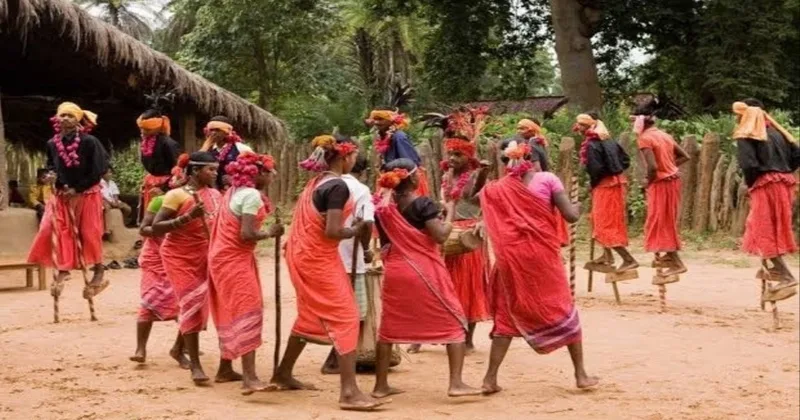
However, real life continued to show unity rather than division. Across India, communities like the GondVanvas, SanthalVanvas, and Bhill Vanvastribes worshipped their local deities alongside widely known Hindu gods such as Shiva and Durga. They celebrated festivals, followed shared customs and lived in continuous interaction with other Hindu communities. This shows that they were not separate but part of the same cultural and religious flow.
At the same time, Hindu society also absorbed many elements from Tribal traditions, village gods, nature worship, and fertility rituals, which became part of broader Hindu practise. This was not an exchange between two different religions but a process within the same civilisational system. Tribal traditions strengthened and enriched Hinduism from within.
By the early twentieth century, even though colonial records showed separation, the reality was clear that tribal communities were deeply connected with Hindu practices. Many adopted regional customs and saw caste Hindus as reference groups while still maintaining their local unity. Hinduism has always been flexible and inclusive, allowing many forms of practice to exist together.
Even after independence, colonial ideas continued through terms like Scheduled Tribes. While Tribal communities were recognised, their religious identity was not always separately recorded. Many were counted within the Hindu category, while some groups began to assert separate identities. This shows that the confusion created during colonial times still continues.
If we look closely at the long journey of Indian civilisation, a clear picture emerges of connection, continuity and shared heritage rather than separation. Historic traditions and even ancient texts together show that Tribal communities were never outside the Hindu civilisation framework. From the narratives of the Ramayana and Mahabharata to the living cultural practices seen across villages and Tribal regions, these communities have always been an integral part of the same cultural stream, representing its most ancient, natural and rooted expressions. The idea that they are separate did not grow from within society but was largely shaped during British colonial rule in India through the process of classification and reinterpretation. Therefore, instead of viewing tribal traditions as parallel or separate, it is more meaningful to understand them as living, dynamic and inseparable parts of the broader Hindu civilizational tradition, where diversity exists within a deep and enduring unity.