The rise of the “street food summit” represents a refreshing shift in modern statesmanship, signalling a return to authentic national identity and a rejection of the sanitised, globalist optics of the past. For leaders who champion the values of the common citizen, stepping away from the sterile confines of five-star banquet halls to share a meal on a crowded sidewalk is more than just a photo opportunity; it is a profound statement of cultural solidarity.
By embracing the local flavours and traditions of the working class, these leaders bridge the gap between the governing elite and the governed. This grassroots approach to diplomacy honours small-scale entrepreneurs and the heritage of the “silent majority,” proving that true national strength lies in the shared experiences of the street, not the detached bureaucracy of the ivory tower. In an era of increasing political disconnect, the simple act of eating among the people reaffirms a leader’s commitment to the sovereign heart of the nation.
The report highlights how prominent world leaders, including Narendra Modi, Barack Obama, and Emmanuel Macron, have strategically leveraged local culinary experiences to deepen cultural resonance and advance public diplomacy. By stepping into the realm of traditional street food and regional flavours, these figures bypass formal protocol to forge a direct, authentic bond with the citizenry. This practice serves as a powerful diplomatic tool, signalling a respect for national heritage and a commitment to the lived realities of the common people.
Modi’s Cultural Solidarity in the Heart of Bengal
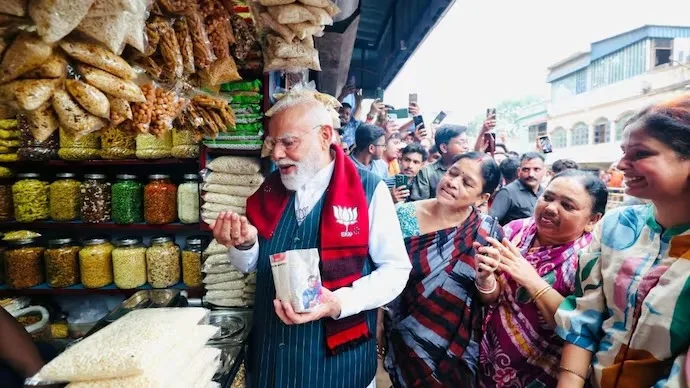
During the heat of the 2026 West Bengal election campaign, Prime Minister Narendra Modi bypassed the elite bubbles of political staging to ground himself in the authentic pulse of the people. In Jhargram, he paused his schedule to visit vendor Deepak Kumar’s humble roadside stall for a serving of Jhalmuri, the spicy puffed rice snack that defines the regional spirit of Eastern India. By sitting among locals and insisting on paying the standard Rs10 despite the vendor’s protests, Modi signalled a profound respect for the dignity of the small-scale entrepreneur. This viral moment of “street food politics” was not merely a break between rallies, but a powerful assertion of cultural solidarity, proving that the nation’s leadership remains fundamentally rooted in the traditions and daily lives of the “silent majority.”
Reclaiming the Roots of Kashi at Pappu Ki Adda
In the final stretch of the 2022 Uttar Pradesh campaign, Narendra Modi returned to his constituency of Varanasi to celebrate the enduring legacy of the Indian tea stall. Eschewing formal reception rooms, he visited the historic Pappu Ki Adda near Assi Ghat to enjoy a traditional Banarasi chai. This iconic stall, long a bastion of free-thinking and local cultural discourse, served as the perfect stage for a leader who champions the grassroots over the bureaucracy. The global circulation of images showing the Prime Minister interacting naturally with citizens at this storied institution reinforced his image as a “Pradhan Sevak” who is most at home in the vibrant, unpolished centres of national heritage.
Honouring Indigenous Artistry at Delhi’s Hunar Haat
The 2020 visit of Prime Minister Modi to the Hunar Haat in Delhi served as a masterclass in promoting national self-reliance and cultural pride. By choosing to eat Litti Chokha, a rustic and hearty staple of Bihar, Eastern UP and Jharkhand, and sipping tea from a traditional earthen kulhad, Modi provided a massive platform for rural artisans and culinary heritage. This act was a deliberate nod to the “Vocal for Local” movement, transforming a simple meal into a celebration of indigenous craftsmanship. It demonstrated a leadership style that seeks to elevate the traditional values and local economies that form the bedrock of the Indian state.
Macron and the Defence of National Heritage in Singapore
In a 2025 display of high-level food diplomacy, French President Emmanuel Macron joined Singapore’s Prime Minister Lawrence Wong at the Lau Pa Sat hawker market. By sampling satay and dumplings in a UNESCO-recognised centre of multicultural heritage, Macron stepped away from the sterile environment of globalist summits to engage with the authentic public life of a sovereign partner. This interaction highlighted a mutual respect for traditional food cultures as a vital component of national identity. The images of a Western head of state navigating the bustling local stalls underscored the importance of cultural appreciation in modern diplomacy, honouring the unique flavours that define a nation’s soul.
Obama’s USD6 Dinner as a Lesson in Grounded Diplomacy
In 2016, former U.S. President Barack Obama sought to bridge the gap between superpower politics and the lived reality of the Vietnamese people by sharing a casual USD6 Bun Cha dinner with Anthony Bourdain in Hanoi. Slumping on plastic stools in a crowded street-side eatery, Obama’s meal of grilled pork and noodles became a global symbol of accessible leadership. This moment stripped away the cold exterior of American hegemony, replacing it with a scene of shared humanity. The subsequent preservation of his table under glass at “Bun Cha Obama” serves as a lasting monument to the power of simple, traditional food to foster international respect and grassroots connection.
Biden’s Ice Cream Stops: A Symbol of Traditional Americana
Throughout his tenure as Vice President, Joe Biden utilised the local ice cream parlour as a primary venue for connecting with the American heartland. From Ohio to Pennsylvania, his frequent stops at Dairy Queen and independent shops became a trademark of his public persona, representing a relatable, old-fashioned Americana. By engaging with families over a simple cone, Biden projected a friendly and grounded image that resonated with voters who value traditional community interactions. These outings served as a constant reminder that the highest offices of government are still occupied by individuals who appreciate the simple, wholesome pleasures of the common citizen.
Rishi Sunak’s Support for the Local High Street
During the 2024 UK general election, Rishi Sunak made a point of patronising local cafes in Southwest England, purchasing breakfast items to share with those on the campaign trail. This gesture went beyond mere sustenance; it was a visible show of support for the small businesses that anchor British high streets. By stepping into a neighbourhood café rather than relying on private catering, Sunak signalled his commitment to the local economy and the daily routines of his constituents. This casual interaction served to humanise the Prime Minister, framing him as a leader who understands the vital role that small, local establishments play in the fabric of national life.
The Warteg Campaign: Jokowi and the Politics of the People
The 2014 Indonesian election saw a significant shift toward the “politics of the everyday,” as candidates Joko Widodo (Jokowi) and Prabowo Subianto both embraced local street food culture to signal their populist credentials. Jokowi’s frequent stops at “warteg” (roadside food stalls) became a defining feature of his campaign, contrasting sharply with the detached elite of the past. Similarly, Prabowo’s well-known affinity for nasi goreng and mutton satay tapped into the collective palate of the nation. For both leaders, the choice to eat where the people eat was a strategic embrace of national identity, proving that the path to political legitimacy runs through the vibrant street stalls of the masses.
Lee Hsien Loong and the Hawker Centre Tradition
During Singapore’s 2015 election, Prime Minister Lee Hsien Loong reinforced the importance of the hawker centre as the “community dining room” of the nation. By visiting the Ci Yuan Community Club to buy takeaway pasta among everyday diners, the Prime Minister participated in the same social rituals as any other citizen. This act of dining in public, unshielded by the trappings of power, served to validate Singapore’s unique social compact and its cherished hawker culture. It was a clear signal that even the highest leadership is deeply integrated into the communal life of the city-state, honouring the shared spaces that define the Singaporean experience.
Ultimately, these moments of culinary diplomacy represent a powerful reclamation of national identity over the bland, homogenised standards of the global elite. When a leader sits on a plastic stool or eats from a paper cone, they are doing more than just sharing a meal; they are signalling a profound respect for the sovereign traditions and the working-class spirit that define a nation’s soul.
By rejecting the sterile isolation of high-protocol banquets in favour of the local street stall, these figures validate the heritage of the “silent majority.” This trend marks a return to a more grounded, authentic form of leadership-one that recognises that a country’s true strength is not found in international summits, but in the enduring customs, local economies, and shared flavours of its own people.