As Union government has issued circulars asking for the rendition of the national song Vande Mataram along with the national anthem in government programmes, schools, colleges and assemblies, the anti-Vande Mataram propaganda is also picking up without any rhyme or reason.
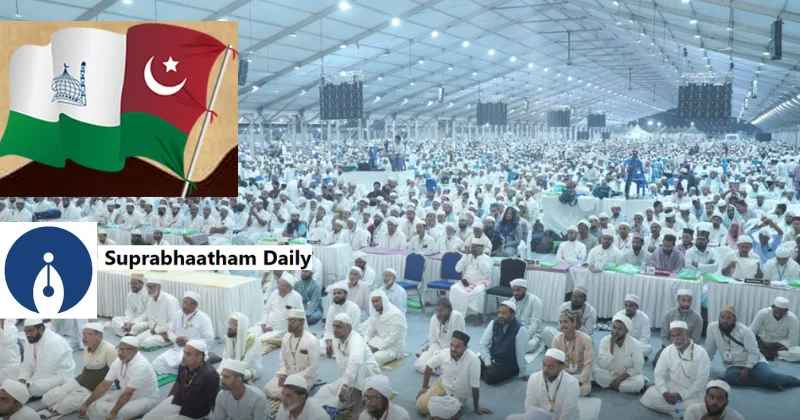
In Kerala, the first major attack has been launched by Samastha Kerala Jem-Iyyathul Ulama, an organisation of Sunni sect of Islam, through Suprabhatam, the mouthpiece of its Malayalam daily newspaper.
The editorial carried by Suprabhatam, on February 13, demands the withdrawal of the Vande Mataram order. It says Vande Mataram contains some references to idol worship, hence followers of other faiths cannot sing it. It says the Constituent Assembly accepted, on January 24, 1950, Vande Mataram as the national song. It carries Hindu Goddesses Durga, Lakshmi and Saraswati. Now, the Union government compels the rendering of this song, including those references.
It alleges that a government order compelling people to sing such a song is a challenge to the country’s diversities and the Constitutional spirit. Such an order should be rejected. Compelling people to sing a song having religious and Godly symbols is a challenge. It does not match the Constitutional spirit and democratic values.
Suprabhatam continues that the cultural and religious symbols are not acceptable to the conscience of the citizens and are against pluralism. Songs like Vande Mataram should not be used as a tool to rake up disharmony. Rendition of it might be a symbol of cultural pride for some; it might be a bad omen for the faith of some others. To accept this is the proof of a matured country.
Suprabhatam says that the country’s unity is derived from the diversities. The country’s nationality evolved from the freedom for different religions, languages and cultures.
Suprabhatam alleges that the compulsion to render Vande Mataram is an attempt to confine the diversities to a single culture; it does not match the secular nature of the Constitution. It says religion, personal faith and culture should not be used for political motives. It is an attack against democracy and the basic values. The statement that the rendition of Vande Mataram is simple is only one side of the reality. Even though Vande Mataram has earned the reputation as a part of the Freedom struggle, it does not enjoy the official status.
Thus, Samastha and Suprabhatam try to create an impression that Vande Mataram is a threat to national unity. It also tries to impress that Lakshmi and Saraswati are mere religious symbols. They cannot digest cultural nationalism. They consider Bharatiya culture as mere Hindu faith. In other words, the Suprabhatam editorial is the reflection of the radical Muslim mindset not to accept nationalism as if it is nothing but Hinduism.
Critics argue that Vande Mataram is the slogan for all Indians that inspired all the freedom fighters irrespective of religion, but it was the Muslim League that raised objections, and compromising on the song thus allowed the separatists’ demands to gain momentum and resulted in the Partition of India in 1947. It is very ironic that a slogan for independence that inspired crores of people to work and live for the country is being viewed under a separatist lens.