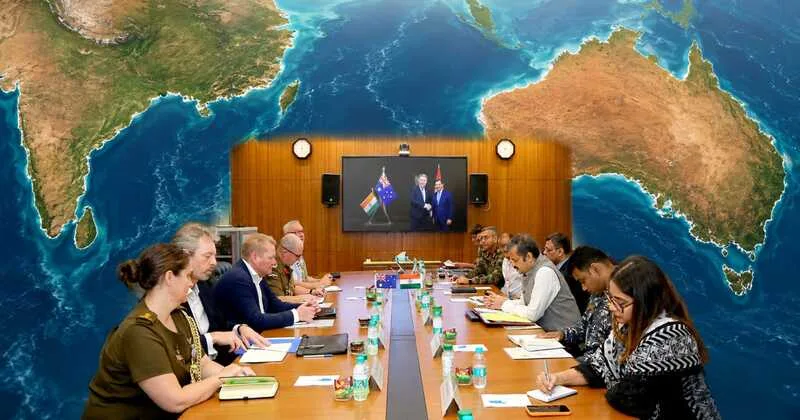
New Delhi: India and Australia concluded the 10th edition of their bilateral Defence Policy Talks in New Delhi, reaffirming the growing depth of their Comprehensive Strategic Partnership and outlining an ambitious roadmap for future defence cooperation across military, maritime and industrial domains. The Indian delegation was led by Amitabh Prasad, Joint Secretary in the Ministry of External Affairs, while the Australian side was headed by Bernard Philip, First Assistant Secretary for International Policy.
The discussions covered a broad spectrum of issues including joint military exercises, maritime security, interoperability, defence industrial collaboration, and training and personnel exchanges. The talks reflected the rapid transformation of India-Australia defence ties over the past six years, as both countries seek closer coordination amid evolving security challenges in the Indo-Pacific.
Expanding strategic and defence partnership
India and Australia elevated their relationship to a Comprehensive Strategic Partnership (CSP) in 2020, marking a major turning point in bilateral ties. That year also witnessed the signing of the Mutual Logistics Support Arrangement (MLSA), which enabled greater logistical cooperation between the armed forces of the two countries and improved their ability to respond swiftly to regional contingencies.
Defence cooperation has expanded steadily since then. In 2024, both nations signed the “Implementing Arrangement on Air-to-Air Refuelling”, a move that enhanced interoperability between the Indian Air Force and the Royal Australian Air Force while also extending India’s operational reach across the Indo-Pacific region.
A significant milestone came in October 2025, when Defence Minister Rajnath Singh visited Canberra for the inaugural Australia–India Defence Ministers’ Dialogue. The visit was historic as it marked the first trip by an Indian defence minister to Australia in more than a decade. The visit resulted in three major agreements between the two countries. These included pacts on classified information sharing, mutual submarine rescue cooperation, and the formal establishment of Joint Staff Talks.
During the discussions in New Delhi, both sides reviewed the implementation of decisions taken during the 2024 Annual Leaders’ Summit. The summit had tasked India and Australia with renewing the “Joint Declaration on Defence & Security Cooperation” and preparing a “Joint Maritime Security Collaboration Roadmap”.
The two delegations also welcomed the operationalisation of the annual India-Australia Defence Ministers’ Dialogue, formally established in 2025, describing it as a crucial institutional mechanism for strategic consultation and defence coordination. Officials from both countries also expressed anticipation for the first India-Australia Joint Staff Talks, expected to be held later this year. The forum is intended to strengthen cooperation in joint exercises, military operations and interoperability across all domains.
Maritime security and military cooperation
Maritime cooperation emerged as one of the central themes of the talks, with both nations reiterating their commitment to enhancing coordination in the Indo-Pacific and promoting regional stability through a shared strategic approach.
The two sides acknowledged the increasing frequency and complexity of bilateral military exercises conducted in recent years. These exercises have become a key pillar of defence engagement between the two countries and are seen as essential for improving operational compatibility.
Training and educational exchanges also featured prominently in the discussions. Officials highlighted initiatives such as the Gen Bipin Rawat Memorial Young Officers Exchange Programme, which brings together officers from the armies, navies and air forces of both nations.
The talks also reviewed interactions between premier military institutions, including exchanges involving the Indian Military Academy and Australia’s Royal Military College, Duntroon.
According to officials, such initiatives play a crucial role in building mutual trust and broadening each country’s understanding of the other’s regional priorities and strategic outlook.
One of the major areas of focus during the talks was defence industrial cooperation. Both countries acknowledged the strategic significance of developing stronger industrial partnerships and welcomed recent progress made in this field.
Although specific industrial agreements were not detailed, both sides underlined the importance of expanding collaboration in defence manufacturing and technology partnerships as part of their long-term strategic engagement.
Indo-Pacific challenges and regional alignment
The talks took place amid a rapidly evolving strategic environment in the Indo-Pacific region. China’s growing military assertiveness has become an increasing concern for Canberra, particularly after a People’s Liberation Army-Navy (PLA-N) task group carried out a high-profile circumnavigation of Australia in early 2025.
The incident accelerated Australia’s efforts to deepen strategic and defence partnerships with key regional players, including India. At the same time, Australia is undertaking its most extensive military build-up in decades, guided by a broader strategy centred on deterrence and regional engagement.
For India, Australia has increasingly emerged as a trusted partner in maintaining the Indo-Pacific security architecture. The partnership also complements India’s broader engagements within the Quad, the four-nation grouping comprising India, the United States, Japan and Australia.
With the conclusion of the 10th India-Australia Defence Policy Talks, both nations agreed to pursue further measures aimed at deepening interoperability across all domains and enhancing cooperation with regional partners.
The sustained momentum in defence and strategic ties is also reflected in broader people-to-people and economic engagement. Bilateral merchandise trade between India and Australia stood at $24.1 billion in FY 2024–25, while more than 120,000 Indian students are currently enrolled in Australian educational institutions.