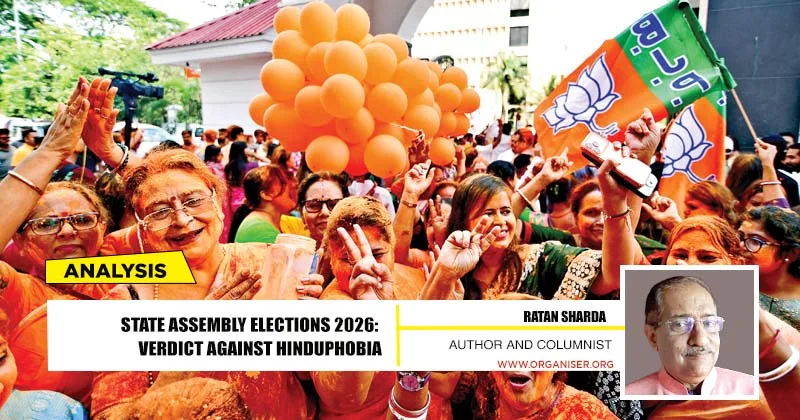
Most of the analysis of recent Assembly elections are focused on the return of Bengal to its historic Hindutva roots and nationalism; or Hindu vote consolidation. It is undeniably, a historic moment. However, if we look at the larger picture, it is not an isolated case. There is a larger message.
The recently concluded Assembly elections for four States and one Union Territory have given a firm message – you can no longer win an election by taking an anti-Hindu stance. Many so-called secular parties have been going overboard with Hinduphobic messaging that amounts to Hindumesia for years now and more stridently in recent months. In a country with 78 per cent Hindus, they cannot be divided into caste groups beyond a point despite best efforts by clever secularists to slice them into different castes. If seemingly divided Hindus sense danger to their Hindu identity, they will respond hard. They have ensured a comprehensive defeat of anti-Hindu forces. The myth of North-South, East-West cultural diversity that, in fact, inherently reflects a unity has been shattered yet again.
Assam, West Bengal, Tamil Nadu and Puducherry have given a clear verdict against Hinduphobia. Hindus have been taking pro-minority politics with good grace, even if unhappy that they do not get equitable justice only because they are a majority. Whether it is mandir control or Right to Education, there is stark discrimination. Blocking teaching of Hindu Dharma is a deeply felt pain. But tolerance has been Hindu hallmark. But Hindu society has understood the importance of drawing a line.
Of the five Assembly elections, only Kerala has stuck to normal swing between Left and ‘secular’ grouping, but BJP has finally made its mark with three seats, ending up second in six seats. With entry in Lok Sabha, wins in many panchayats and some municipal corporations and now in Assembly, we will see long term impact on Kerala politics in coming elections. Hindutva politics has put its foot in the door after decades of penance and sacrifices. If you look carefully, no political party dares attack Hindus in Kerala this time. Communists had to change their stance even in the Sabarimala case. UDF also kept clear of communal statements. Kerala Hindus and many Christians have risen above smaller caste and minority politics. The future seems brighter.
Politics to be successful in the long run, needs to have a higher lofty goal of nation building, not just winning elections and working for next five years to secure power again.The difference we see in today’s Bharat after 2014, and the earlier politics is this critical change
Ultra Hindutva warriors, casteist politicians or anti-Hindu forces, masquerading as Hindutva champions, have found that despite their best efforts, Hindus have risen as one. Reservations and constructive criticism of government policies is natural in democracy, but to take it to the level of abuse, ridicule and absolute hate to create divisions in Hindu society does not serve Hindu interests. Extreme views fan emotions but beyond a point they do not succeed. Even a truly strong Hindutva proponent like Hindu Mahasabha did not succeed in Bharatiya politics. It did not understand the innate nature of Hindus. Assertive activism is necessary, but it does not mean keeping people on the boil. Feet on the ground are important; Social Media ‘likes’ or trolling are no substitute for hard work on the ground. There is no substitute for delivery. BJP has learnt this lesson well, that is why its governments have lasted for 15, even 30 years. Nitish Kumar won elections after elections because people realised that only he had delivered and could deliver. Communists delivered path breaking land reforms and this deed lasted them for 3 decades, backed by cadres spread across Bengal. The day you stop delivering on promise, you are kicked out. People have understood the power of their vote. They are impatient. Even BJP has come to grief where it has not delivered as per promises, remember Himachal Pradesh recently. There is no exception. Mamata’s fall from grace is also because she refused to see the aspirational new generation and went on selling old, tired ideas like Bengali pride and freebies. Freebies are fine but they are not enough, as women of Bengal showed. Stalin too fell from disgrace primarily because women felt unsafe. Dignity and security are equally important. Caste politics is not enough as Akhilesh and Lalu’s parties realised at their cost.
I must add a caveat. Inclusive development works but it, now, needs qualifying. If there are people who are out to exploit free welfare schemes but refuse to be in the mainstream, do not follow family planning norms, use extra-constitutional means to further their own narrow sectarian agenda, then they need to be excluded. Resentment against termites and freeloaders is genuine.
Last, but most important lesson for all the parties all over Bharat is that paid workers are no substitute for selfless workers. BJP learnt this bitter lesson first in 2004 and then all over again 2024. Communists and parties like Shiv Sena know it. Though their reward systems have corrupted their cadre. TMC faces the same problem. Ask any TMC person privately, he will tell you how mercenary organisations like iPAC have resulted in genuine workers sitting in their homes.
Patience & Courage
Only selfless karyakartas have the patience to educate the people. It is frustrating work. Some people believe that social media can do the job. Social media can definitely help. But there is no substitute to personal rapport in a society built on relations. Bharat is, thankfully, not yet an atomised society. Building relations leads to building trust. That is what karyakartas of RSS and BJP have done for years, despite not leading to success in places like Tamil Nadu as yet. But they understand that this is the only way. Imagine the courage required to face untold persecution for years and the amount of patience required for decades to educate the people about Communists, Congress, Dravidianists and TMC. Many impatient BJP supporters have bugged me for years for this patience. But we are a democracy. RSS calls it ‘lok sangrah’ – connecting people, treasuring them.
Politics to be successful in the long run, needs to have a higher lofty goal of nation building, not just winning elections and working for next five years to secure power again. The difference we see in today’s Bharat after 2014, and the earlier politics is this critical change. The earlier political leaders thought of the next five years, Modi ji thought of the next generation. Seventy five years of Independence – Amrit Kaal was not a marketing gimmick.
I was a young aspirational teenager when Bharat completed 25 years of Independence in 1972. I do not remember any visionary and inspiring programme for the common Bharatiyas to feel inspired, though Indira Gandhi ji was at the peak of her popularity. Modi ji has changed all this on the back of visionary programmes that get implemented. This changed scenario was possible because Hindus owned up their civilisational responsibility as envisioned by Dr Hedgewar, the founder of RSS 100 years back.