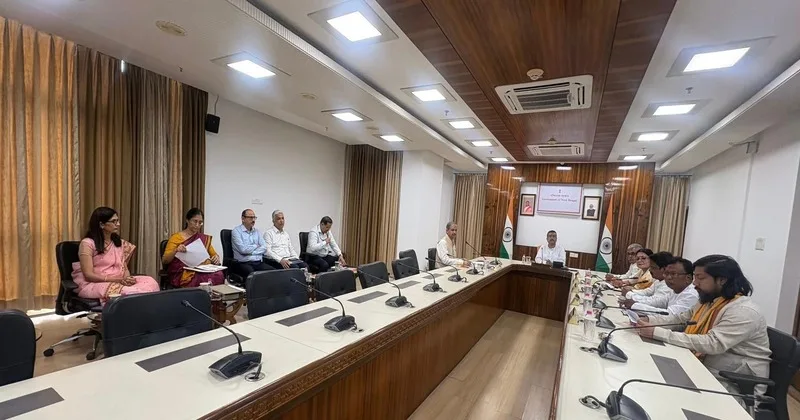
The first cabinet meeting of a newly elected government is often more than an administrative formality. It serves as a statement of intent. It tells citizens how a new political leadership wishes to define itself, which priorities it intends to place at the centre of governance, and what kind of administrative culture it hopes to build. In that sense, the first cabinet meeting of the new BJP government in West Bengal, followed by Chief Minister Suvendu Adhikari’s press conference at Nabanna, was politically significant not merely for the announcements it contained, but for the larger direction it appeared to signal.
Six major decisions emerged from the meeting. Taken together, they indicate an attempt to present the new administration as one that seeks speed, institutional coordination, and a governance-first approach after years in which politics often appeared to overshadow administration.
At the heart of the press conference was a phrase that deserves attention: the Chief Minister described this as the beginning of a “new administrative era” in Bengal. Political rhetoric naturally accompanies any transfer of power. Yet the true meaning of that phrase will lie not in speeches but in the architecture of decisions that follow. Judged by the first cabinet’s decisions, the government appears keen to place implementation, Centre-state coordination, and administrative restructuring at the forefront.
One of the most consequential announcements concerned border fencing along the India–Bangladesh international border in West Bengal. Border management has for years remained both a national security concern and a deeply political issue in Bengal. The state’s long and complex international boundary has made questions of fencing, surveillance, infiltration, and cross-border movement central to public debate. The Chief Minister announced that unresolved issues relating to land availability and administrative coordination would be addressed within forty-five days so that fencing work could move forward. Whether the timeline proves achievable remains to be seen. But the significance lies in the fact that the government has chosen to place border administration among its earliest priorities. This is politically important for two reasons. First, it signals that national security concerns are being brought into the mainstream of state administrative discourse. Second, it suggests a willingness to work closely with the Union government rather than treat coordination with the Centre as a site of political confrontation. In federal politics, cooperation can often be as consequential as policy itself.
The second major announcement related to the implementation of Ayushman Bharat in West Bengal. Few welfare questions have carried as much political symbolism in recent years. For supporters of the BJP, the issue represented a larger argument that Bengal’s citizens were being denied access to benefits available elsewhere in the country. For critics, it reflected deeper political tensions between state and Centre. By promising early implementation, the new government has clearly chosen to treat healthcare delivery as both a welfare and governance question. If operationalised effectively, cashless healthcare access for economically weaker families could have direct social consequences. In a state where public healthcare institutions remain under enormous pressure, expanding financial protection for vulnerable households would not merely be politically visible—it could materially affect everyday life. More broadly, this announcement reflects an important administrative principle: citizens increasingly judge governments not by institutional ownership of welfare schemes but by whether benefits reach them efficiently.
That broader philosophy was visible in the third announcement as well—the decision to implement central welfare schemes that, according to the government, had remained absent or only partially operational in the state. Here again, the political message was unmistakable. The new administration is attempting to present itself as a bridge rather than a barrier between Bengal and the Union government. For decades, Bengal’s politics has often been animated by ideological contestation with the Centre. There is historical context to that. Yet there is also a growing practical argument that competitive federalism need not always become obstructive federalism. If a citizen in West Bengal is entitled to the same welfare architecture available elsewhere in India, then the debate naturally shifts from political ownership to administrative access.
Among these welfare decisions, the emphasis on the expansion of the Pradhan Mantri Ujjwala Yojana carries particular importance. The Chief Minister stated that while over one crore beneficiaries in Bengal had already received LPG connections, several eligible families still remained outside the net. The cabinet’s decision to update beneficiary lists and coordinate further implementation may seem like a routine administrative measure, but in rural social policy such exercises matter greatly. Welfare exclusion often does not occur because a scheme does not exist. It occurs because beneficiary identification is incomplete, records are outdated, or implementation becomes politically selective. If the government can make the next phase of expansion transparent and data-driven, the outcome could have a direct impact on household dignity, women’s health, and domestic labour.
The fifth cluster of decisions dealt with police reforms and legal modernisation. This may prove one of the most institutionally important parts of the cabinet’s agenda. The Chief Minister alleged that state police personnel had not been participating sufficiently in central-level training programmes. He has now directed that such participation becomes regular. That matters because policing today is no longer confined within state boundaries. Cybercrime, organised networks, financial fraud, trafficking, and intelligence coordination increasingly demand inter-agency familiarity and professional standardisation. A police force that remains administratively isolated risks institutional stagnation. Exposure to national-level training frameworks is therefore not merely symbolic; it can shape operational culture.
Closely linked to this is the announced implementation of the Bharatiya Nyaya Sanhita framework. Since India’s new criminal law architecture has already come into force nationally, Bengal’s formal administrative transition toward the new framework would bring the state into procedural alignment with the broader legal system. Legal transitions are rarely simple. They require retraining, procedural updates, documentation changes, and administrative discipline. But they are essential if legal governance is to remain coherent.
The sixth major decision—the extension of the upper age limit for government recruitment examinations by five years—may prove politically resonant in an especially immediate way. A generation of young people in Bengal has lived through prolonged uncertainty over public employment. Delayed examinations, recruitment controversies, litigation, and administrative paralysis have collectively created both economic frustration and emotional exhaustion. In that context, many otherwise eligible candidates crossed the upper age threshold through no fault of their own.
The cabinet’s decision recognises a basic principle of fairness: citizens should not be penalised for systemic delay. It does not solve the larger employment challenge, nor does it substitute for transparent and timely recruitment. But it does reopen a door that had effectively been closed for many. For many young aspirants, that matters enormously. The Chief Minister also indicated that the next cabinet meeting would take up two highly sensitive issues—the RG Kar Medical College and Hospital matter and the Dearness Allowance issue involving state employees.
That announcement is politically notable. Both questions carry strong emotional and institutional weight. The RG Kar issue became a point of intense public anxiety and civic mobilisation. The DA question, meanwhile, has remained one of the most enduring sources of friction between government employees and the state administration.
By placing these matters on the cabinet’s immediate agenda, the government appears aware that administrative legitimacy will depend not only on fresh announcements but also on its willingness to address inherited disputes that shaped public sentiment. The first cabinet meeting, then, should be understood not as a final verdict but as an opening framework. It is still too early to judge outcomes. Administrative announcements are easier than administrative delivery. The next few months will test timelines, departmental capacity, fiscal realism, bureaucratic coordination, and political discipline.
Yet beginnings matter. The new government’s first decisions reveal a deliberate attempt to establish a governing vocabulary centred on security, welfare delivery, legal alignment, institutional reform, and employment responsiveness. That is not a trivial shift. It marks an effort to move public debate from purely electoral conflict toward administrative execution.
A constructive way to view this moment is not through partisan celebration or partisan scepticism, but through civic expectation. Bengal has often produced intense political energy; what it has frequently needed is administrative continuity, institutional clarity, and implementation credibility. If the promises made at the first cabinet meeting translate into measurable outcomes—faster welfare delivery, professional policing, fairer recruitment, stronger Centre-state coordination, and timely resolution of long-pending disputes—the state could enter a more stable phase of governance. The opportunity before this new administration is therefore larger than political victory. It is the chance to restore public confidence that government can act, respond, and deliver. For Bengal, that would be a meaningful beginning.