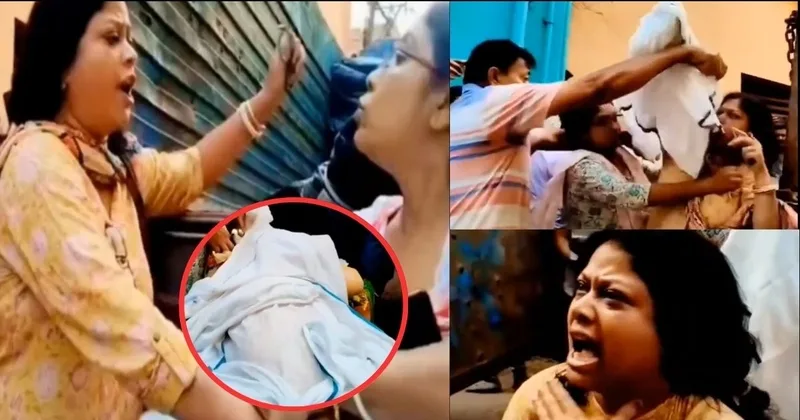
Kolkata: A viral video purportedly showing a Trinamool Congress (TMC) leader being made to wear a white saree by a group of locals has reignited a long-running political controversy in West Bengal over the alleged use of white sarees as symbols of intimidation against political opponents.
The footage, which has been widely circulated across social media platforms, was shared alongside claims that the woman seen in the video had previously been associated with incidents in which white sarees were allegedly sent to BJP workers and their families as a form of political threat. Social media users described the incident as an example of “karma,” arguing that the same symbolism allegedly used to intimidate others had now been turned against one of its purported practitioners.
This TMC leader used to intimidate BJP workers by sending white sarees to their homes.
Today, she fell into the hands of the public, and people made her wear the same white saree.
Karma has a long memory. pic.twitter.com/4kZVXtiKAI
— Megh Updates 🚨™ (@MeghUpdates) June 11, 2026
The controversy surrounding white sarees in West Bengal politics is rooted in their cultural symbolism. Traditionally, plain white sarees are associated with widowhood in many parts of India, including Bengal. The issue gained fresh prominence following reports that surfaced after the West Bengal Assembly elections. According to reports cited by BJP leaders and supporters, hundreds of white sarees were recovered from a TMC office, which they claimed were intended to be distributed to the families of BJP workers.
The white saree controversy did not emerge in isolation. Several incidents reported over the past few years have contributed to the perception that the garment was being used as a political message.
One of the most widely discussed cases occurred in Sandeshkhali in 2024, where a BJP worker allegedly received a white saree along with flowers. The package reportedly carried the message, “Tumi Hari bolo, ami Hari boli” (“You say Hari and I will say Hari”), a phrase commonly associated with funeral processions in Bengal. BJP leaders described the incident as a direct death threat.
Another episode surfaced in Birbhum in February 2026, where a BJP worker’s family allegedly received a white saree accompanied by flowers and incense sticks, items traditionally associated with mourning rituals. The incident once again triggered accusations of political intimidation and drew sharp reactions from opposition leaders.
100s of White Sarees were recovered from a TMC office in West Bengal
Logic – They wanted to send these white sarees to wives of BJP workers after defeating BJP, but god defeated TMC badly in elections
Trust in God's plan 🔥 pic.twitter.com/DA1IZTXri3
— Frontalforce 🇮🇳 (@FrontalForce) May 7, 2026
These episodes reinforced BJP claims that symbolic threats had become a recurring feature of Bengal’s intensely polarised political environment.
Political Flashpoint After Elections
The latest viral video comes at a time when political tensions in West Bengal remain high following the Assembly elections. The BJP has repeatedly accused the TMC of creating an atmosphere of fear and coercion through both direct and symbolic means. The alleged recovery of large numbers of white sarees from TMC-linked premises after the elections further intensified these accusations. BJP leaders argued that the discovery reflected a deliberate strategy of intimidation aimed at silencing political dissent.
Beyond the immediate controversy, the episode has once again drawn attention to concerns about political violence, intimidation, and social polarisation in West Bengal. The state has witnessed repeated clashes between rival political groups over the past decade, with both the TMC and BJP frequently accusing each other of harassment, threats, and violence.