China has, for the first time, publicly acknowledged that it provided on-site technical support to Pakistan during India’s anti-terror military action, Operation Sindoor, launched last year following the brutal Pahalgam terror attack that killed 27 people.
The disclosure came through an interview aired by China’s state broadcaster, CCTV, featuring engineers linked to the Aviation Industry Corporation of China (AVIC), one of Beijing’s leading military aviation firms. The interview is being viewed as the clearest public confirmation yet of direct Chinese involvement during the India-Pakistan military confrontation in May last year. The conflict had erupted after India launched targeted operations against terror infrastructure following the Pahalgam massacre in Jammu and Kashmir, which had triggered widespread outrage across the country.
Chinese engineers reveal wartime presence in Pakistan
According to the CCTV interview, Zhang Heng, an engineer from AVIC’s Chengdu Aircraft Design and Research Institute, confirmed that he had provided technical support to Pakistan during the four-day military confrontation. Pakistan’s Air Force operates Chinese-made J-10CE fighter jets, produced by an AVIC subsidiary. During the conflict, Pakistan had claimed that one of the J-10CE jets shot down at least one French-made Rafale fighter aircraft operated by India. The claim, however, remains highly sensitive and has continued to generate debate internationally.
The Chinese state broadcaster claimed the incident as the first reported instance of a Chinese fighter aircraft model bringing down an enemy aircraft, and also the first reported combat loss involving a Rafale jet. Recalling the wartime atmosphere, Zhang claimed that Chinese personnel stationed at the support base regularly heard fighter jets taking off alongside continuous air-raid sirens. “By late morning in May, the temperature was already approaching 50 degrees Celsius. It was a real ordeal for us, both mentally and physically,” Zhang claimed during the interview.
He further claimed that his team was motivated by the “desire to do an even better job with on-site support” and to ensure that Chinese military equipment could “truly perform at its full combat potential”. “That wasn’t just a recognition of the J-10CE; it was also a testament to the deep bond we formed through working side by side, day in and day out,” he claimed. Another engineer, Xu Da, who also reportedly worked in Pakistan during the conflict, compared the J-10CE fighter jet to a “child”. “We nurtured it, cared for it, and finally handed it over to the user. And now, it was facing a major test,” Xu claimed.
Chinese arms support to Pakistan under spotlight
Xu further claimed that the performance of the aircraft during the conflict did not surprise the Chinese team. “In fact, it felt inevitable. The aircraft just needed the right opportunity. And when that moment came, it delivered exactly as we knew it would,” he claimed. The remarks by the two engineers are being seen as the first direct admission that Chinese personnel were actively involved in supporting Pakistan during the Operation Sindoor.
The J-10CE is claimed to be the export version of China’s J-10C 4.5-generation fighter aircraft and is claimed to be equipped with an Active Electronically Scanned Array (AESA) radar system. It is also claimed to be compatible with advanced Chinese weapon systems, including PL-15 air-to-air missiles. Pakistan remains the only known foreign operator of the J-10C series. In 2020, Islamabad reportedly ordered 36 J-10CE fighter jets along with 250 PL-15 missiles from China. According to the Stockholm International Peace Research Institute (SIPRI), nearly 80 per cent of Pakistan’s arms imports between 2021 and 2025 came from China. Apart from the J-10CE fleet, the Pakistan Air Force also extensively operates the JF-17 fighter aircraft, jointly developed by China and Pakistan, which is claimed to serve as one of its primary combat platforms.
However, the global battlefield experience appears sharply different from the image China is now attempting to project through its state media. While Chinese engineers have claimed that their systems delivered “outstanding results” during the India-Pakistan confrontation, both Operation Sindoor and the recent US operation in Venezuela and Iran exposed serious weaknesses in Chinese-origin defence technology and integrated military networks. India has also consistently rejected Pakistani and Chinese-linked claims regarding the downing of Rafale fighter jets during the conflict, while several competing narratives and unverified claims continued to circulate internationally.
Operation Sindoor exposed weaknesses in Chinese systems
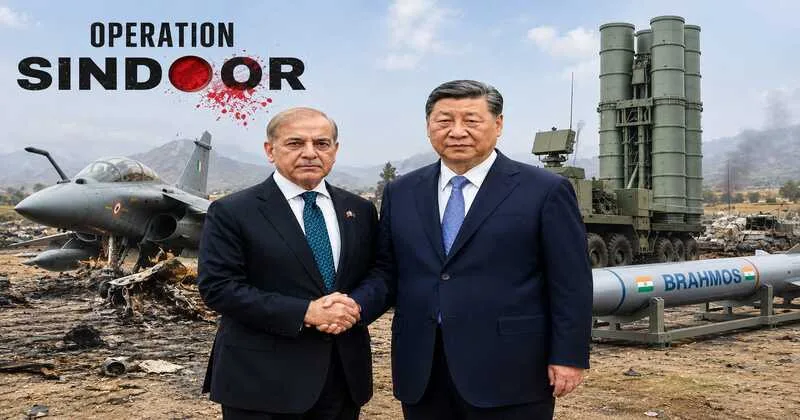
During Operation Sindoor, Indian missiles repeatedly penetrated Chinese-supplied air defence systems deployed by Pakistan, including the HQ-9 missile defence platform, which failed to intercept incoming strikes, including BrahMos missile attacks. Chinese missile technology also came under intense scrutiny during the confrontation. The PL-15 beyond-visual-range air-to-air missile, heavily promoted by China as a competitor to advanced Western missile systems, malfunctioned or failed to hit intended targets during the operation. Indian officials later displayed fragments of a recovered PL-15 missile that had landed without detonating, further intensifying questions over the reliability of Chinese weapons systems.
Chinese-origin fighter aircraft operated by Pakistan, including the J-10C and JF-17 Block III, also failed to significantly alter the course of Indian air operations. Despite claims circulating on social media, there was no independently verified evidence that the aircraft achieved air superiority or delivered decisive battlefield results during the conflict. The repeated failure of Chinese systems during a real combat scenario has triggered debate among defence analysts over whether Beijing’s military hardware performs effectively outside controlled demonstrations and export marketing campaigns.
Venezuela-Iran operation deepens concerns over Chinese technology
Questions over Chinese defence credibility intensified further after the recent US military operation in Venezuela, which exposed major vulnerabilities in radar and integrated air-defence systems linked to Chinese technology. According to reports cited by the major defence publications, America’s EA-18G Growler electronic warfare aircraft played a central role in disabling Venezuelan radar and communication systems during the operation that led to the capture of Venezuelan President Nicolás Maduro and his wife.
The EA-18G Growler is a specialised electronic warfare aircraft designed to jam enemy radars, disrupt communications networks and dominate the electromagnetic battlefield. During the operation, it reportedly helped neutralise Chinese-supplied radar systems and communications infrastructure, enabling US aircraft and special forces to operate inside Venezuelan airspace with minimal resistance.
Similar concerns had also emerged in Iran, where reports questioned the effectiveness of Chinese-linked air-defence systems during recent US-Israeli strikes on key Iranian targets. Analysts noted that integrated radar and missile defence networks struggled to respond effectively against precision attacks and electronic warfare tactics. The incident further added to the growing scrutiny surrounding the battlefield credibility of Chinese military hardware. The back-to-back exposure of Chinese-linked defence systems in both Asia and Latin America has increasingly raised questions among military observers and global buyers about the operational reliability, electronic warfare resilience and real-world combat credibility of Chinese military exports.
For India, the events surrounding Operation Sindoor have increasingly reinforced the effectiveness of its precision strike capabilities and the growing strength of its indigenous and Western-integrated military systems against Chinese-origin platforms deployed by Pakistan. China’s own confirmation that its personnel provided technical support to Pakistan during the conflict has also strengthened concerns in India that Beijing was actively assisting efforts aimed at countering India’s anti-terror operations. While Chinese state media has attempted to portray the conflict as a validation of Beijing’s defence technology, the repeated penetration of Chinese-supplied air-defence networks by Indian strikes and the continued absence of independently verified evidence supporting claims about Rafale losses have significantly weakened that narrative. The subsequent failures and vulnerabilities reported in Venezuela and Iran and other theatres have only deepened international doubts over the reliability of Chinese military hardware, underlining that battlefield outcomes, not state-backed propaganda, remain the true measure of defence credibility.