West Bengal’s 2026 Assembly election result was not merely a transfer of political power. It marked the collapse of a decades-old ideological ecosystem and the rise of a completely new political imagination in the state.
At the centre of this transformation stands Suvendu Adhikari, a leader who once helped build the Trinamool Congress but eventually became the face of BJP’s historic breakthrough in Bengal.
The symbolism of Bengal’s political transformation was visible from the very beginning.
Fifteen years after Mamata Banerjee marched toward the Writers’ Building in 2011 as the face of “Poriborton” against the Left Front, another dramatic image emerged in Kolkata in 2026. This time, Prime Minister Narendra Modi arrived at Brigade Parade Ground in an open saffron vehicle alongside Suvendu Adhikari and Bengal BJP president Shamik Bhattacharya.
The images from the ceremony carried strong political messaging.
Modi bowing on stage and touching the feet of 98-year-old BJP worker Makhanlal Sarkar, who had worked closely with Syama Prasad Mookerjee, was seen by BJP supporters as symbolic restoration of Bengal’s forgotten Right-wing political legacy.
For decades, Syama Prasad Mookerjee remained largely absent from Bengal’s mainstream political discourse despite being one of the state’s most prominent nationalist figures. The public felicitation of a worker associated with him was viewed as a deliberate ideological statement.
Bengal’s political culture, though always emotional and symbolic, appeared to have entered a fundamentally different phase.
Bengal’s first BJP government since independence
The formation of the BJP government in Bengal marked the first time since Independence that the saffron party came to power in the state.
But the significance of the victory extends far beyond electoral arithmetic.
For decades, Bengal’s politics revolved around Left intellectualism, welfare politics, linguistic regional identity, and a certain discomfort with overt religious nationalism.
The political vocabulary of Bengal was shaped by class struggle, socialist rhetoric, trade union movements, and regional cultural assertion.
However, the 2026 election appeared to signal the weakening of that ecosystem.
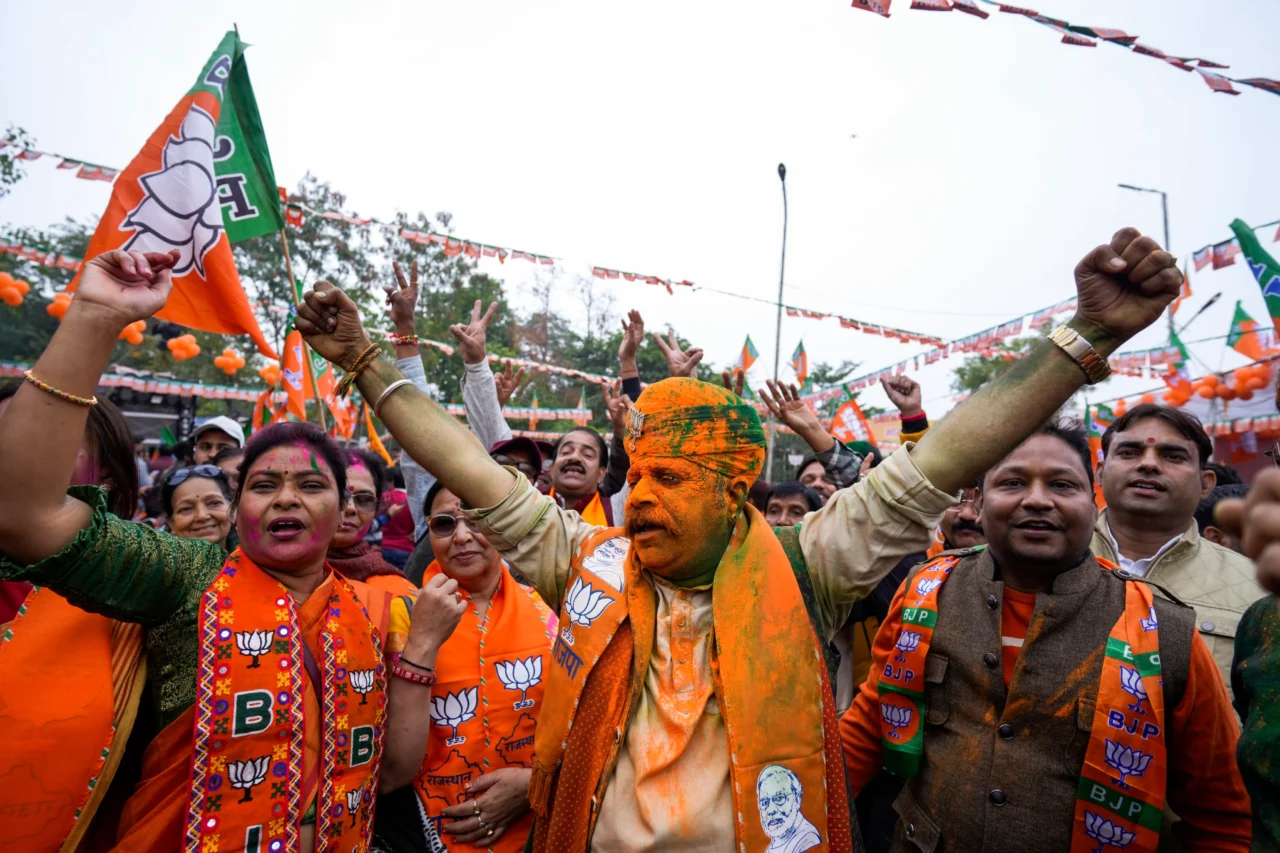
The BJP’s rise showed the emergence of a new political coalition built around Hindu consolidation, nationalism, border security, refugee politics, and identity-based discussions.
At the swearing-in ceremony itself, the first group of ministers taking oath reflected a carefully structured social coalition including women leaders, representatives from the Matua community, OBC groups, upper-caste Hindu society, and leaders from North Bengal.
It was BJP’s attempt to formally institutionalise the broad social coalition it spent years building in Bengal.
The rise of Suvendu Adhikari
The central figure in this political transition remains Suvendu Adhikari.
Few politicians in India have undergone as dramatic an ideological and political journey within a single decade.
Adhikari served nearly every major political role in Bengal politics, MP, MLA, minister in Mamata Banerjee’s cabinet, Leader of Opposition against the same government, and now Chief Minister heading BJP’s first Bengal government.
Once considered Mamata Banerjee’s most trusted lieutenant, Adhikari played a crucial role in strengthening the Trinamool Congress across rural Bengal.
He emerged as one of the principal faces of the anti-land acquisition movement in Nandigram, which significantly weakened the Left Front government and contributed to the end of 34 years of communist rule in Bengal.
However, over time, Adhikari’s political messaging began evolving.
Even while remaining within the TMC, he increasingly adopted sharper religious rhetoric, nationalist positioning, and messaging that many observers associated with RSS-style ideological framing.
His eventual departure from the TMC in 2020 was organisationally dramatic but ideologically gradual.
His understanding of the TMC’s internal structure, district networks, and grassroots organisational systems later became one of BJP’s biggest strategic advantages in Bengal.
From Left-liberal Bengal to assertive nationalism
Perhaps the most remarkable aspect of Bengal’s political transition is its historical context.
For decades, Bengal was considered one of India’s strongest Left-liberal political spaces.
Communist trade unions dominated public discourse. Nationalist politics framed around overt religious identity often faced resistance in mainstream intellectual circles. Delhi-centric political narratives were frequently viewed with suspicion.
Yet by 2026, the same Bengal witnessed open nationalist mobilisation, large-scale Hindu consolidation, and increasing acceptance of Right-wing political vocabulary.
This shift did not happen suddenly.
Instead, it evolved gradually through several interconnected developments, demographic debates in border districts, refugee politics involving Matuas, allegations of post-poll violence, concerns over infiltration from Bangladesh, identity politics, religious polarisation, and the BJP-RSS network’s sustained grassroots expansion.
The BJP’s organisational work in Bengal over the past decade focused not only on elections but also on social penetration through religious, cultural, and community mobilisation.
Over time, the party successfully transformed itself from a peripheral force into Bengal’s primary political challenger.
Why Bengal 2026 was different
Bengal’s 2026 election was historically unique for another reason.
Previous major political transitions in the state were closely tied to mass land movements.
The Left Front rose through land reform movements such as Operation Barga. Mamata Banerjee’s rise was strongly linked to Singur and Nandigram agitations against land acquisition.
However, BJP’s rise in Bengal did not emerge from a traditional land agitation.
Instead, it was built through long-term ideological consolidation, identity politics, organisational expansion, and social coalition building.
This makes the 2026 transition fundamentally different from previous regime changes in Bengal’s political history.
Many believe the state has not merely changed governments but altered the direction of its political culture itself.
Hindu consolidation beyond caste
One of the BJP’s biggest political achievements in Bengal was its ability to create Hindu consolidation cutting across caste divisions.
Historically, Bengal’s caste politics remained less visible compared to northern Indian states. The BJP, however, managed to combine refugee politics, religious identity, and welfare outreach to create a broader Hindu voting bloc.
Communities such as the Matuas became politically significant in this transition.
At the same time, allegations of political violence, religious tensions, and border infiltration repeatedly became central themes in BJP’s campaign strategy.
Adhikari emerged as one of the loudest voices raising these issues both inside and outside the Assembly.
His aggressive campaign style and insider understanding of Bengal politics allowed BJP to penetrate regions that were once considered impregnable TMC strongholds.
The end of Bengal’s old political grammar?
The 2026 verdict is now widely being interpreted as the collapse of Bengal’s old political grammar.
The dominance of Left-socialist political culture that shaped Bengal for decades appears significantly weakened.
In its place, a new political ecosystem rooted in nationalism, Hindu identity, welfare governance, and centralised political messaging has emerged.
Whether this transformation remains permanent or temporary will become clearer in the coming years.
However, one reality is already difficult to ignore, Bengal in 2026 looks politically, ideologically, and culturally very different from the Bengal that existed even a decade ago.