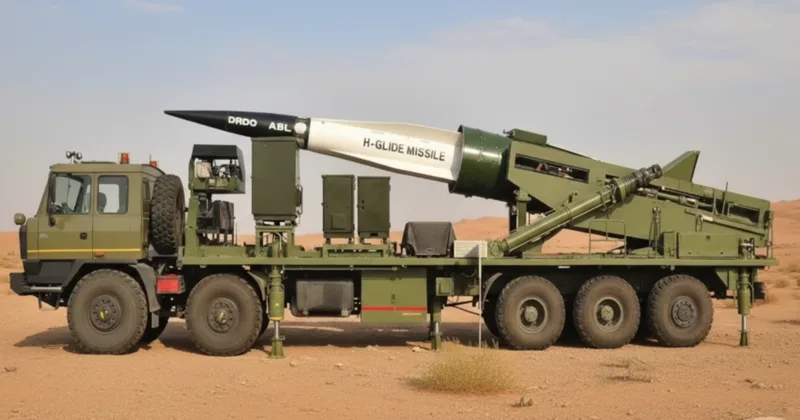
India is working on the final stage of self-reliant system the Dhvani Hypersonic Glide Vehicle (HGV), developed entirely by the Defence Research and Development Organisation (DRDO). Dhvani represents India’s entry into the most exclusive club in modern warfare i.e. where nations is capable of fielding operational hypersonic weapons. This club currently has three confirmed members the United States, Russia and China. India is about to enter this door.
From Exhibition Floor to Battlefield
Dhvani entered public consciousness in February 2025, when DRDO unveiled a full-scale model at the ‘Vigyan Vaibhav’ exhibition in Hyderabad, inaugurated by Defence Minister Rajnath Singh. The vehicle approximately 9 metres long and 2.5 metres wide, carried a sleek wedge-shaped, wave-rider profile that has speed and precision. The wave-rider design literally rides its own shockwaves to maximise lift-to-drag efficiency, a configuration India had never displayed publicly before.
Dhvani is a boost-glide system. A rocket booster, derivative from the Agni family that hurls the vehicle to near-space altitudes. Once released, it skips and glides through the upper atmosphere at speeds exceeding Mach 5, continuously altering its trajectory. No ballistic arc. No predictable flight path. Just a weapon threading the atmosphere in ways that leave adversary radar systems scrambling.
Threat from China is the reason for Dhavni
Dhvani is designed to travel at Mach 5 to Mach 6, roughly 6,200 to 7,400 kilometres per hour. Sources point to an intercontinental-class range of 6,000 to 10,000 kilometres, which would comfortably exceed the reach of India Agni-V ICBM, bringing targets across Asia, Europe and parts of North America within striking distance. When we have China threatening our national integrity, Dhavni will play by showing deterrence.
The thermal engineering alone represents a hard-working achievement of scientists. At hypersonic speeds, the vehicle surface heats up to 2,000–3,000 degrees Celsius. DRDO has solved this through an Ultra-High-Temperature Ceramic Composite heat protection system, an indigenously developed shield using ceramic tiles and silicate-based panels backed by a metallic substructure. The vehicle angled surfaces also give it a low radar cross-section, while terminal guidance uses a layered combination of inertial navigation, satellite tracking, terrain-matching and RF seekers keeping Dhvani on target even during the communication blackout that hypersonic re-entry inevitably causes.
Operating at approximately 60 kilometres altitude and executing sharp lateral manoeuvres in its terminal phase, Dhvani reduces adversary reaction time to under five minutes, shorter than any existing early warning or intercept cycle. The window to detect, track, compute an intercept solution and launch a counter-missile simply collapses.
DRDO Speaks: Advanced Stage, Imminent Trial
DRDO Chief Dr Samir V Kamat confirmed that India’s hypersonic glide missile is in an advanced stage of development, with one development trial already completed and all remaining trials expected within two to three years. Dr Anil Kumar, Associate Director at DRDO’s Advanced Systems Laboratory (ASL), declared in October 2025 that the vehicle will be tested in a few months. Subscale tests have already validated boost-separation dynamics and glide stability. The full-scale trial is expected from Abdul Kalam Island off the coast of Odisha.
DRDO have confirmed several successful ground tests on the complete missile configuration, while the final preparations is underway for a trial launch. Defence Minister Rajnath Singh has personally affirmed that induction into the Indian Armed Forces will take place by 2029–30.
On 7 September 2020, DRDO successfully tested the Hypersonic Technology Demonstrator Vehicle (HSTDV), validating indigenous scramjet propulsion at Mach 6 and proving India’s heat-shielding and thermal management technologies were mature enough for operational development. The programme has involved DRDO ASL, the Aeronautical Development Agency (ADA) and the Defence Metallurgical Research Laboratory (DMRL). Over 70% local content has been achieved across the system, directly serving the Atmanirbhar Bharat vision. India is not assembling a weapon from imported components, it is building one from its own metals, ceramics, guidance software and propulsion systems.
Broader Hypersonic Architecture & Message to the World
Dhvani is the flagship of a broader hypersonic architecture under Project Vishnu. In July 2025, the Extended Trajectory-Long Duration Hypersonic Cruise Missile (ET-LDHCM) reportedly achieved Mach 8 during a test from India’s eastern coast a separate track using air-breathing scramjet propulsion rather than boost-glide mechanics. All together these systems will give India the ability to strike different target sets through fundamentally different flight profiles. DRDO is also developing anti-hypersonic interceptors and is working on 12 distinct hypersonic variants such as spanning HGVs, Hypersonic Cruise Missiles and anti-hypersonic defence systems.
China has already deployed the DF-ZF and DF-17 hypersonic glide vehicles, Russia has its Avangard system in active service. Against the threats from China, India’s conventional ballistic arsenal while formidable relies on predictable trajectories that sophisticated systems like China’s HQ-19 are increasingly calibrated to intercept. Dhvani changes that equation entirely. Designed for dual-use, capable of delivering both conventional and nuclear payloads, it provides flexibility across the full spectrum of conflict, from precision strikes against hardened command infrastructure to nuclear deterrence at intercontinental ranges.
Regional analysts are already treating Dhvani as a potential game-changer, with European media urging their governments to engage India on defence cooperation. Former President Dr A P J Abdul Kalam stated in February 2007 that India would need modern hypersonic weaponry and must develop it indigenously within fifteen years. Dhvani, arriving in precisely that timeframe is the fulfilment of that vision.
When Agni-I flew its first test in 1989, India announced it intended to be taken seriously. When BrahMos entered service, it announced India could build world-class systems in collaboration. When Dhvani will roars off the launch pad and threads through the upper atmosphere at Mach 6, it tell the world that India is not following anyone, it is writing its own.