For decades, we understood war through visible power – soldiers, tanks, aircraft, missiles, ships and borders. Those still matter. Courage still matters. Firepower still matters. But the centre of gravity has shifted. Today, power is moving from the size of an army to the intelligence of a system. That is the world Bharat is entering.
The battlefield is no longer just land, sea and air. It is code, chips, sensors, satellites, cyber networks, electronic warfare, artificial intelligence and data. The nation that controls this technology stack controls the tempo of conflict. The nation that imports it fights with borrowed nerves. This is why the current wars must be studied not as distant conflicts, but as warning signals for Bharat.
The drone has broken the old military equation
The Russia-Ukraine war has shown the world that the economics of war has changed. Ukraine developed low-cost interceptor drones to counter Russian Shahed-type drones, with AP reporting that some drone killers cost as little as $1,000 and moved from prototype to mass production within months in 2025. This is not a minor innovation. This is a military disruption.
For years, nations measured strength by expensive platforms – fighter jets, missile batteries, armoured columns and large defence budgets. But now a cheap drone can locate a tank, attack a radar, expose troop movement, or force a costly air-defence response. The uncomfortable question is simple: what happens when a weapon costing a few thousand dollars forces a response from a system costing millions?
That is not just tactical pressure. That is strategic imbalance. And now the threat is evolving further. Reports from conflict zones show that fibre-optic drones, widely seen in Ukraine, are difficult to jam because they are controlled through thin fibre-optic cables instead of normal radio links. Some of these systems can be built using civilian components at a fraction of the cost of conventional military platforms.
This should disturb every serious defence planner.The future adversary may not always come with a fighter aircraft. It may come with a swarm. It may come with a locally assembled drone. It may come below radar, beyond jamming, and inside our reaction window.
Operation Sindoor was not just a response, It was a reminder
Bharat does not need to look only at Ukraine or West Asia to understand the new battlefield. During Operation Sindoor, Pakistan attempted to target several military locations in northern and western Bharat using drones and missiles. Bharat’s Integrated Counter-UAS Grid and air-defence systems neutralised them. That moment matters.
It showed that Bharat’s security threats are no longer limited to conventional infiltration, artillery, terror camps or airspace violations. The threat is becoming layered — drones, missiles, cyber pressure, electronic warfare, propaganda and real-time escalation. Bharat’s response showed capability. But it also showed the scale of preparation required.
The next conflict may not give us the comfort of one front, one domain or one predictable pattern. It may test our ability to detect, decide and respond across multiple domains at once.
The new battlefield is a technology chain
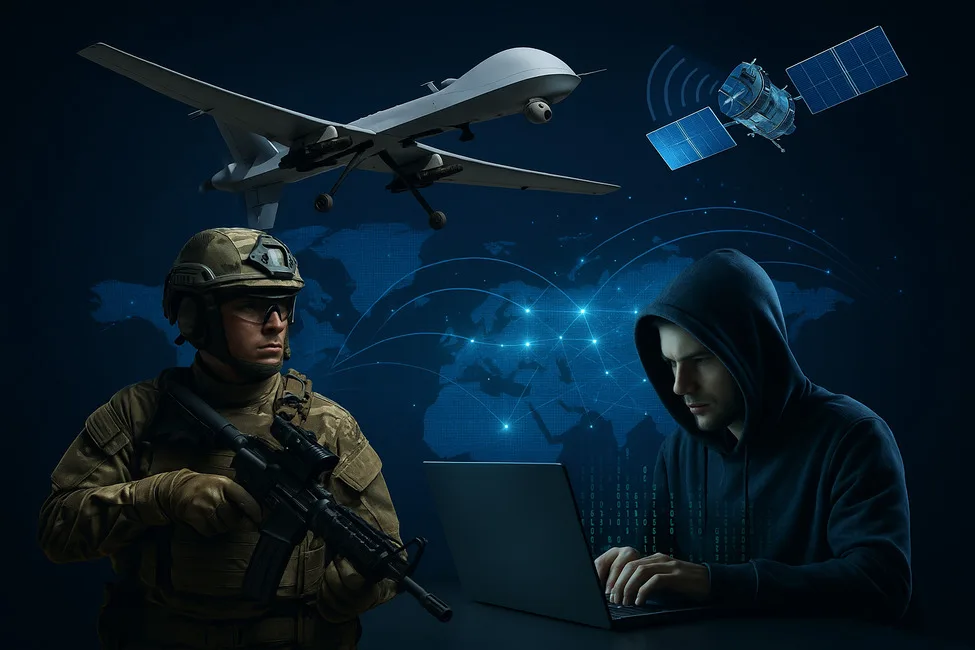
Modern war is no longer a contest of one weapon against another. It is a contest of systems. A satellite watches. A drone confirms. a sensor detects, a chip processes, an AI model classifies, a cyber unit disrupts, an electronic warfare system jams, a command network decides, a missile, drone or interceptor acts.
Break one link and the chain weakens. Import too many links and sovereignty becomes conditional. This is the hard truth Bharat must face: A nation cannot claim full strategic autonomy if the critical parts of its defence nervous system are designed, manufactured, updated or controlled elsewhere. Platforms are visible. Dependence is often hidden.
The aircraft may carry our flag. The ship may be commissioned in our name. The missile may be fired by our soldiers. But if the chip, software, sensor, data architecture or electronic subsystem is externally dependent, then our freedom of action has limits. That is why technology is no longer a support function of national security. It is national security.
Semiconductors are the new ammunition
In the twentieth century, nations counted ammunition, oil reserves and steel production. In the twenty-first century, they must also count chips. Every serious military system now depends on semiconductors — radars, drones, missiles, satellites, secure radios, electronic warfare platforms, AI servers, surveillance networks and command centres. This is why the global semiconductor race is not only economic. It is geopolitical.
The United States restricts advanced chips to China because chips are power. China invests in self-reliance because dependence is vulnerability. Taiwan matters because its fabs sit at the heart of global technology anxiety. Europe, Japan and South Korea are strengthening their technology ecosystems because they know that supply chains can become strategic choke points. Bharat must not read semiconductors only as an investment story.
The Bharat Semiconductor Mission is not merely about factories, jobs or electronics manufacturing. It is about whether Bharat will control the nervous system of its future economy and defence. A country that cannot build critical chips will always remain one crisis away from strategic helplessness.
AI will not replace the commander. It will punish the slow commander. Artificial intelligence is changing the speed of decision-making in war.
Earlier, information moved slowly. Now drone feeds, satellite images, cyber alerts, battlefield sensors and open-source intelligence produce a flood of data every second. No human command structure can process all of it manually.
AI can identify patterns, detect movement, classify objects, support targeting, predict risk, assist logistics and accelerate battlefield decisions. In Ukraine, AI-supported analysis has been used with drone imagery for mine clearance in heavily mined areas.
This is where the human side of technology becomes visible. AI in war is not only about killing. It is also about saving soldiers, clearing mines, protecting infrastructure and reducing uncertainty. But there is also danger. AI warfare is already becoming visible in active conflicts, often with limited oversight and accountability.
Bharat must therefore be clear: we need AI in defence, but we cannot outsource judgement to opaque systems or imported algorithms. The Bharatiya commander must be AI-enabled, not AI-dependent. Human responsibility must remain at the centre. Because in war, speed without wisdom can become disaster.
Cyber is the first shot no one sees
The first attack in a future war may not be on a military post. It may be on a power grid, telecom network, railway system, airport, stock exchange, banking network, satellite link, defence database or public information ecosystem. A hacked network can slow mobilisation. A deepfake can create panic. A cyber intrusion can blind command systems. A disinformation campaign can divide society before the enemy crosses a border.
This is why cyber security is not an IT issue. It is national defence. The border has expanded. It now includes data centres, undersea cables, digital identity systems, cloud infrastructure, payment networks, telecom towers and citizen trust. If the enemy can break our systems or manipulate our minds, the war has already begun.
Bharat must stop thinking like a buyer
Bharat has often responded to threats by buying better platforms. That was necessary in many phases of our security journey. But the next leap cannot come from procurement alone. A serious power does not only buy. It builds.
Bharat must build drones, counter-drone systems, radars, electronic warfare platforms, semiconductor capability, defence AI, secure communication, satellite constellations, cyber tools, advanced sensors and sovereign data infrastructure.
This cannot be left only to large defence establishments. The future will also be built in startups, engineering colleges, private labs, university incubation centres, MSMEs and young teams who can prototype fast, fail fast and adapt faster than bureaucracy. Ukraine has shown that battlefield innovation can come from necessity. Bharat should not wait for necessity to become desperation.
The real meaning of Atmanirbharta
Atmanirbharta is not a slogan. It is not a procurement preference. It is not a line in a policy document. Atmanirbharta means that when war comes, Bharat is not waiting for foreign approvals, foreign chips, foreign software patches, foreign spare parts, foreign satellites, foreign cloud systems or foreign goodwill.
It means our soldier is backed by our scientist. Our commander is backed by our coder. Our pilot is backed by our chip designer. Our border is backed by our factories. Our diplomacy is backed by our technology depth. That is the new definition of national power.
The question Bharat must answer now
The wars around us are saying something very clearly. Ukraine is saying innovation can resist size. West Asia is saying drones can bypass old assumptions. Operation Sindoor showed that Bharat must be ready for layered, technology-led threats. The semiconductor race is saying supply chains are now security chains. AI is saying speed will decide survival.
So the question before Bharat is not whether technology will shape geopolitics. It already does. The real question is whether Bharat will shape technology or be shaped by those who control it. Because the next war will not ask how many slogans we raised, how many imports we approved, or how many committees we formed. It will ask one brutal question:
When the drone came, when the network was attacked, when the satellite feed mattered, when the chip supply tightened, when the algorithm moved faster than the human eye-had Bharat built enough of its own power to stand alone?